

Products
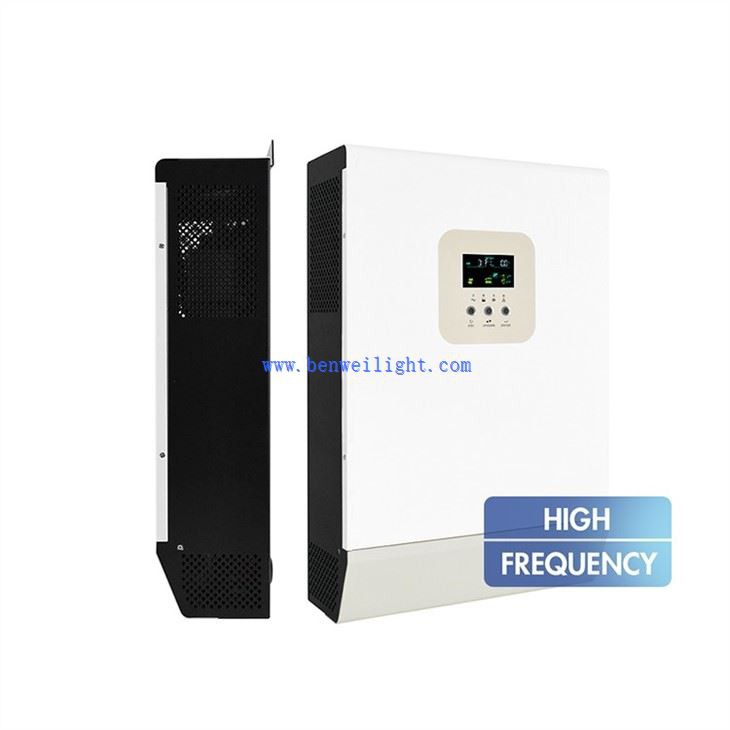


Power Inverter For Solar Panels
# Parallel Function up to maximum 9 units : Enlarge More Loads .
# Communication option: External WIFI, Supervise at Any Time.
# Slim Body, Convenient Installation And Transportation, Cheaper Freight by Air,Sea and Land.
# PF1.0, High Efficiency, Lower consumption : Energy Conservation/Environmental Protection/Electricity Saving/Cost Saving.
Send Inquiry
Product Introduction
Shenzhen Benwei Lighting Technology Co., Ltd. is one of the best manufacturers and suppliers of power inverter for solar panels in China. Welcome to buy durable products for sale here and get pricelist from our factory. All customized products are with high quality and competitive price.
power inverter for solar panels
Feature:
# Parallel Function up to maximum 9 units : Enlarge More Loads .
# Communication option: External WIFI, Supervise at Any Time.
# Slim Body, Convenient Installation And Transportation, Cheaper Freight by Air,Sea and Land.
# PF1.0, High Efficiency, Lower consumption : Energy Conservation/Environmental Protection/Electricity Saving/Cost Saving.
# Support working without battery:Reduce solar system cost and save money.
# High precision of output voltage,±5%,take care of your appliances.
Product Parameters:
| BWGA power inverter for solar panels | ||||
| Model | GA3024ML | GA3024MH | GA5048MH | |
| Input | Phase | L+N+PE | ||
| Nominal Voltage | 208/220/230/240VAC | |||
| Voltage Range | 154-264VAC±3V(Normal Mode) 185-264VAC±3V(UPS Mode) | |||
| Frequency Range | 50Hz/60Hz(Adaptive) | |||
| Output | Rated Power | 3000W | 3000W | 5000W |
| Output Voltage(AC) | 208/220/230/240VAC±5% | |||
| Output Frequency | 50/60Hz±0.1% | |||
| Waveform | Pure sine wave | |||
| Transfer Time( Optional) | 10ms for computer , 20ms for home appliances | |||
| Peak power | 6000VA | 6000VA | 10000VA | |
| Overload | Battery Mode: 1min@102%~110% Load 10s@110%~130% Load 3s@130%~150% Load 200ms@>150% Load | |||
| Peak efficiency (battery mode) | >94% | >94% | >94% | |
| Battery | Rated voltage | 24Vdc | 24Vdc | 48Vdc |
| Constant voltage charging voltage (Optional) | 28.2Vdc | 28.2Vdc | 56.4Vdc | |
| Floating charge voltage (Optional) | 27Vdc | 27Vdc | 54Vdc | |
| charger | PV charging method | MPPT | MPPT | MPPT |
| PV max input power | 1500W | 3500W | 5500W | |
| MPPT tracking range | 30~115Vdc | 120~430Vdc | 120~430Vdc | |
| Max PV input voltage | 145Vdc | 450Vdc | 450Vdc | |
| Max PV charging current | 60A | 60A | 80A | |
| Max AC charging current | 60A | 60A | 80A | |
| Max charging current | 120A | 60A | 80A | |
| Display | LCD display | Operating mode/load/input/output, etc. | ||
| Communication port | RS232 | 5PIN/Pitch2.0mm, baud rate 2400 | ||
| Expansion & configuration port | 2×5PIN/Pitch2.54mm, lithium battery BMS communication card, WIFI card, dry contact card, etc. | |||
| Parallel interface | No | Yes | ||
| Environmental parameters | Operating environment temperature | 0~40℃ | ||
| Operating environment humidity | 20%~95%(Non condensing) | |||
| Storage temperature | -15~60℃ | |||
| Altitude | The altitude should not exceed 1000m, derating above 1000m, up to 4000m, refer to IEC62040 | |||
| Noise | ≤50db | |||
| Certifications | EN-IEC 60335-1, EN-IEC 60335-2-29, IEC 62109-1 | |||


Can a power inverter run continuously?
Yes. It is possible but not advisable. When the inverter is kept on, it will start draining the battery quickly. Even no electronic appliance is connected to the inverter, and the battery will draw the power and start draining quickly.
It needs a power supply to keep the battery full and ready to use when there is no power supply in the home.
Therefore, some inverter is designed to automatically shut down when there is power disconnection from the local grid.
It automatically turns on when the power is resumed. You can moderate the power storage of the inverter.
Once the battery is fully charged, you can switch off the inverter. However, you should know that even the battery is turned off, it will keep losing the charge continuously.
If it is not charged again, the battery will be fully drained after few hours.
When should I turn off my inverter?
Inverters need proper maintenance and care to keep them in good condition and sustain them for a long period. There will be occasions when you have to shut down all the appliances of the home.
Especially when you are going on an extended vacation, and no one is at home to use the power.
In those days, the inverter needs to be switch off.
Suppose you are leaving your home for several months. In that case, you should fully disconnect the batteries from the primary grid and other appliances to avoid any damage or unexpected event taking place at home.
Contact your nearest battery service provider if they offer the maintenance service with the storage facility at their place, so you do not have to worry about the batteries kept in the home.
The household inverters are made of chemicals that preserve the energy source from the primary grid and these batteries some time leaks due to environmental damage or heating problem.
As a result, it may catch fire unexpectedly and damage your home. It requires separate free space to store and keep them away from heat and electrical appliances.
If no one is around to take care of the inverter batteries, then it is wise to decide to shut off the inverter and resume the power when you come back.
Does an inverter use power if nothing is plugged in?
The simple answer is yes. The power the inverter draws will be negligible. It will not impact the overall performance of the inverter. However, the inverter, which is not in use, still drains the power.
The power depletion rate will be around 0.20 amps up to 2 amps depending on the unit. Some inverters are designed for the standby system that prevents the inverter from discharging fully when not in use.
When the appliance is connected to the inverter, you should monitor the power consumption frequently to ensure that sufficient power is left in the inverter for emergency purposes.
The appliance may fully drain the battery, and you will be left with the dead battery.
Some inverters draw the entry at the rate of 5% to 10% when nothing is connected. So there are possibilities that when you try to connect the appliance after few hours, there will be no charge.
All the remaining energy will be drain when nothing was connected. The electricity is always in the move, and it will get consumed in various forms and consumed even when no electricity is used.
How do I turn off my inverter when not in use?
Most modern batteries are capable of switching the inverter when not in use. It turns the power off when there is no power supply from the primary grid. As soon as the power resumes, it automatically turned on.
If you want to stop the home appliance from running on the inverters, then disconnect them by removing the plug.
It will stop the inverter from powering the home appliance, and your inverter will no longer use the power supplied from the device.
The manual turn-off switch may not be available on the inverters. The only way to switch the power inverter from the primary grid is by disconnecting it from the main grid wire.
You will find the DC wire connected to the local grid and the inverter.
The DC wire makes the current flow to the inverter, converted to the AC before using it for running the home appliances.
So when you plan to travel for long holidays. Remove the connection from the primary grid.
Once it is disconnected from the primary grid, no energy will be supplied to the inverter. Also, for the safety of the home, reduce the power storage of the inverter.
If there is too much power is left in the inverter, there is the possibility that due to damage or excess heat from the environment.
The battery may get heated, or in some cases, it may produce fire.
It is dangerous to have the battery left with full charge at a place where no one is around for maintenance.
Conclusion:
Storing energy is an expensive affair. It would be best if you used the inverter to its maximum capacity. If you leave your batter turned off for an extended period, you are losing energy from it.
The loss may cost you more energy bills when you connect the inverter back to the local grid for the charging.
Therefore, use the inverter wisely and do now allow it to waste energy. Inverters work best when it is kept at the lower temperature.
The heat increases the energy depletion rate, and your battery may lose more energy at a high temperature.
Also, use the proper ventilation to prevent the battery from producing more heat. The heated air should be thrown out. Else, the battery will not perform well under the high temperature.
Proper care also increases the life of the inverter, and it may last longer.
Hot Tags: power inverter for solar panels, China, suppliers, manufacturers, factory, buy, price, best, cheap, for sale, in stock, free sample
Previous:
1kw 3kw 5kw Solar Inverter Price
Next:
Hybrid Off Grid Inverter
Send Inquiry


