Products


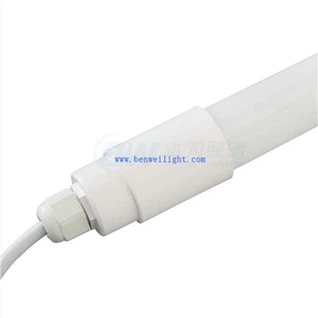
Hen House Light
The use of professional LED lights can effectively:
Improve the growth rate, the reproductive capacity, and the meat quality.
Accelerate the weight gain rate,Increase poultry appetite and enhance immunity.
Not to mention it can also save energy, reduce maintenance costs, and improve the factory safety.
Send Inquiry
Product Introduction
Shenzhen Benwei Lighting Technology Co., Ltd. is one of the best manufacturers and suppliers of hen house light in China. Welcome to buy durable products for sale here and get pricelist from our factory. All customized products are with high quality and competitive price.
hen house light

POULTRY FARMING PROFESSIONAL LIGHTING
The use of professional LED lights can effectively:
Improve the growth rate, the reproductive capacity, and the meat quality.
Accelerate the weight gain rate,Increase poultry appetite and enhance immunity.
Not to mention it can also save energy, reduce maintenance costs, and improve the factory safety.
It is important to choose the correct color for your environment and birds.
Product Specification:
hen house light
| Power | Dimension(MM) | LED Quantity(PCS) |
| 9W | 600*26mm | Epistar 2835/48PCS |
| 13W | 900*26mm | Epistar 2835/72PCS |
| 18W | 1200*26mm | Epistar 2835/96PCS |
| 24W | 1500*26mm | Epistar 2835/120PCS |
| 36W | 2400*26mm | Epistar 2835/384PCS |
Light environments
Chickens are affected by the duration, intensity and spectrum of light. Light can be utilized as a management tool to help optimize pullet growth, age of sexual maturity, egg weight and egg production in laying hens in a variety of environments.
Duration
As a general rule, decreasing light duration is utilized for growing pullets and increasing light duration is used to stimulate layers. Light stimulation (usually an increase of as little as one hour) has an immediate effect on the production of reproductive hormones. The standard level of light for maximum production is 16 hours. It is ideal to reach 16 hours of light by 30–35 weeks to help prolong peak production
Spectrum
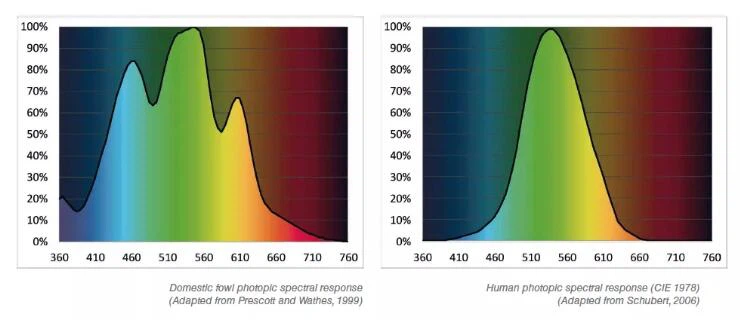
Understanding the color spectrum given off by a light source will assist producers in selecting a light bulb which can deliver the proper amounts of red, green and blue light. Light bulb color can be expressed in degrees Kelvin (K) and color rendering index (CRI).
However, neither of these measurements expresses the spectral peak intensity in the red, green, and blue spectra that are important for poultry growth and production. Research on broilers has shown that blue and green LED lights enhance growth. Research on layer pullets indicates that LED lights with a greater portion of blue and green spectra result in better body weights and uniformity compared to incandescent bulbs, although more data is needed (Settar, unpublished data). Overall, pullets may be reared with warm or cool lights, but laying hens should have lights with a sufficient red spectrum3 (2700K–3000K). Light bulb manufacturers usually provide information on degrees Kelvin, or a spectrometer can be used.
Intensity
Light intensity, measured in lux, clux or foot candles, is also important for poultry production. In general, light intensity below 5 lux is too dark to stimulate proper growth and production, while higher light intensity (above 50 lux) may cause nervousness and aberrant behaviour.
The standard recommendation for growing pullets is to brood for 2 to 3 weeks at 30–50 lux, and then dim to 10–15 lux until 14 weeks. Two weeks prior to the transfer, gradually increase the light intensity to match the levels in the layer house. Laying hens should be kept at an average of 30 lux at the level of the feed trough.
Maintaining uniform light intensity in a modern poultry facility can be difficult. To measure light distribution in conventional cage or colony houses with manure belts, it is ideal to take a measurement at the feed trough every 25 cm (or 1 foot) between lights and at every level. This will typically require between 30 and 100 light readings to accurately assess the light distribution.
In floor houses, measure at the wall, at feeder and drinker lines beneath the lights and 2–3 times in between lights for a total of 10 to 50 measurements.
In open-sided houses, use window shades and curtains to prevent direct sunlight from coming into the house. Even with these interventions, the light intensity in open houses can easily reach above 1000 lux.
Product Details for lighting for broiler chickens:


Test report:

Hot Tags: hen house light, China, suppliers, manufacturers, factory, buy, price, best, cheap, for sale, in stock, free sample, led tube poultry farm light, poultry lighting equipment, poultry house lighting, led light bulbs for chicken house, led lights for laying hens, poultry farm lighting
Previous:
Lighting in Poultry Houses
Send Inquiry