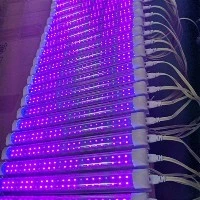

Walk into almost any narrow-web flexo pressroom, screen-printing shop, or adhesive bonding line that has been running for more than a decade, and you will find them: rows of 40W UV-A T12 fluorescent tubes, quietly doing the work of curing inks, coatings, and pressure-sensitive adhesives. They are cheap to replace, universally compatible with G13 fixtures, and-in the right wavelength band-remarkably effective at triggering photopolymerization. But the UV curing landscape has shifted. LED alternatives now dominate the conversation, and the question every process engineer eventually faces is not "should we switch?" but "what are we actually giving up if we don't?" The answer depends far less on the wattage printed on the tube and far more on two variables that rarely make it onto a purchase order: the peak wavelength and the irradiance profile at the substrate surface.
The Wavelength You Choose Determines the Chemistry You Can Cure
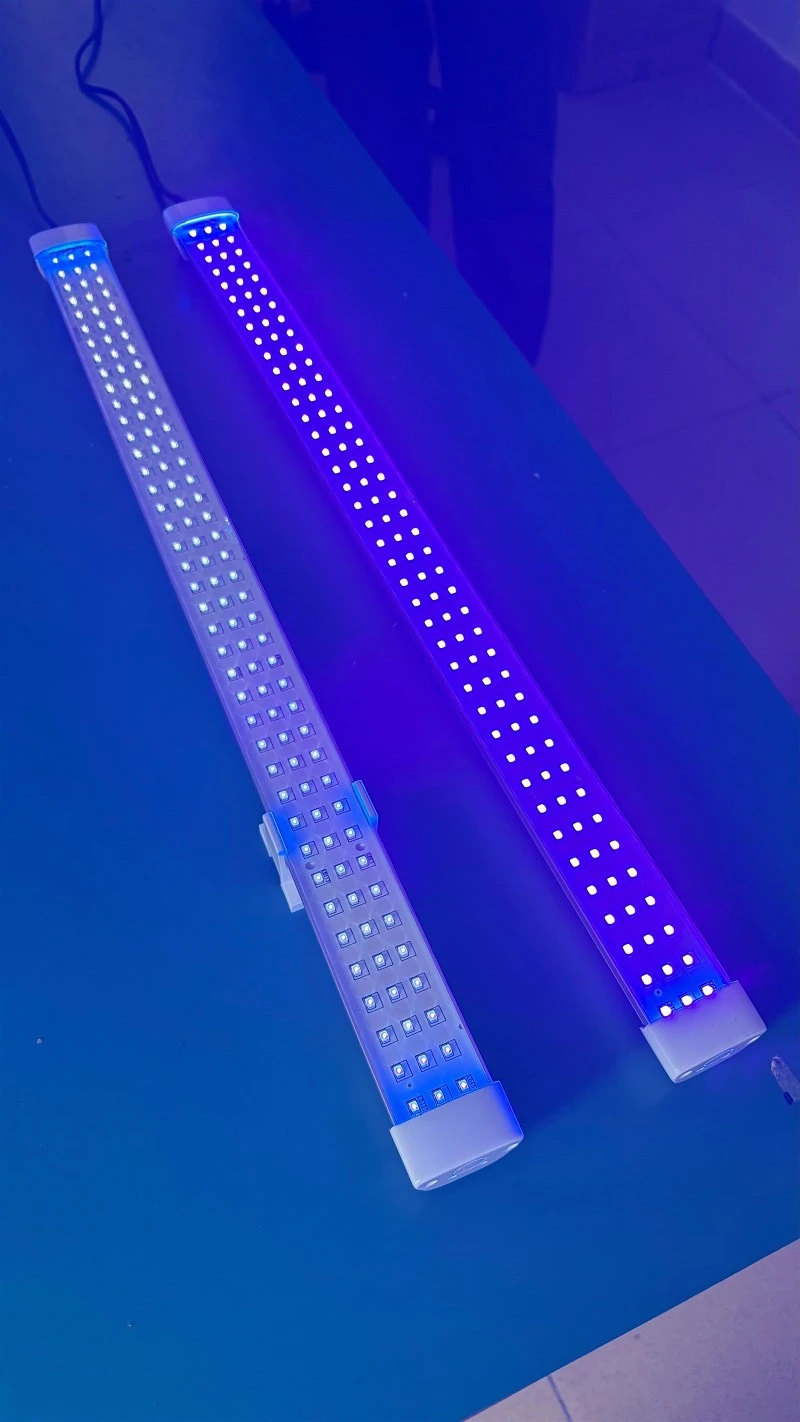
UV-A is a broad neighborhood-roughly 315 nm to 400 nm-but not all UV-A photons are created equal. A standard 40W T12 "blacklight" fluorescent tube emits predominantly between 350 nm and 400 nm, with peak intensity typically falling at 365 nm or 370 nm depending on the phosphor formulation. That spectral position is not accidental. The photoinitiators used in the overwhelming majority of acrylate-based UV adhesives, flexo inks, and screen-print coatings are engineered to absorb most efficiently in that exact window.
What complicates the picture is that many low-cost UV-A tubes marketed for "curing" actually peak closer to 395 nm. The distinction matters because photon energy scales inversely with wavelength. A 365 nm photon carries meaningfully more energy than a 395 nm photon, and that energy differential translates into a different interaction with the photoinitiator molecule. Benwei's own technical documentation on the subject is direct: 365 nm carries higher photon energy than 395 nm, and the visible purple brightness that operators perceive cannot be used as a proxy for actual UV irradiance measured in mW/cm². A tube can look impressively "purple" while delivering inadequate actinic output for the adhesive in front of it.
Table 1: 365 nm vs. 395 nm - Operational and Safety Trade-offs in UV-A Curing
| Dimension | 365 nm Peak | 395 nm Peak | Practical Implication |
|---|---|---|---|
| Photon energy | Higher | Lower | 365 nm is more efficient at exciting standard photoinitiators |
| Visible light "glow" | Low (appears dim) | High (bright purple) | Perceived brightness is not a proxy for UV dose |
| Skin erythema risk threshold | >3 mW/cm² (30 s exposure) | >8 mW/cm² (60 s exposure) | 365 nm demands stricter exposure controls |
| Eye hazard threshold | >0.1 mW/cm² | >0.5 mW/cm² | 365 nm systems require more rigorous shielding |
| Ozone management | Critical above 5 mW/cm² | Generally lower concern at comparable output | 365 nm installations need active ventilation planning |
Data sourced from Benwei Lighting's published safety protocol analysis for 365 nm and 395 nm UV-A systems.
Why the T12 Form Factor Still Matters in Industrial Curing
The "T12" designation refers to the tube diameter-38 mm-and it is not a trivial detail. A 40W T12 tube running at standard current produces a linear irradiance profile along its length that is exceptionally uniform compared to point-source LED emitters. In web-fed flexo printing, where the substrate moves continuously past the lamp array, that uniformity directly determines whether the adhesive cures evenly across the full web width. A hot spot in the center and undercured edges is a recipe for delamination and customer returns.
The trade-off is irradiance density. A 40W T12 fluorescent tube delivers a relatively modest UV output in the range of a few watts of actinic radiation, spread across its 4-foot length. UV-LED flood arrays, by contrast, concentrate energy into a narrower band and can achieve working-distance irradiances hundreds of times higher. That is why LED systems often cure in seconds what fluorescent tubes cure in minutes. But higher irradiance is not universally desirable. Heat-sensitive substrates, thick adhesive layers that benefit from a slower "through-cure," and processes where a longer, cooler exposure produces better adhesion without thermal stress are precisely where 40W T12 fluorescent tubes retain a legitimate engineering rationale.
Table 2: 40W UV-A T12 Fluorescent vs. UV-LED - Where Each Belongs
| Criterion | 40W UV-A T12 Fluorescent | UV-LED Curing System | Decision Driver |
|---|---|---|---|
| Warm-up time | Several minutes to stable output | Near-instant | Throughput and on-demand curing |
| Irradiance at working distance | Low (sub-mW/cm² to low mW/cm² range) | 500–8,000 mW/cm² (flood/spot systems) | Cure speed and adhesive chemistry |
| Spatial uniformity along length | Excellent for linear web processes | Requires array design for even coverage | Web width and coating consistency |
| Heat at substrate | Lower peak heat, but sustained exposure | High localized heat | Heat-sensitive films and thin substrates |
| Replacement cost per unit | Low | High upfront, lower operating cost over life | Production volume and duty cycle |
| Best-fit scenario | Low-to-medium volume, wide-web, heat-sensitive, or legacy G13 infrastructure | High-volume, high-speed, narrow-web, or heat-tolerant processes | Application economics, not dogma |
Fluorescent-to-LED comparison framework informed by published emission-characteristic studies and industrial curing irradiance benchmarks.
The Decision That Actually Matters: Matching the Lamp to the Line
The most expensive mistake in UV curing is not choosing fluorescent over LED, or LED over fluorescent. It is specifying a lamp by wattage and fixture compatibility alone, without verifying that its spectral peak aligns with the photoinitiator chemistry and that its irradiance profile matches the dwell time of the process.
A 40W UV-A T12 tube with a genuine 365 nm peak and a phosphor designed for actinic output will outperform a nominally higher-power 395 nm tube on adhesives formulated for 365 nm absorption-every time. Conversely, if the adhesive is a newer LED-optimized formulation with a photoinitiator tuned to 395 nm or 405 nm, no amount of fluorescent 365 nm output will compensate for the spectral mismatch. The tube is not "better" or "worse" in isolation; it is either chemically compatible with the process or it is not.
This is where the conversation shifts from catalog browsing to engineering consultation. The right specification for your line depends on the adhesive datasheet, the line speed, the substrate thermal limits, and the existing fixture infrastructure-variables that a generic product page cannot resolve on its own. If you are currently running a legacy G13 T12 setup and want to confirm whether a 40W UV-A T12 lamp remains the most cost-effective path for your specific ink or adhesive system, the productive next step is not another round of online comparison shopping. It is a process-matched recommendation grounded in your actual curing parameters. Reach out to Benwei Lighting's UV application team with your adhesive or ink specification, line speed, and substrate details, and we will help you determine whether your existing T12 infrastructure is still working for you-or quietly working against your cure quality.