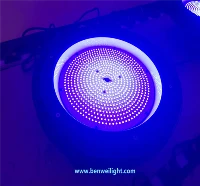
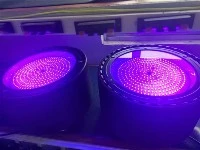
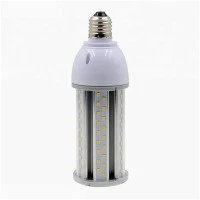
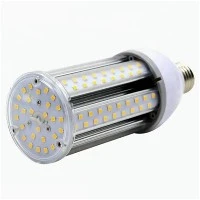
LED (Light Emitting Diode), light-emitting diode, is mainly composed of five materials: bracket, silver glue, chip, gold wire, and epoxy resin.
LED (Light-Emitting-Diode) in Chinese means light-emitting diode) is a kind of semiconductor that can convert electrical energy into light energy. It changes the principle of tungsten light emission of incandescent lamp and three-primary color powder emission of energy-saving lamp, and electroluminescence is adopted. According to the analysis, the characteristics of LED are very obvious, long life, high luminous efficiency, low radiation and low power consumption. Almost all the spectrum of white light LED is concentrated in the visible light frequency band, and its luminous efficiency can exceed 150lm/W (2010). Comparing LED with ordinary incandescent lamp, spiral energy-saving lamp and T5 tri-color fluorescent lamp, the results show that: ordinary incandescent lamp has a luminous efficiency of 12lm/W and a lifespan of less than 2000 hours, and a spiral energy-saving lamp has a luminous efficiency of 60lm/W, which is less than For 8000 hours, the T5 fluorescent lamp is 96lm/W and the lifetime is about 10000 hours, while the white light LED with a diameter of 5mm can theoretically exceed 150lm/W, and the lifetime can be greater than 100,000 hours. Someone also predicts that the upper limit of LED life will be infinite in the future. With the recent improvements in LED heat dissipation technology, high-power LED street lamps, floodlights and other LED high-power lighting fixtures for outdoor lighting have achieved industrial production and have begun to be widely used. The dance table lamps and studio lamps for indoor lighting that require high color temperature and color rendering have also been mass-produced and put into use. The T8, T5, T4, lamp tubes and screw bulbs that replace incandescent lamps and energy-saving lamps with the largest application range and the largest amount of consumption have been serialized, with a service life of up to 50,000 hours. LED lighting has entered a period of rapid development.
The brightness of the LED is inevitable related to the light-emitting angle of the LED. The smaller the angle of the LED, the higher the brightness. There is nothing super bright and not super bright. It is a lie to children. If it is a good quality LED, no matter which one it is. The brightness of everyone produced by LED manufacturers is the same, but the production process is different, and the service life is slightly different, because everyone uses those foreign LED chips. If it is a 5MM LED, the luminous intensity of the white light at a 180 degree angle is only A few hundred MCD, if it is a 15-degree angle of light intensity, it will go to more than ten thousand and twenty thousand MCD. The difference in light intensity is dozens of times. If it is used for lighting, it is best to use high power outdoors. The brightness of the LED is higher, and the single power is 1W, 3W, 5W, and some are combined with multiple high-power to form a high-power LED, and the power can reach several hundred W.