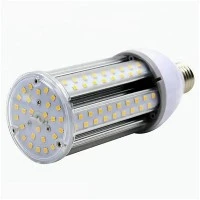
Comparison of 5 radiators of LED lighting fixtures
At present, the biggest technical problem of LED lighting fixtures is heat dissipation. Poor heat dissipation has led to LED driving power supplies and electrolytic capacitors that have become shortcomings in the further development of LED lighting fixtures, and the cause of the premature decay of LED light sources.
At present, after the LED light source is powered on, about 30% of the electric energy is converted into light energy, and the rest is converted into heat energy. Therefore, to export so much heat energy as soon as possible is a key technology in the structural design of LED lamps. The heat energy needs to be dissipated through heat conduction, heat convection, and heat radiation. Only by dissipating heat as soon as possible can the cavity temperature in the LED lamp be effectively reduced, and the power supply can be protected from working in a long-lasting high temperature environment, and the premature aging of the LED light source due to long-term high temperature work can be avoided.
Let us follow the editor of Kedeliang to take a look at the heat dissipation methods of LED lighting fixtures:
Because the LED light source itself does not have infrared or ultraviolet rays, the LED light source itself has no radiation heat dissipation function. The heat dissipation path of the LED lighting fixture can only export heat through the radiator closely combined with the LED lamp bead plate. The radiator must have the functions of heat conduction, heat convection, and heat radiation
Any radiator, in addition to being able to quickly conduct heat from the heat source to the surface of the radiator, the main thing is to dissipate heat into the air by convection and radiation. Heat conduction only solves the way of heat transfer, and thermal convection is the main function of the radiator. The heat dissipation performance is mainly determined by the heat dissipation area, shape, and the ability of natural convection intensity. Thermal radiation is only an auxiliary function.
Commonly used heat dissipation methods are die-cast aluminum radiator, extruded aluminum radiator, stamped aluminum radiator, plastic-clad aluminum radiator, and high thermal conductivity plastic radiator.
Die-cast aluminum radiator
The production cost is controllable, the heat dissipation wing cannot be made thin, and it is difficult to enlarge the heat dissipation area. The commonly used die-casting materials for LED lamp radiators are ADC10 and ADC12.
Extruded aluminum radiator
The liquid aluminum is extruded through a fixed die, and then the bar is machined and cut into the required shape of the radiator, and the post-processing cost is relatively high. The radiating wing can be made many and thin, and the heat dissipation area is expanded to the maximum. When the radiating wing is working, air convection is automatically formed to diffuse heat, and the heat dissipation effect is better. Commonly used materials are AL6061 and AL6063
Stamped aluminum radiator
It is made into a cup-shaped radiator by punching and pulling up steel and aluminum alloy plates through a punch and die. The inner and outer periphery of the punched radiator is smooth, and the heat dissipation area is limited due to no wings. Commonly used aluminum alloy materials are 5052, 6061, and 6063. The quality of stamping parts is small and the material utilization rate is high, which is a low-cost solution.
The heat conduction of aluminum alloy radiator is ideal, and it is more suitable for isolated switching constant current power supply. For non-isolated switch constant current power supplies, it is necessary to isolate AC and DC, high-voltage and low-voltage power supplies through the structural design of the lamp in order to pass CE or UL certification
Plastic-clad aluminum radiator
It is a heat-conducting plastic shell aluminum core radiator. The thermal conductive plastic and the aluminum heat sink are formed on the injection molding machine at one time, and the aluminum heat sink is used as an embedded part, which needs to be mechanically processed in advance. The heat of the LED lamp bead is quickly transferred to the thermally conductive plastic through the aluminum heat dissipation core. The thermally conductive plastic uses its multiple wings to form air convection for heat dissipation, and uses its surface to radiate part of the heat.
The density of thermally conductive plastic is 40% lower than that of die-cast aluminum and ceramics. The weight of the plastic-clad aluminum can be reduced by nearly one-third for the same shape of the radiator. Compared with the all-aluminum radiator, the processing cost is low, the processing cycle is short, and the processing temperature is low; The finished product is not fragile; the customer-provided injection molding machine can carry out the design and production of the differentiated appearance of the lamp. The plastic-clad aluminum radiator has good insulation performance and is easy to pass safety regulations.
High thermal conductivity plastic radiator
High thermal conductivity plastic radiator is an all-plastic radiator. Its thermal conductivity is several tens of times higher than ordinary plastics, reaching 2-9w/mk. It has excellent heat conduction and heat radiation capabilities; it can be applied to a new type of lamps with various powers. Insulation and heat dissipation material, which can be widely used in various LED lamps of 1W~200W
The high thermal conductivity plastic radiator can be designed with many precision cooling wings. The cooling wings can be made very thin, and the heat dissipation area is maximized. When the cooling wings work, air convection is automatically formed to diffuse heat, and the heat dissipation effect is better. The heat of the LED lamp bead is directly transferred to the heat dissipation wing through the high thermal conductivity plastic, and the heat is quickly dissipated through air convection and surface radiation.
The density of high thermal conductivity plastic heat sink is lighter than aluminum. The density of aluminum is 2700kg/m3, while the density of plastic is 1420kg/m3, which is almost half that of aluminum. Therefore, the weight of a plastic radiator with the same shape is only 1/2 of that of aluminum. Moreover, the processing is simple, and the molding cycle can be shortened by 20-50%, which reduces the power of cost.
The above is the technical sharing of the editor of Kedeliang, please continue to pay attention to Kedeliang lighting, we will continue to bring you more exciting content.