Design of High-Efficiency and High-Uniformity LED Plant Growth Lamps for Vertical Farming
Abstract
With the rapid growth of the global population and increasing urbanization, food security has become a pressing worldwide challenge. We urgently require innovative agricultural methods to enhance crop yield and nutritional quality within limited space and resources. Among these, Controlled Environment Agriculture (CEA), particularly vertical farming, has emerged as a promising solution. A critical component of vertical farming systems is artificial lighting, which substitutes or supplements natural sunlight to drive photosynthesis. Light-Emitting Diodes (LEDs) have become the preferred light source due to their energy efficiency, longevity, spectral tunability, and low thermal radiation. To use LED lighting effectively in multi-layered vertical farms, it is important to have not only high efficiency for photosynthesis but also even light spread across the plants. Non-uniform illumination can lead to uneven plant growth, reduced overall yield, and wasted energy. This article delves into a novel optical design for LED plant growth lamps based on digital light field theory, which utilizes a custom free-form surface lens to achieve highly uniform photosynthetic photon flux density (PPFD) distribution on the cultivation plane using a single, centrally mounted lamp tube, thereby addressing key economic and operational challenges in vertical farming.
1. Introduction
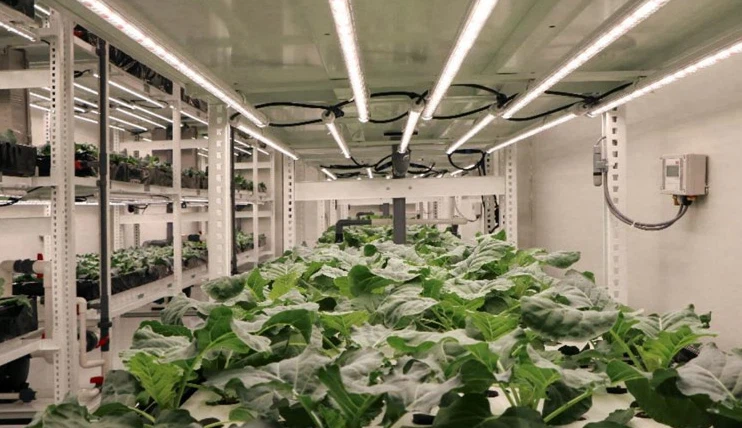
Vertical farming represents a paradigm shift in agricultural production, involving the cultivation of crops in vertically stacked layers, often within buildings or controlled environments. This method maximizes land use efficiency, reduces water consumption, minimizes pesticide use, and enables local food production in urban areas. One of the most important and energy-intensive parts of this technology is being able to control the growth environment very precisely.
LED-based plant growth lamps offer significant advantages over traditional lighting, such as high-pressure sodium (HPS) lamps, including spectral specificity, dimmability, and directional light output. The main aim for these lamps in vertical farms is to provide an even amount of PPFD-the number of light particles that plants can use for photosynthesis-over the whole growing area. Achieving high uniformity ensures consistent growth rates and quality for all plants, minimizing the need for sorting and grading.
Traditionally, we pursue high uniformity by deploying multiple lamp tubes side-by-side above a single cultivation plane. While effective, this multi-lamp approach has several drawbacks: high initial capital cost due to the large number of fixtures, significant energy waste from light spillage beyond the target area (especially at the edges), and increased maintenance complexity and cost. Therefore, a compelling alternative is to design an optical system that allows a single lamp tube to produce a uniform PPFD distribution over a standard cultivation width (e.g., 60 cm). This approach promises to retain all the benefits of LED lighting while mitigating the issues of cost, energy waste, and maintenance. This paper presents the design, simulation, and experimental validation of such a system, employing a free-form lens designed via Digital Light Field methodology.
2. Methodology: Digital Light Field and Optical Design
2.1 The Concept of Digital Light Field
Traditional photometric quantities like illuminance and luminous intensity describe the density of luminous flux on a surface or within a solid angle. While essential for evaluation, they are not directly conducive to the inverse design process of optical surfaces. The digital light field theory provides a more foundational framework. It involves discretizing the optical field space into microelements. Each element is characterized by a light cone passing through it and its surface normal vector. The overall light field is described by a non-imaging digital light field function (NDLFF). This digitalization transforms the optical design problem into one of manipulating the NDLFF on a target surface through the use of one or more optical surfaces, such as free-form lenses. This method, developed by Xingye Optical Technology, enables precise control over irradiance and intensity distribution, making it particularly suitable for complex lighting design tasks.
2.2 Source, Layout, and Target Distribution Optimization
The design process begins by defining the light source and target. The chosen source is a high-power 3535-packaged LED with a dome lens. For a typical cultivation shelf, the target is a plane located 30 cm below the lamp, with a width slightly exceeding 60 cm. The lamp tube comprises 25 such LEDs spaced 48 mm apart in a single row, resulting in a total length of 1.2 m.

A critical step is determining the optimal PPFD distribution that a single LED-lens combination should produce on the target plane. If each LED creates a simple, rotationally symmetric uniform spot, the superposition of 25 such spots from the linear array would result in a "bright center, dark edges" distribution due to overlapping. Therefore, the ideal single-LED distribution must compensate for this. Instead of complex analytical solutions, a numerical optimization approach was employed using MATLAB.
The single-LED PPFD distribution was modeled as a normalized rotationally symmetric function P(r), where r is the radial distance from the spot center. The target area was discretized, and P(r) was treated as an optimization variable. The optimization objective was to minimize the variance of the total PPFD distribution resulting from the superposition of 25 LEDs at their fixed positions. The optimized result, shown in Figure 3 of the original paper, reveals a counterintuitive "dark center, bright periphery" distribution for the single LED. This unique distribution ensures that when multiple LED spots overlap, they fill in each other's dimmer regions, culminating in a highly uniform overall distribution on the cultivation plane.
2.3 Free-Form Lens Design via the "Secondary Source Surface Method"
To achieve the optimized PPFD distribution described above, a free-form lens was designed. Conventional spherical lenses lack the degrees of freedom required for such precise control. The design employed Xingye Optics' "Secondary Source Surface Method," a technique grounded in the Digital Light Field theory that directly works with extended sources (rather than simplifying them to point sources), ensuring high accuracy even for compact optical systems.
The designed lens features a smooth, non-rotationally symmetric free-form surface that meticulously redirects light rays. As shown in Figure 4/5, the main light rays from the LED bend at different angles, with more rays aimed at wider angles to form the bright outer ring in the single-LED spot. The lens model was then imported into optical simulation software (e.g., LightTools) for rigorous analysis.
3. Results and Analysis
3.1 Single LED-Lens Simulation
Ray-tracing simulation using the Monte Carlo method was performed on the designed lens paired with the LED model. The PPFD distribution on the target plane (Figure 5) matched very well with the ideal target distribution from Section 2.2, proving that the design is valid.
3.2 Full Lamp Tube Performance
An array of 25 LED-lens units spaced 48 mm apart was modeled to simulate the complete 1.2 m lamp tube. The simulated PPFD distribution on the cultivation plane 30 cm below is shown in Figure 6. The results demonstrate a wide, highly uniform light field with a sharp cutoff at the edges. The width comfortably covers the 60 cm target shelf. Crucially, the calculated theoretical energy utilization ratio-defined as the PPF on the shelf divided by the total PPF emitted by the LEDs-exceeds 92%. This indicates that over 92% of the photosynthetically active photons generated by the LEDs are delivered directly to the plant canopy, drastically reducing spillage and energy waste compared to conventional designs.
3.3 Scalability for Extended Setups
In practical vertical farms, cultivation shelves are often arranged end-to-end in long rows. The simulated PPFD distribution from a single lamp shows slightly tapered ends. When two or more lamps are placed end-to-end, their PPFD distributions overlap and complement each other in these transitional zones. Simulation of two connected lamps (Figure 7) confirms that the overlapping areas enhance uniformity, resulting in a seamlessly uniform light field over an extended longitudinal area.
3.4 Experimental Prototype and Validation
A prototype lamp was fabricated based on the design, including molded free-form lenses, an aluminum extrusion heatsink, and end caps. Photographs of the prototype and its illuminated spot (Figure 8) visually corroborate the simulated wide and uniform light pattern.
Experimental measurements yielded strong performance metrics:
High Efficiency: The system was more than 92% efficient, and more than 86% of the source's photosynthetic photons hit the cultivation plane.
High Uniformity: The ratio of minimum to average PPFD on the target plane was greater than 82%, indicating excellent spatial uniformity that is critical for consistent plant growth.
4. Discussion and Conclusion
The design and implementation of this high-efficiency, high-uniformity LED plant growth lamp address several key pain points in vertical farming:
Cost Reduction: By enabling uniform coverage with a single central lamp tube per shelf, the design significantly reduces the number of fixtures required per cultivation layer, lowering initial capital expenditure (CapEx) and ongoing maintenance costs.
Energy Savings: The sharply defined light field with minimal spillage, achieving >92% energy utilization, directly translates to lower electricity consumption and operational expenses (OpEx).
Improved Crop Quality: High PPFD uniformity ensures all plants receive equivalent light levels, promoting consistent growth, maturation, and quality. This reduces yield variability and the subsequent need for labor-intensive sorting.
Operational Simplicity: A single, centrally located lamp is easier to install, clean, and service compared to multiple fixtures, simplifying farm management.
This work demonstrates the powerful application of advanced optical design principles, specifically the digital light field theory and free-form surface manufacturing, to agritech challenges. The "secondary source surface method" proved effective in designing a compact, high-performance lens tailored for an extended LED source. The resulting plant growth lamp system successfully transforms the light output from a linear LED array into a broad, batwing-like distribution that superposes into a highly uniform field.
In conclusion, the integration of digital optical design with LED technology paves the way for the next generation of precision agricultural lighting. The lamp design presented herein offers a compelling solution for vertical farms, combining high photon delivery efficiency, superior spatial uniformity, and economic benefits. Future work may explore adapting this methodology for different shelf dimensions, optimising spectra for specific crops, and further integrating smart controls for dynamic lighting recipes, ultimately contributing to more sustainable and productive urban agriculture systems.
References
[1] Liu Wenke. Plant Light Quality Physiology and Its Regulation in Plant Factories [M]. Beijing: China Agricultural Science and Technology Press, 2019.
[2] Cheng Ying. Research on Design Method and Application of Optical Freeform Surface [D]. Tianjin: Tianjin University, 2013.
[3] Yang Tong, Duan Cuizhe, Cheng Dewen, et al. Design of freeform surface imaging optical systems: Theory, development, and application [J]. Acta Optica Sinica, 2021, 41(1): 115-143.
[4] Yin Xia. Research on Three-Dimensional Non-imaging Optical Design Method for LED Sources [D]. Hangzhou: China Jiliang University, 2015.
[5] Zhao Liang, Cen Songyuan. An Energy-Saving Wall-Mounted Plant Growth Lamp Designed Based on Non-imaging Digital Light Field Theory [J]. Zhaoming Gongcheng Xuebao, 2021, 32(2): 14-18.
[6] Jiang Yifan, Chen Zhimin. Development Experience and Enlightenment of Foreign Vertical Agriculture [J]. Rural Economy and Science-Technology, 2021, 32(13): 208-210.
https://www.benweilight.com/lighting-tube-bulb/grow-lights-for-houseplants.html