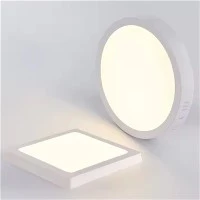
Many buyers and renovation clients, upon first encountering "blue sky" ceiling lights (also known as sky-effect ceiling panels), often ask the same question: "If I install this, do I still need to keep the original main light?"
There is no one-size-fits-all answer. In some spaces, these lights can stand alone, while in others, they function better as an "ambiance enhancer," working in tandem with a primary light source. Below, we examine the characteristics of these products and break down various scenarios to help you make informed decisions when selecting or recommending them to end clients.
What exactly is a "blue sky" ceiling light?
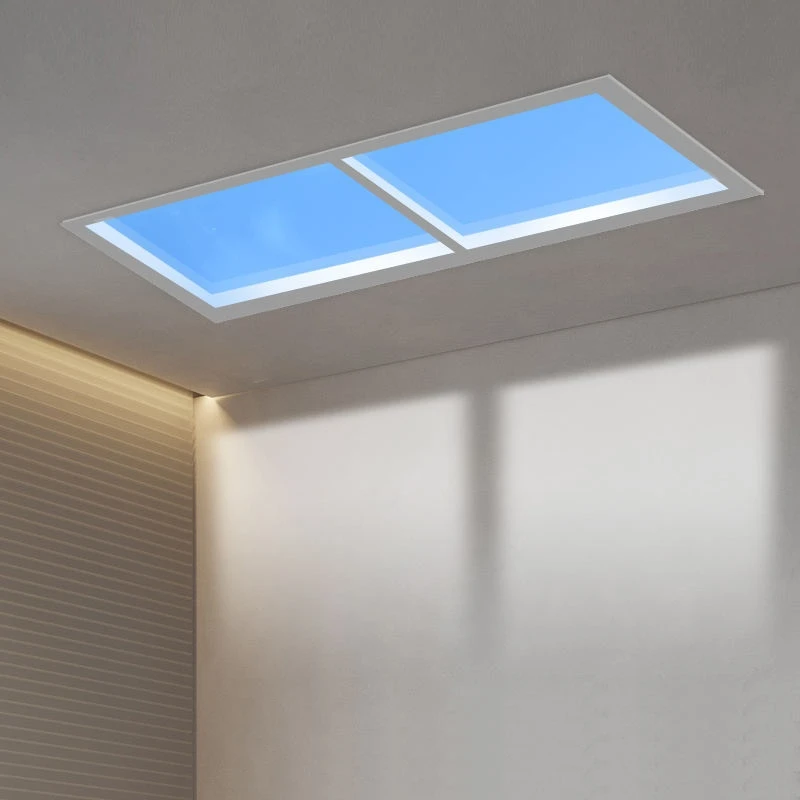
Let's clarify its classification. Essentially, a "blue sky" ceiling light is an LED panel designed to display an image or effect of the sky. Through the use of light-guiding components, diffusers, or specialized optical films, it makes the ceiling appear as if it were an open, clear blue sky-some models even replicate the subtle gradients of natural daylight.
It differs from a standard LED panel in two key ways:
• Visual impact is the primary selling point: The core value lies in making the ceiling look like a skylight; general illumination is merely a secondary function.
• Softer light distribution: To achieve the texture of the sky, the panel surface is typically treated with a diffuser, resulting in highly uniform light-though the brightness level may not necessarily match that of a standard lighting panel.
Therefore, whether it can replace a main light depends on the specific model's luminous flux (total light output), rather than just its appearance.
Why, in most cases, it is not suitable as a standalone replacement for a main light
Many clients make assumptions here, and we have frequently encountered feedback like: "It looks great, but the room just isn't bright enough." This is usually due to the following factors:
• Limited surface area and insufficient total luminous flux: These sky-effect lights are generally designed with specific decorative dimensions-such as 60×60 cm or 60×120 cm. A single panel often lacks the power and total light output required to adequately illuminate a living room spanning over a dozen square meters. • Leans toward ambient lighting, lacking focused illumination: While uniform, soft light is excellent for setting a mood, it fails to provide the targeted, high-intensity lighting required for tasks like reading, cooking, or applying makeup.
• Patterns absorb some light: Panels featuring blue designs typically have lower light transmission than pure white panels, meaning the actual brightness is reduced even at the same power output.
• Color temperature influences the atmosphere: Cool, blue-toned light creates a refreshing, crisp feel; however, in spaces like bedrooms or dining rooms-where warm light is preferred for relaxation-using it alone may make the environment feel too cold.
In short, its strength lies in "giving a space character" rather than "ensuring every corner is fully illuminated."
Where can it serve as the primary light source?
It is not entirely incapable of acting as a primary light source. A single-fixture setup can be effective if the following conditions are met:
• Small spaces: Areas such as bathrooms, walk-in closets, entryways, hallways, or storage rooms-typically 3 to 6 square meters-can be sufficiently lit by a single high-brightness unit.
• Windowless rooms: In spaces like basements, interior corridors, or windowless bathrooms-where a sense of "natural daylight" is missing-these "blue sky" lights are most valuable, and the requirements for overall brightness are generally more modest.
• High luminous flux models: If a product's specified luminous flux is sufficient for the room's size-and it supports dimming-it can serve as the primary source of ambient lighting.
• Spaces focused on display or experience: Settings such as beauty salons, therapy rooms, specific zones within a café, or exhibition halls prioritize atmosphere over the need for high-precision task lighting.
A rough rule of thumb: Calculate the room's area and compare it against the product's luminous flux to see if it meets the basic lighting requirements for that space. If it falls short, it is better to supplement it with additional lighting rather than forcing a single fixture to do the job alone.
Common ways to combine it with other lighting
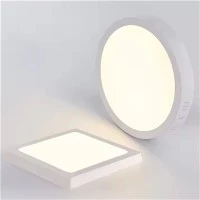
In standard spaces like living rooms, bedrooms, or offices, the more common approach is to pair a "blue sky" light with other fixtures, creating a layered lighting scheme. • Use "blue-sky" lights (simulated sky fixtures) for ambiance, while relying on downlights or spotlights for general illumination: use the latter for everyday brightness, and switch on the blue-sky lights when you want to relax or create a photogenic setting.
• Use blue-sky lights as a focal point: install them above a sofa area, at the foot of a bed, or in a corner of a workspace to create a visual highlight, while keeping the existing main lighting for the rest of the space.
• Implement separate circuit control: wire the blue-sky lights and the main lights on separate circuits with independent switches. This allows for greater flexibility-they can be operated individually or simultaneously.
• Incorporate a dimmer: in the evening, keep the blue-sky lights on at a low brightness setting to serve as a soft, ambient background glow-a more comfortable alternative to using the main overhead lights.
This approach offers the best of both worlds: it maintains adequate illumination levels while showcasing the unique appeal of the blue-sky lights, typically resulting in higher client satisfaction.
Key Parameters to Verify During Selection
Whether a client chooses to use these lights as a "replacement" for or an "addition" to their existing lighting, the following parameters should be confirmed in advance-these are the essential details to clarify when requesting a quote:
• Luminous Flux (lm): A critical metric for determining whether a fixture can function as a primary light source; always check the actual measured output rather than just the wattage.
• Color Temperature Range: Determine whether the light has a fixed color temperature or is adjustable. While "blue-sky" fixtures are typically cool white, an adjustable color temperature is more practical if the unit is also intended for daily general lighting.
• Color Rendering Index (CRI): A higher value ensures more accurate color reproduction-this is particularly important in spaces where the appearance of skin tones or food is a priority.
• Dimming Method: Confirm compatibility with the site's control system (e.g., 0-10V, TRIAC/phase-cut, remote control, or smart home integration).
• Dimensions and Mounting Type: Options include recessed, surface-mounted, or suspended; each has specific requirements regarding ceiling structure and floor-to-ceiling height.
• Driver and Flicker: The quality of the LED driver affects both the lifespan and stability of the fixture; products with low-flicker performance are more comfortable for long-term use.
• Patterns and Customization: Check whether the sky pattern can be changed, and inquire about project-specific customization options, such as custom dimensions, cloud configurations, or frame designs.
Conclusion
Returning to the initial question: Should a "blue sky" ceiling light serve as a primary light source, or should it be used in combination with other main lights?
• For small spaces, windowless rooms, or high-brightness models: It can function effectively as a primary light source.
• For standard spaces-such as living rooms, bedrooms, or offices-it is best used in conjunction with downlights or spotlights to create layered lighting.
• Key selection criteria: First, ensure the luminous flux is appropriate for the room size; then, consider the color temperature, dimming capabilities, and installation method.
There is no absolute "right" or "wrong" approach-only what best suits your specific space and usage habits. Think of it as a "breathing ceiling" rather than merely a tool for illumination, and your decision-making process will become much clearer.
Looking for the right "blue sky" ceiling light for your project?
If you are selecting "blue sky" ceiling lights for a hotel, commercial space, residential project, or your own retail channels, please feel free to contact us directly. Simply provide details such as the room area, desired illuminance, and intended use, and our team will recommend the ideal model. We can also provide specification sheets, samples, and customized solutions-with options to tailor dimensions, patterns, color temperatures, and dimming methods to your specific requirements.Send us an inquiry today, and we will get back to you promptly.