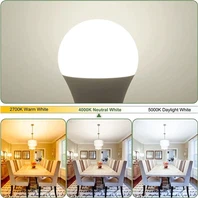
AMA encourages the use of 3000K or lower lighting for outdoor installations such as roadways. At 3000K, the human eye still perceives the light as "white", nevertheless it's moderately warmer in tone, and has approximately 21% of its emission in the blue-appearing part of the spectrum. This emission still remains very blue for the nighttime environment, but is a substantial improvement over the 4000K lighting considering the fact that it reduces discomfort and disability glare. Attributable to different coatings, the energy efficiency of 3000K lighting is only 3% less than 4000K, yet the light is significantly more pleasing to humans and has a reduced amount of an impact on wildlife. Furthermore, all LED lighting should be properly shielded to minimize glare and detrimental human and environmental effects, and efforts should be given to take advantage of the ability of LED lighting to be dimmed for off-peak cycles.
Under the LED lighting of around 3000K CCT, the human eye has decent dark adaption time and color discrimination abilities, the LED light at this CCT also has relatively high luminous efficacy and less adverse effect on our physical and mental well-being. The answer is obvious that high CCT LED lighting should be avoided for street lighting although there're tradeoffs in lighting design, in which luminance, color rendering index (CRI), CCT, glare control, flicker, mesopic vision illuminance, dark adaption, blue light hazard, color perception, fog penetration, and skyglow pollution are integral components of any project assessment that determine a light's suitability for street lighting.