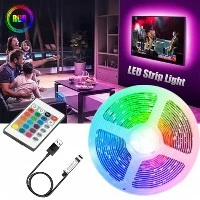
When buying RGB light strips, many people's first instinct is to check if the colors are dazzling or the lighting effects are varied, often overlooking brightness. However, in actual use, you'll find significant differences: while one "RGB light strip" installed in a living room corner might illuminate an entire wall, another attached behind a TV might provide only a faint ambient glow. This article explores the factors that determine RGB light strip brightness and how to evaluate them when shopping.
What determines the brightness of a light strip?
You cannot judge the brightness of an RGB light strip simply by the word "high-brightness" on the packaging; instead, you must look at specific parameters: the luminous efficacy of the LED chips themselves, the chip density along the strip, and the driving current. Simply put, brightness is not a fixed attribute of the strip but the result of the interplay between these factors. This explains why two seemingly similar light strips can differ in brightness by more than twofold once powered on.
Key factors affecting actual brightness
LED chip model and quantity
Common RGB LED chip models include 5050 and 2835; different models offer varying levels of luminous efficacy per chip. Additionally, the number of chips per meter (e.g., 30, 60, or 120 LEDs/meter) directly impacts overall brightness. Higher density theoretically allows for greater maximum brightness, though power consumption increases accordingly.
Color ratio and color mixing
RGB light strips create various colors by mixing red, green, and blue light. If the brightness levels of the three colors are unbalanced, it not only affects overall brightness but also leads to inaccurate color mixing or color casts. This is why the white light produced by some low-cost strips may appear yellowish or purplish.
Driving current and power supply matching
Brightness is directly linked to driving current, but more current isn't always better; exceeding the chips' rated current range can shorten their lifespan and accelerate light degradation. Furthermore, if the power supply's wattage doesn't match the strip's requirements, the actual brightness may fall short of the rated specifications-an issue particularly noticeable with long-distance installations.
LED Strip Length and Voltage Drop
The longer the LED strip, the dimmer the far end tends to be compared to the starting end due to voltage drop. This is the primary reason users often notice that "one end is bright while the other is dim"; it is not necessarily an issue with the quality of the strip itself.
Details Often Overlooked When Purchasing
Clarity of lumen ratings: Reliable products usually specify the lumen output per meter rather than using vague terms like "ultra-bright," allowing for direct comparison during purchase.
Dimming chip responsiveness: For dimmable strips, consider whether the chip supports smooth, stepless dimming; inferior chips often cause flickering or abrupt brightness jumps.
Heat dissipation design: For high-density, high-brightness strips, inadequate heat dissipation leads to faster brightness degradation over time-something worth inquiring about when buying high-density strips.
Protective film or casing material: For use in outdoor or humid environments (like bathrooms), the light transmittance of the outer protective layer affects the actual perceived brightness.
Usage Scenarios Based on Brightness Needs
Ambient lighting (e.g., bedside, TV background): Low brightness requirements; a density of around 30 LEDs/meter is usually sufficient.
Home contour lighting (e.g., living room ceilings, hallways): Moderate-to-high brightness required; the 60 LEDs/meter specification is commonly chosen.
Commercial displays and shop decoration: High requirements for brightness and color rendering; high-density strips (120 LEDs/meter or higher) are more common.
Stage and performance lighting: Requires extremely high brightness and rapid dimming response; these scenarios also demand higher-quality LED chip models and driver solutions.
Summary
Determining the brightness of an RGB LED strip requires looking at more than just a single parameter; the final result is determined by a combination of factors, including the LED chip model, density, RGB color ratio, drive current, and voltage drop caused by the strip's length.
When purchasing, focus on specific data like lumen ratings rather than relying solely on vague descriptions such as "high brightness." If you are selecting RGB LED strips with the appropriate brightness and specifications for your project, or would like detailed specifications and pricing for products with varying LED densities, please feel free to contact us. We can recommend the right product solution based on your specific application scenario.
https://www.benweilight.com/lighting-tube-bulb/rgb-led-blub/digital-rgb-led-strip.html