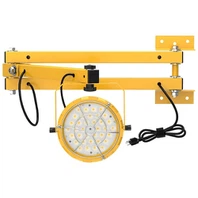
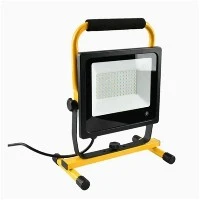
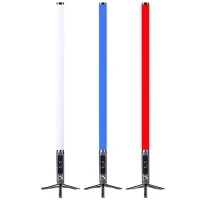
If you've ever stood in a loading dock at dusk trying to see into the back of a trailer, you already know why arm length matters more than most buyers expect. A dock light that's too short leaves the far end of the trailer in shadow. One that's too long can get crushed by a forklift, a trailer roof, or a closing dock door. Getting the arm length right isn't a minor spec - it's the difference between a light that works for years and one that ends up bent, broken, or simply useless within a few months.
In this article, we'll walk through what "arm length" actually means for dock lights, the factors that should drive your decision, and how to match arm length to your dock's real-world layout.
What Does "Arm Length" Mean on a Dock Light?
Arm length refers to the distance the light head extends from the mounting bracket into the trailer opening. It's usually measured from the base of the arm to the center of the light head, and it's what determines how far the beam can reach past the dock door and into the trailer without the fixture itself getting in the way.
A short arm keeps the light close to the dock face - useful in tight spaces but limited in throw distance. A long arm pushes the light head deeper into the trailer, giving broader, more even coverage across the load, but it also takes up more room and is more exposed to impact.
Key Factors That Determine the Right Arm Length
There's no single "correct" arm length - it depends on the physical conditions of your dock. A few things worth checking before you choose:
Dock door width and trailer depth. Wider doors and deeper trailers generally need a longer arm to light the full interior.
Canopy or dock leveler clearance. If there's a canopy, awning, or overhead structure, a longer arm may hit it when the light swings up or the door closes.
Traffic in the loading area. Docks with heavy forklift traffic or frequent trailer changes are harder on longer arms - they get bumped more often.
Mounting position. Lights mounted lower on the wall may need a bit more length to clear equipment and reach the trailer interior at a usable angle.
Whether the light folds or retracts. Some arms are designed to swing flush against the wall when not in use, which changes how much clearance you actually need to plan for.
Common Arm Length Options and Where They Fit
Dock lights are typically available in a handful of standard lengths, and each tends to suit a different type of dock:
18"–20" arms - compact docks, tight door clearances, or facilities where equipment regularly passes close to the light.
24"–30" arms - the most common range for standard loading docks, offering a good balance of reach and durability.
36"–40" arms - deeper trailers, wider bays, or docks that need light to reach well past the door threshold.
These aren't fixed rules - manufacturers vary - but they're a reasonable starting point when comparing spec sheets.
Single Arm vs. Double Arm: Does It Change the Math?
Double-arm dock lights (two jointed sections instead of one straight arm) fold more compactly and can sometimes reach a similar effective distance with a shorter overall footprint. If clearance is tight but you still need decent reach, a double-arm design is worth comparing against a single long arm - it often solves the same problem without extending as far into the traffic path.
Rigid Arm vs. Flexible/Gooseneck Arm
Arm length interacts with arm type. A flexible or gooseneck arm can be bent to redirect the beam without changing the physical length, which gives some room to compensate for a slightly short or slightly long arm. A rigid arm, by contrast, holds a fixed position - so getting the length right at the time of purchase matters more, since there's less room to adjust after installation.
A Simple Way to Measure Before You Order
Before choosing a length, it helps to physically check the dock:
Measure from the intended mounting point to the inside edge of the trailer when a typical trailer is backed in.
Note the height of any canopy, leveler, or door track the arm might swing near.
Check the swing path - does anything block the arm when it's raised, lowered, or folded against the wall?
If those numbers land near the edge between two standard sizes, it's usually safer to go with the shorter option and adjust the mounting angle, rather than risk a longer arm getting struck by equipment.
Summary
Arm length isn't just about how far the light reaches - it's about matching the fixture to your dock's actual clearances, traffic, and trailer sizes. Shorter arms suit tight, high-traffic docks; longer arms suit deep trailers and wider bays; and arm type (rigid vs. flexible, single vs. double) can shift what length actually makes sense for your space. Measuring your dock before ordering is the simplest way to avoid a light that's either too short to be useful or too long to survive daily use.
If you're unsure which boom length is best for your dock, please send us your dock's gate width, trailer depth, and site photos. We can then recommend a suitable lighting solution based on your specific needs. Feel free to leave a message or send an inquiry anytime; we'll reply as soon as possible.
https://www.benweilight.com/lighting-tube-bulb/led-panel-light-600x600.html