How To Successfully Charge LiFePO4 Batteries

When talking about charging, there are a lot of things to consider, like how to charge, what kind of charger is required, and more. Follow these easy charging recommendations from our Power Pros to make sure your BENWEI LiFePO4 battery gets the most life possible. It's crucial to keep in mind that chargers designed for other lithium-ion chemistries, which are often configured to a greater voltage than what LiFePO4 batteries need, should not be used while charging LiFePO4 batteries. If the voltage settings are within the ranges of the LiFePO4 batteries, a lead-acid battery charger may be used.
How Often Should You Charge a LiFePO4 Battery?
Since LiFePO4 batteries are not damaged when left in a partial state of charge (PSOC), if your BENWEI LiFePO4 batteries are not completely discharged, they do not need to be charged after each use. Your LiFePO4 batteries may be recharged after each usage or when they are down to 20% state of charge (SOC) or 80% depth of discharge (DOD). Remove the load and charge the battery right away if the Battery Management System (BMS) disconnects it owing to low voltage (voltage will be 8V). To reduce irreversible capacity loss, we advise keeping batteries charged to 50% of their initial state of charge (SOC).
Voltage Temperature
Between 0°C and 55°C (32°F to 131°F), LiFePO4 batteries may be securely charged at the full rate specified on their data sheet. Charging between 0°C (32°F) and -10°C (14°F) requires a reduction in charge current to.1C. The charge current must be lowered to.05C while charging between -10°C (14°F) and -20°C. A BMS that guards against overheating is included with every BENWEI LiFePO4 battery. Wait until the temperature drops if the BMS disconnects because of a high temperature before using or recharging the battery. For the BMS high-temperature cut-off and reconnect settings, please see the data sheet for your particular battery.
Parallel and series system charging
Before using batteries connected in parallel or series, make sure they are all within 50mV (0.05V) of one another. By doing this, the likelihood of battery imbalance will be reduced. You should charge each battery separately to rebalance if your series-connected batteries get out of balance and any battery's voltage differs by more than 50mV (0.05V) from another battery in the set. To prevent imbalance, you may also occasionally charge each battery separately. To keep the cells balanced while charging LiFePO4 batteries in series, it is advisable to utilise a multi-bank charger that charges each battery separately.
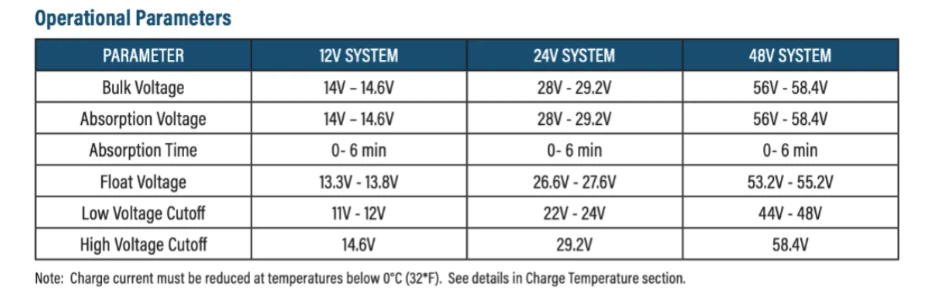
Inverter/Charger, Charge Controller, or Other Charging Source
The important, usual charger inputs for LiFePO4 battery use with an inverter/charger or charge controller are listed below. BENWEI technical support can help with the extra settings that many inverter/chargers need. When charging at hot or cold temperatures, LiFePO4 batteries do not need voltage equalisation or temperature compensation.
Chargers that use both an alternator and a DC-to-DC converter
The alternator's quality will determine whether or not LiFePO4 batteries may be used with it. However, poor voltage regulation in low-quality alternators can lead to the BMS disconnecting LiFePO4 batteries. The alternator may be harmed if the BMS disconnects the batteries. Use a compatible, high-quality alternator that you can verify is compatible with LiFePO4 batteries, or install a voltage regulator, to protect your LiFePO4 battery and alternator. To securely and efficiently charge your batteries, including home banks, you may also utilise a DC-to-DC converter.
Petrol metre
A voltage-based gasoline gauge made for lead-acid batteries will not reliably reflect the state of charge (SOC) of your batteries if you use one. It is preferable to swap out your current gauge with a voltage-free one that monitors current instead.