LED Strip Lights Illuminate the Future of Retail: The Art of Light from Product Display to Sales Conversion
Step into any modern retail space-have you ever been captivated by perfectly executed lighting? When jewelry sparkles under precise spotlighting, when fabric colors appear true under soft illumination, when fresh produce looks more appealing under a tempting glow-a meticulously planned lighting revolution is at work behind the scenes. Traditional lighting is being replaced by more strategic LED strip retail lighting solutions that do more than just illuminate space; they silently guide purchasing decisions, becoming an invisible force that boosts sales.

Why are LED Strip Lights Reshaping the Retail Lighting Landscape?
Retail lighting is far from just "bright enough." Traditional fluorescent or halogen lighting, while providing basic illumination, often comes with issues like glare, color distortion, high energy consumption, and heat. The advent of LED strip lights fundamentally addresses these pain points, with their core advantages forming the foundation of a new generation of energy-efficient retail strip lighting solutions.
A Complete Overhaul of Efficiency and Cost: LED conversion efficiency can exceed 80%, saving 60%-80% in energy compared to traditional light sources. For a medium-sized store, this translates to annual savings of thousands to tens of thousands of dollars on electricity bills. More importantly, their lifespan of over 50,000 hours minimizes the labor and material costs associated with frequent lamp replacements.
Unprecedented Freedom in Design: The flexible nature of LED strips allows them to be perfectly embedded into shelf gaps, outline counter contours, and hidden in ceiling coves, achieving the sophisticated "light without seeing the source" visual effect. This flexibility allows designers to use light as an architectural material, fundamentally changing the visual narrative of retail spaces.
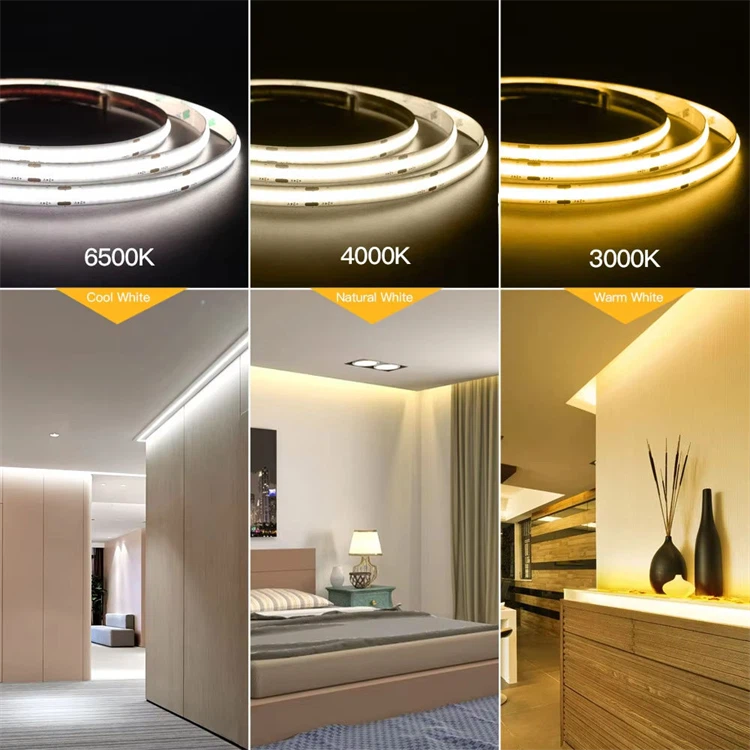
A Breakthrough in Precise Light Quality Control: From the 2700K warm white that evokes a sense of luxury to the 6500K cool white that highlights technology, high-quality LED strips can provide stable and consistent color temperature. A high Color Rendering Index (CRI) ensures true color reproduction of merchandise, which is crucial for categories like apparel, cosmetics, and food, directly impacting consumers' color perception and purchase confidence.
| Comparison Dimension | Traditional Lighting (e.g., Fluorescent Tubes) | Modern LED Strip Solutions |
|---|---|---|
| Efficiency & Thermal Management | Low luminous efficacy, significant energy wasted as heat, increases air conditioning load. | High luminous efficacy, minimal heat output, delivers dual benefits of energy saving and reduced cooling. |
| Design Integration | Bulky, installation locations are limited, prone to creating shadows and glare. | Compact and flexible, supports seamless integration and concealed installation. |
| Light Quality & Consistency | Average CRI, potential for flicker, rapid lumen depreciation, and color temperature shift. | High CRI, flicker-free, slow lumen depreciation, consistent color temperature across the entire strip. |
| Lifespan & Maintenance | Short lifespan (~8,000-15,000 hours), frequent replacement required. | Long lifespan (50,000+ hours), minimal maintenance required, low total cost of ownership. |
| Smart Control Potential | Difficult to achieve fine dimming and scene control. | Natively supports dimming, color tuning, and easy integration with smart control systems. |
How to Scientifically Design a Retail Space's Light Environment?
1. Color Temperature Strategy: Defining Brand Personality with Light
Light has emotion. A customized lighting color temperature scheme is the primary tool for shaping a store's ambiance.
Warm White (2700K-3000K): Creates a relaxing, trustworthy, and cozy atmosphere. Ideal for home goods stores, cafes, and luxury boutiques, encouraging customers to slow down and extend their dwell time.
Neutral White (3500K-4500K): Provides the most accurate color rendering. The gold standard for apparel stores, beauty retailers, and bookstores, ensuring zero misjudgment of product color by customers.
Cool White (5000K-6500K): Communicates clarity, professionalism, and vitality. Perfect for electronics stores, jewelry shops, and sporting goods stores, highlighting product details and texture.
Dynamic RGB / Tunable White: Suitable for window displays, seasonal theme areas, or pop-up stores. Creates dramatic effects through programmable colors to capture the attention of passersby.
2. Installation & Optics: The Key from "Illumination" to "Presentation"
The installation method determines the final lighting effect. A professional-grade retail display LED installation system typically includes aluminum profiles, diffusers, and dedicated accessories.
Surface Mounting: The fastest method, suitable for temporary displays or projects with budget constraints.
Recessed Installation: Embeds the strip into an aluminum channel capped with an opal PC diffuser. The light is soft and glare-free, offering a cleaner, more high-end visual appeal-the preferred choice for most boutiques.
Indirect Lighting: Directs light towards walls or ceilings, providing uniform, glare-free ambient light through reflection, creating a soothing atmosphere.
Accent Lighting: Utilizes lenses or specific installation angles to form a narrow beam, precisely highlighting products like jewelry or artwork, creating a visual focal point.
3. Brightness Calculation: Data-Driven Lighting Design
Avoid lighting "by feel." Illuminance requirements vary by product type (measured in Lux):
Luxury Goods / Jewelry: 1,000 - 3,000 Lux
Apparel / Cosmetics: 750 - 1,500 Lux
Supermarkets / Fresh Produce: 500 - 1,000 Lux
Bookstores / Home Furnishings: 300 - 500 Lux
The calculation formula must consider: Target Illuminance × Illuminated Area ÷ Luminaire Efficacy ÷ Coefficient of Utilization × Maintenance Factor. Here, the Coefficient of Utilization is affected by surface reflectivity, and the Maintenance Factor anticipates light loss and dust accumulation. Professional design should use software like Dialux for simulation to ensure uniformity standards are met.
4. Smart Controls: The Intelligent Brain of Lighting
A smart lighting control system upgrades static lighting into a dynamic asset.
Scene Modes: One-touch switching between "Open for Business," "Clearance Sale," and "After-Hours Security" modes.
Dynamic Dimming: Automatically adjusts brightness based on changing natural light to maintain constant illuminance, saving up to 40% in energy.
Occupancy & Scheduling: Enables "lights on when occupied, dim when vacant" in stockrooms or low-traffic areas.
Data Collection: Analyzes foot traffic and lighting duration in various zones, providing data support for merchandise placement and operations.

How Can Light Create Quantifiable Value?
An LED strip retrofit is not just an expense but an investment. A Return on Investment (ROI) analysis typically considers:
Direct Energy Savings: Electricity costs reduced by over 60%.
Maintenance Savings: Replacement cycles extended from 1-2 years to 5+ years, saving labor and materials.
Reduced Cooling Load: Lower heat output decreases air conditioning energy use.
Sales Increase: Studies show优质照明 can increase sales by 15%-30%, representing the largest potential return.
Brand Premium: A high-quality light environment elevates brand image, supporting higher price points.
For example, a 200-square-meter clothing store might have an initial investment of $20,000-$40,000, but the annual comprehensive savings (energy + maintenance + potential sales uplift) could reach $15,000-$30,000. The payback period is typically 1.5-3 years, with a strong long-term ROI.

FAQ
Q1: How long will LED strip lights last in a retail store? Does frequent switching affect their lifespan?
A: Professional-grade LED strips typically have a rated lifespan of 50,000 hours (approximately 13+ years at 10 hours daily). Here, "lifespan" refers to the time until luminous flux maintenance drops to 70% of its initial value (L70). Unlike earlier products, the lifespan of modern LEDs is primarily affected by driver quality and thermal management. Frequent switching has a negligible impact. Choosing quality brands and ensuring proper heat dissipation are key to ensuring long-term performance.
Q2: How do I choose the most suitable color temperature for my store? Can different ones be mixed?
A: Selection follows the principle of "product first, ambiance second." Use 4000K Neutral White for apparel and cosmetics for true color; 3000K Warm White for wooden furniture and bakeries to add warmth; 6000K Cool White for electronics and jewelry for clarity. Mixing is not only possible but encouraged-use neutral white for general ambient lighting, warm white to create ambiance in lounge areas, and cool white to precisely highlight featured products. This layered approach creates a richer spatial experience.
Q3: I want to implement smart dimming but worry about complex wiring and high costs. Are there solutions?
A: Modern wireless control systems have greatly simplified this process. You can adopt a wireless smart lighting system based on Zigbee or Bluetooth Mesh protocols. This eliminates the need for control wiring-simply replace with dimmable drivers and install a wireless gateway. Grouping, dimming, and scheduling can then be managed via a mobile app or wireless wall switches. This solution offers flexible retrofitting and controllable costs, making it ideal for store upgrades. Ensure all components (strips, drivers, controllers) are compatible in terms of dimming protocol.
References & Citations
Data on LED efficacy and energy savings references the U.S. Department of Energy (DOE) *2023 Solid-State Lighting R&D Plan*, specifically the commercial lighting efficiency comparison report.
Illuminance standards for different retail categories reference the Illuminating Engineering Society of North America (IESNA) Lighting Handbook (10th Edition), "Retail Lighting" chapter recommended values.
Research on the impact of the light environment on consumer behavior partially cites findings from relevant studies in the Journal of Retailing and Consumer Psychology, indicating a significant positive correlation between lighting quality and customer dwell time/purchase intent.
Smart lighting control system protocols and architecture are based on relevant technical white papers from the International Organization for Standardization (ISO/IEC) concerning the application of short-range wireless communication in building automation.