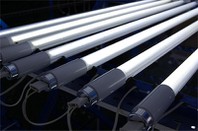
In recent years, with the frequent occurrence of safety accidents in special dangerous places such as coal mines and chemical enterprises, the country's emphasis on safety production has gradually increased. Special electrical products such as flameproof and flameproof lamps are the key to safe production.
Explosion-proof lamps are electrical products used in explosive environments. According to their explosion-proof types, they are mainly divided into: explosion-proof "d", "n", "e", "explosion-proof", "explosion-proof" and Or a composite type composite explosion-proof type composed of two or more explosion-proof types, etc. Its design, inspection, production, installation, use and maintenance must comply with GB3836 explosion-proof standard and related standards.
As a flame-proof electronic product, explosion-proof lamps have certain special characteristics. Because their luminous and heating characteristics are not easy to meet the requirements of explosion-proof electrical energy limit and temperature limit, special attention should be paid to the energy generated by them in the design and manufacturing process. control.
It is well known that the "maximum surface temperature" in an explosive atmosphere is a key factor, which refers to the electrical equipment operating under the worst conditions allowed, its surface or any part may reach, and may cause the surrounding explosive gas atmosphere. maximum temperature. As an electrical product that can quickly generate high temperature and heat, the "maximum surface temperature" is even more important for it. Therefore, for the testing organization of explosion-proof lamps, the temperature test is the most important and the most difficult operation in the test.
One is the classification of explosion-proof lamps.
a Explosion-proof fluorescent lamps are divided into explosion-proof incandescent lamps, explosion-proof high-pressure mercury lamps, explosion-proof sodium lamps, explosion-proof metal halide lamps, LED explosion-proof lamps, etc. according to the type of light source;
b According to the installation type, it is divided into: ceiling explosion-proof light, wall-suction explosion-proof light, hanging explosion-proof light, embedded explosion-proof light;
c According to the use, it can be divided into: explosion-proof lighting fixtures, explosion-proof lighting fixtures, explosion-proof signal lights, explosion-proof emergency lighting, explosion-proof mobile lights;
There are also some differences in the lighting methods used in the experiments.
Flameproof bulb temperature test.
In the temperature test of explosion-proof lamps, the following points should be paid attention to:
a explosion-proof type;
b lighting fixtures and lighting fixtures;
c optical principle (light-emitting type);
d Select the temperature measurement point;
In the experiment, lamps with different light sources, different installation methods and different optical principles should be analyzed, and a reasonable temperature test point should be selected, which is also the most important step in temperature measurement.
a Explosion-proof type
Explosion-proof lamps and temperature measurement points are different, and the temperature measurement points are also different. Example: When measuring the surface temperature of explosion-proof lamps, it is only necessary to detect the surface temperature of the sample, while for the increased safety type and "n" type lamps, it is necessary to measure the surface temperature of the electrical components inside the lamp body such as the wiring terminals and the surface of the light source. test.
Method and lighting of lamps.
The presence of heat in the physical phenomenon will rise, so different installation methods will affect the choice of the maximum surface temperature of the luminaire. For the same lamp body, the calorific value of different light sources is also different, and the light source with the highest calorific value should be considered when measuring temperature.
c optical principle
Depending on the mechanism of action and the point of photopolymerization, the maximum temperature will also vary.
3 Typical examples
The following will comprehensively analyze several typical cases:
(1) Ordinary flameproof incandescent lamps or floodlights.
Light from incandescent or floodlights doesn't concentrate, so it's easier to think about temperature measurements. If the installation method is that the light source is vertically upward, according to the physical phenomenon of hot air rising, the highest temperature point of the lamp should be close to the arc top of the glass transparent part. The measurement error is relatively large, and the current measuring instruments generally use thermocouples). Similarly, if the light source is installed horizontally (ie, flat), the highest temperature point should be located at the waist of the transparent object.
(2) Explosion-proof lighting.
The characteristics of the light source, when light is emitted, the light is concentrated in one direction, which causes the temperature to concentrate to a certain point, which causes the temperature to concentrate, should be paid attention to in the experiment. The installation method of this product is that the light source is vertically upward, and its temperature measurement method is no different from floodlights. However, the installation method is in the horizontal direction of the light source, and the test point is different from that of the floodlight, because the light emitted by the light source is concentrated. The maximum temperature of the bulb is in the range of 0~10 degrees upward inclination of the arc top (the initial temperature will be concentrated on the arc top of the transparent part, and with the stabilization of heat transfer, the maximum temperature will be stable at the upper position). If installed in a vertical direction, the highest temperature will be generated at the arc top of the transparent part and the connection between the transparent part and the metal casing.
For increased safety and "n" type lamps, the most typical LED bulbs are LED bulbs. This new type of lighting is increasingly appearing in the market, and safety cannot be ignored. This type of bulb is difficult to operate in the test, because the highest temperature inside and outside the lamp body is selected as the maximum surface temperature, but LED lamps are usually operated by multiple parallel bulbs at the same time. , when considering the electronic components inside the lamp body, we choose the highest temperature. The heating of electrical components is mainly caused by the excessive current on the contact surface of the contactor or its own power. For LED lights, the contact points are mainly distributed in the place where the bulb and the circuit board are combined (LED lights are mostly wired with PCB circuit boards), This is the main heat source. When burying the thermocouple, pay attention to the effective contact of the thermocouple and not affect the normal operation of the circuit; secondly, the position between the back of the circuit board and the casing. At the same time, because the heat sink is a main heat generating part, in addition, the ballast is also a heat source. In specific tests, product structure and circuit design should also be considered for proper handling.
The above is only a general situation, the position of the light source inside the casing will also affect the maximum change of the heating point, which needs to be carefully observed and searched during the test.
In addition, there are certain regularities when different light sources are used for the same casing. After a long period of testing and verification, the maximum surface temperature of a metal halide light source with the same power is more distinctive than other light sources. For example, the size of the lamp cavity, the material of metal parts, and the quality of light sources produced by different manufacturers will affect the lamp. The change of the temperature measurement point (more special, less cases), under such conditions, the inspector needs to carefully and carefully analyze and study the structure and principle of the product, so as to obtain accurate data accurately and quickly.
With the increasing application of explosion-proof lamps in industrial production, their safety is becoming more and more prominent. For inspectors, they should be as serious and accurate as possible to avoid danger in production.
Benwei Lighting is an LED Tube, LED flood light, LED Panel Light, LED High Bay, LED manufacturer with 12 years of experience. If you want to purchase a high-quality LED flood light or have a more in-depth understanding of the application of LED flood lights, please contact send us inquiry, our web: https://www.benweilight.com/.