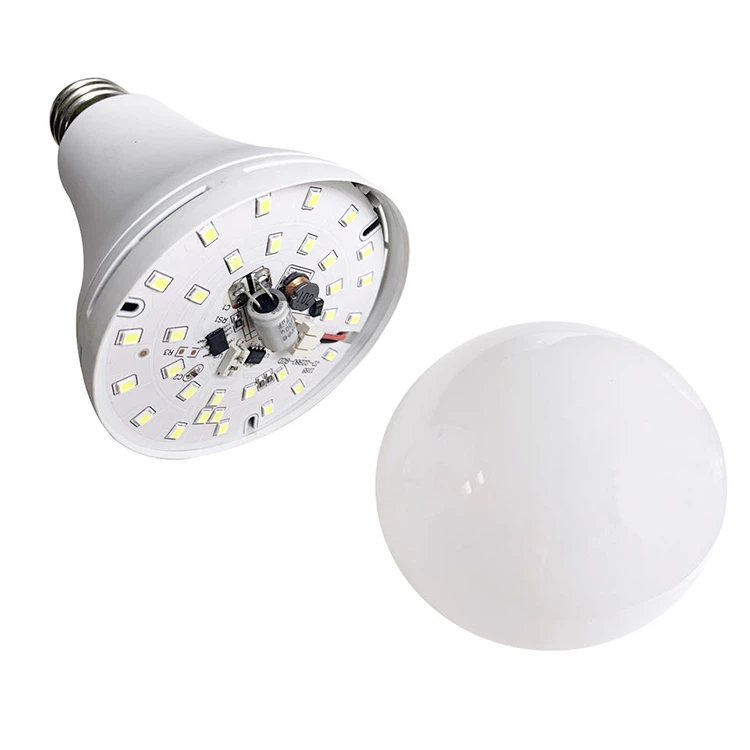
Most Common Light Bulbs and Their LED Replacement
Despite being used for many years, light bulbs appear to be losing their effectiveness. When video movies first debuted in the 1980s, they were a huge success. However, they were later supplanted by DVDs, and now DVDs have been replaced by Blu-rays, and light bulbs are following suit.
Electric current is used to power light bulbs by running it via a filament, a type of wire. As the filament "burns," light is produced. A light bulb will eventually stop working because the filament will burn out.
An LED operates in a completely different manner. It generates and releases photons, which are the same particles produced and emitted by the sun, when an electrical device known as a diode is passed through it. The LED starts to glow and emit light as a result.
The advantages of switching to LED lights over conventional incandescent light bulbs are immediately apparent.
LEDs are superior to conventional bulbs in two key ways. First, they require a lot less energy to create the same amount of light as light bulbs, and second, because they don't 'burn,' they last a lot longer.
Replacing all of your light bulbs with their LED equivalents is one of the ways you can significantly reduce your home's energy costs. It can be challenging to move from light bulbs to LEDs on an equivalent basis, therefore this can be challenging.
There are two crucial elements for both bulbs: input power and light output. (output). Lumens are used to quantify light intensity while watts are used to indicate power.
Because light bulbs' power and lumen output are standardized, back in the "light bulb days," people only truly concerned about the power input. A 40 watt bulb, for instance, always produced less light than a 60 watt bulb.
25, 40, 60, 75, and 100 watt light bulbs are the most typical sizes used in households. A 60 watt bulb is the standard for the majority of rooms. A 100 watt bulb is quite bright, whereas a 25 watt bulb produces little light.
Search for Replacement LED Light Bulbs by Referring to the Information Below
A 25 watt bulb is equivalent to a 2 watt LED, a 40 watt bulb to a 5 watt LED, a 50 watt bulb to a 7 watt LED, a 75 watt bulb to a 9 watt LED, and a 100 watt bulb to a 12 watt LED.
The fact that LEDs consume a great deal less energy than incandescent bulbs is obvious. One-twelfth of the energy is used by an equivalent 25w traditional bulb, for instance, to achieve the same degree of illumination as an analogous LED bulb.
Although it may seem straightforward in and of itself, it is actually simpler to think of LEDs in terms of lumens (light output) rather than power. For instance, the majority of usage call for an LED that produces between 700 and 800 lumens. Over 1,000 lumens is required for powerful light, whereas under 300 lumens will do for basic illumination.
With LEDs, you may customize the color temperature, or the kind of light produced. This could be a yellowish white to mimic the color of sunlight, a cool or neutral white, a warm glow, or a warm glow.
Feature
● Built in Rechargeable Battery: 2200 mAH Li-ion rechargeable battery
● Charging Time: 8-10 hrs with overcharging protection to protect battery
● Emergency Mode: Battery backup upto 4 hrs
● High Voltage and surge protection
Specification
| Light Type | LED |
| Special Feature | Energy Saving,Rechargeable |
| Wattage | 12 Watts |
| Light Color | Cool Day light |
| Color Temperature | 6500 Kelvin |