

One Beam of Light, One Transformed Poultry House
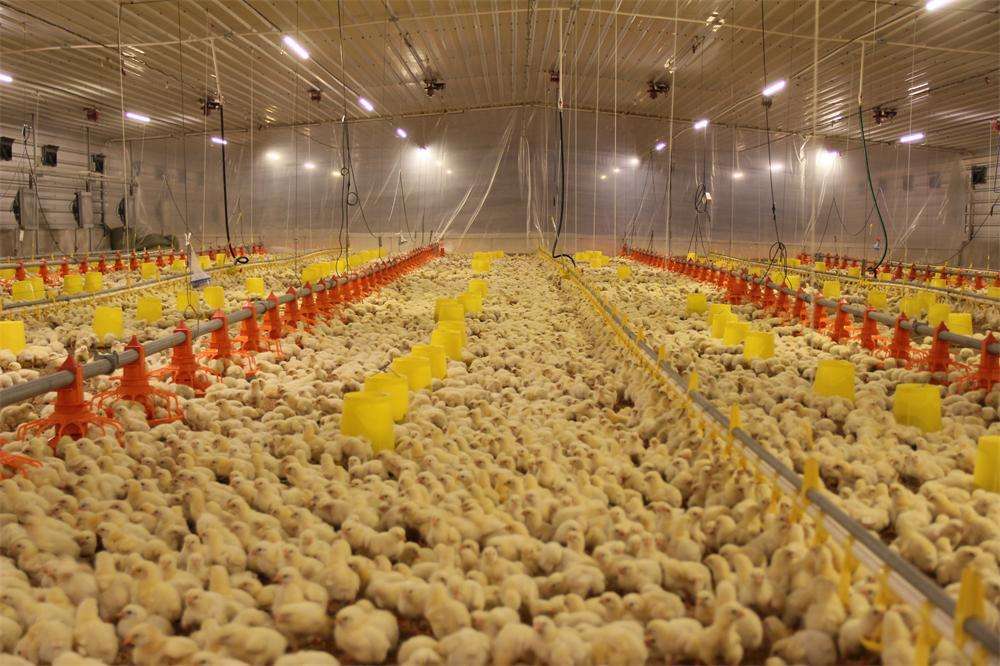
To many farmers, a light is simply a light - flip it on when it's dark, flip it off when the sun comes up. But step inside a modern, high-performing layer or broiler house, and you'll quickly see that lighting has evolved far beyond basic illumination. It has become a precision growth-control system - one that quietly shapes when a flock eats, when it's active, when it rests, and ultimately, egg production, feed conversion, and meat quality.
Let's start with something most people never think about: how a chicken actually sees the world.
Chickens See a World We Can't
Human eyes are trichromatic, picking up only red, blue, and green light. Chickens, by contrast, are tetrachromatic - on top of red, blue, and green, they can also detect ultraviolet light. In other words, the visual world a chicken experiences is layered with far more color information than our own.
Because of this, light intensity, duration, and spectral composition act directly on a bird's endocrine system, growth rhythm, and behavior - which in turn drives meat and egg output and quality. Choosing the right lighting for a flock is, at its core, fine-tuned management of the entire physiological cycle.
Every Color Has a Job
- Red light functions as a reproductive signal. It's the only spectrum known to stimulate a bird's hypothalamic and pineal oscillators, promoting sexual maturity and triggering the release of two key reproductive hormones. The result: stronger feed intake, more activity, and steadier egg production. Red light is also tied to melatonin regulation, which supports immune response and helps counter the immune dips caused by stress, viral disease, or medication.
- Blue light works as a calming agent. During catching, handling, or transferring, blue light noticeably reduces stress responses and restlessness, cutting down on feather pecking - which indirectly improves meat quality. It's an essential tool in broiler operations.
- Green light is all about growth. It promotes early proliferation of skeletal muscle satellite cells, accelerating growth rate during the early chick stage and improving daily weight gain efficiency.
This is exactly why professional poultry lighting is never "just white light." Spectrums are engineered for specific breeds and growth stages - breeder lights lean on red to drive reproductive performance; layer lights balance red, blue, and green to support both egg output and flock calm; broiler lights emphasize blue and green to manage stress and maximize weight gain.
Behind One Simple Table: Intensity and Duration
Good lighting management is never "brighter is better" or "longer is better." Different breeds, at different ages, need very different light intensity (lux) and daily photoperiods:
- Broiler chicks (0–1.5 weeks): 30–50 lx of stronger light, encouraging early adaptation and active feeding
- Broiler grow-out (1.5+ weeks): intensity drops sharply to around 5 lx, with duration shortened to 18–20 hours, to keep birds calmer and growth efficient
- Layer rearing (0–6 weeks): 10–30 lx, 16 hours a day, to build a strong foundation
- Peak laying period (18–80 weeks): 5–10 lx, 15 hours a day, balancing lay rhythm with flock stability
Managing this level of precision by hand - flipping switches on a schedule - simply isn't realistic. That's exactly why smart dimming systems exist.


Smart Dimmers: Putting "Sunrise and Sunset" on a Schedule
The real value of poultry lighting is unlocked by what sits behind it: an intelligent dimming control system. Take TriAC leading-edge phase-cutting dimming technology as an example - it delivers 0–100% flicker-free dimming across the entire range, paired with a built-in breeding schedule that lets you precisely set brightness curves, light duration, and sunrise/sunset transition times for every growth stage. The result is a "sun" inside the poultry house that rises and sets on the most scientifically sound rhythm - not a harsh on/off switch.
This kind of soft, gradual lighting transition has been shown to meaningfully improve animal welfare, reducing stress-driven feather pecking and flock panic. The system also supports:
- 0–10V slave control mode, integrating with upstream breeding controllers, with configurable thresholds
- Manual knob dimming - simple, intuitive, and still smooth
- Negative-feedback dimming via light sensor, automatically compensating based on ambient light to hold target illumination
- Power-failure memory, so the system resumes the original schedule automatically after an outage - no missed or scrambled lighting cycles
- IP65 waterproof housing and a 3-year warranty, built for the humid, dusty reality of poultry houses, running reliably for the long haul
The Fixtures Are Evolving Too
It's not just the control system - the lamp fixtures themselves are purpose-built for large-scale poultry housing. IP67/IP69K waterproof and dust-proof ratings mean they can withstand high-pressure washdowns; plug-and-play male/female waterproof connectors allow multiple tubes to be linked in series, drastically simplifying wiring; and 0–10V dimming compatibility, paired with the right dimmer, enables smooth dim-to-0.2% performance - genuinely flicker-free, with no visible steps.
For long installations - say, a 70-meter poultry house - farmers can simply use custom-length extended waterproof cables to distribute lamps evenly across the entire run. This keeps illumination consistent while avoiding the mess and failure points that come from excessive connectors - get the layout right once, and save both hassle and cost down the line.

The Bottom Line
From a chicken's four-color vision, to precisely balanced red-blue-green spectrums, to smart dimming systems that faithfully simulate sunrise and sunset - poultry lighting has long stopped being a simple fixture on the ceiling. It's now core production equipment, directly tied to egg output, feed-to-meat ratio, and animal welfare. Getting the lighting plan right is like installing an invisible productivity engine throughout your poultry house.
If you're upgrading the lighting system in your poultry house - or have questions about tube specs, dimmer selection, or custom cable lengths - reach out anytime. We'd love to help design an efficient, hassle-free, and cost-effective lighting solution tailored to your farm!


