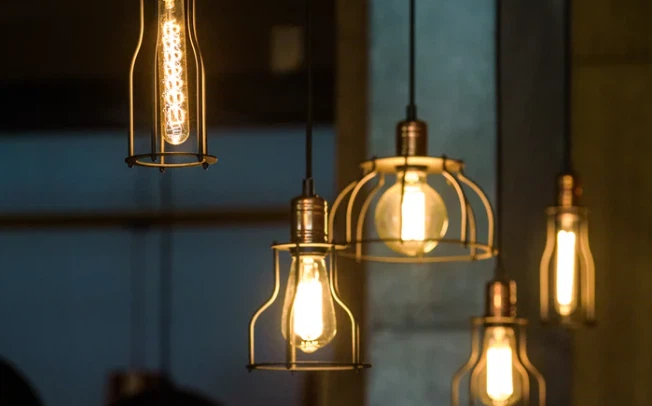
Want to make a space look nicer? Do you want it to seem more vibrant?
Of course, you could remodel it, but hanging pendant lights would be a lot more economical. This pendant light tutorial is perfect for you if you're unsure of what pendant lights are or how to use them.
What Do Pendant Lights Mean?
Hanging Light
A pendant lamp is a single lighting fixture that hangs from the ceiling. It is sometimes referred to as a suspender or drop. The lighting fixture is often supported by a metal rod, a cable, or a chain. Over kitchen counters or dining room tables, pendant lights are typically installed in a pattern (like a straight line). They are now being used in restrooms by an increasing number of individuals.
Glass, plastic, concrete, and other materials are all accessible for pendants. Additionally, they come in a range of styles and forms.
Some people mistakenly believe that a pendant and a chandelier are interchangeable, however this is untrue. A single bulb is used in one fixture for a pendant, as opposed to numerous lights being used in one fixture for a chandelier.
Where may pendant lights be used?
Different applications are possible for pendant lights. They may be utilised for area, task, and overall illumination. The majority of the time, people install them over a kitchen island, but they may also be placed in dining rooms, foyers, stairwells, family rooms, bedrooms, kitchens, bathrooms, and even on porches. Pendant lights may be used to draw attention to paintings, sculptures, and photographs as well as to illuminate dining rooms and small passageways and add glitter to interior spaces.
How big of an area will your pendant lights hang in?
If used properly, pendant lights can make a statement. Do consider the size of the area where the pendant light will be installed while picking pendant lights.
It is essential that your pendant lights are the right size for the room and neither too huge nor too little. Large fixtures obstruct visibility and give the impression that the space is congested. A pendant that is excessively tiny, on the other hand, will look unimportant.
Generally speaking, the size of your pendant light should increase with the size of the interior area.
How should a pendant light be chosen?
Following these four suggestions will make it simple for you to select the ideal pendant light.
Selecting a Pendant Light
Decide how much illumination the pendant light must emit.
Before you begin looking for a pendant light, you need to learn the answers to a few simple but crucial questions.
How much light does the space need? Do you have any additional lights installed in this space? What types of activities are you most likely to carry out here?
You may choose the best sort of pendant light for you based on the answers to these questions.
It goes without saying that various spaces call for various light levels. For instance, a kitchen needs more light than a living room does. Additionally, if you want to put pendant lights in a space that already has other lighting fixtures, such as spotlights, you probably won't utilise them as the main source of illumination. A pendant lamp can be used in this situation only for aesthetic reasons.
However, if the room in issue has no other light source, you must make sure the pendant light you choose provides enough illumination.
Select the location for the pendant lights.
The right location is crucial when using pendant lighting. The pendant light might cause problems if it is hung too high or too low.
The kitchen island or dining room table are just two obvious areas in the home where pendant lighting would look wonderful. When placed tastefully over a bed or in a living area, they may help brighten up items.
Having said that, proper positioning is essential. The last thing you want is to hang a pendant lamp over your kitchen counter only to knock your head against it each time you cook. In the living room, a pendant light that is positioned too low may obscure your view of the TV.
In conclusion, while hanging pendant lights, ensure sure they are positioned correctly and are neither too high nor too low.
Making a statement is one thing that pendant lights are excellent at. Instead of using them for functionality, most individuals do it for aesthetic reasons. However, it's crucial that the pendant lights you choose match the design of your space.
Think about it:
What style does my room have? Bohemian luxury? Currently minimalist? trendy industrial?
What colour dominates the space?
Exist any more focal points or items in the space
You may choose the pendant light that will enhance your area by being aware of the design of your room.
Choose the size and shape.
Your pendant light's size and form should be appropriate. Your line of sight can be obstructed by a large pendant light. It might not effectively illuminate the space if it is set too high.
The following are the most prevalent types of pendant lights, however there are many others.
Multi-light pendant fixtures: Do you require pendant lighting that can cast a wide range of light? If so, a pendant lamp with several lights, such as one made of globes, might be ideal for you.
pendent lampshade
A shade pendant resembles a suspended light fixture that is dangling from the ceiling. The shade is composed of fabric or other materials like ceramic, glass, or metal, and it looks just like a lamp shade.
angular pendants:
Do you need a pendant light to stand out? Then a linear pendant is your best option.
sphere pendants
light globe pendant
A globe hanging from the ceiling is precisely what the name implies: a globe pendant. The supporters of minimalist design love these pendants a lot.
Conclusion
Your space can seem smarter or brighter with the help of pendant lighting. However, it is crucial that you install them correctly and check to make sure they are neither hanging too low from the ceiling nor too high.