PPF or PPFD – Which One Really Matters for Your Crops?
Many growers have made this costly mistake – they buy a grow light with an impressively high PPF number, hang it up with high hopes, and then watch their crops grow mediocre at best, often outperformed by a neighbor's light with "lower" specs. What went wrong? You probably confused two critical metrics: PPF and PPFD. Read on – once you understand these, you'll never be fooled by marketing hype again.
1. What is PPF? – The Lamp's "Total Production"
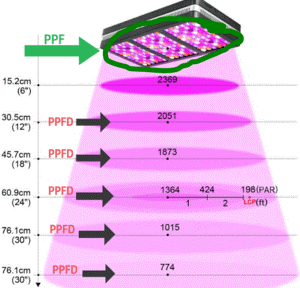
PPF stands for Photosynthetic Photon Flux, measured in μmol/s.
Simply put, PPF tells you how many total "plant‑useful" photons the fixture emits every second. It only cares about "how many are sent out" – not where they end up.
Think of PPF as a factory's total output – regardless of whether the products are sold, delivered, or sitting in a warehouse, that's what the factory produced.
PPF is an intrinsic property of the fixture, determined during design and manufacturing, usually measured in an integrating sphere lab. It reflects the fixture's overall light‑emitting capacity – a basic parameter for evaluating whether a light is "powerful enough."
But here's the catch: A high PPF does not automatically mean your plants will thrive – not by a long shot.
2. What is PPFD? – The Light Your Plants Actually "Eat"
PPFD stands for Photosynthetic Photon Flux Density, measured in μmol/m²/s.
It measures the number of photons that actually reach each square meter of the plant canopy (leaf surface) every second. This is the light your plants truly "consume" – and the real metric for judging whether your lighting setup is adequate.
Back to the factory analogy: PPF is the factory's total production, while PPFD is the actual goods delivered to the customer's doorstep. Losses in transit, uneven distribution – no matter how high the production, if it doesn't reach the customer, it's wasted.
PPFD is influenced by multiple factors – mounting height, beam angle, and growing area all dramatically affect the actual light intensity your plants receive. The very same fixture hung at 30 cm vs. 60 cm can yield a PPFD at canopy level that differs by more than a factor of two.
3. At a Glance: Core Differences Between PPF and PPFD
| Aspect | PPF (Photosynthetic Photon Flux) | PPFD (Photosynthetic Photon Flux Density) |
|---|---|---|
| What it measures | Total photons emitted by the source | Photons arriving at the plant surface |
| Unit | μmol/s | μmol/m²/s |
| Focuses on | How "productive" the lamp is | How much the plant actually receives |
| Influenced by | Fixture design itself | Height, angle, area, reflectivity, etc. |
| Who uses it | Manufacturers, engineers | Growers, farm managers |
| Everyday analogy | Factory total output | Customer's actual received goods |
In one sentence: PPF is the lamp's spec; PPFD is the plant's spec.
PPF tells you what the lamp can theoretically emit; PPFD tells you how much of that light is actually landing on your crop. Top growers no longer trust wattage – they look at PPF and PPFD.
4. So, How Are PPF and PPFD Related?
There is no direct conversion formula between the two. But the basic logic is:
PPFD ≈ PPF × optical utilization ÷ illuminated area
Optical utilization depends on beam design, reflector efficiency, mounting height, angle, and more. For the same fixture, the larger the illuminated area, the lower the average PPFD.
Example: A lamp with a PPF of 2000 μmol/s, lighting a 4 m² area, yields an average PPFD of roughly 500 μmol/m²/s. Expand that area to 10 m², and the average PPFD drops to about 200 μmol/m²/s.
So, choosing a light by PPF alone is like buying a car based on engine horsepower without knowing how much torque reaches the wheels – impressive numbers on paper, disappointing performance in reality.
5. How to Use Both Metrics When Selecting a Grow Light
5.1 Determine the PPFD Your Crop Needs
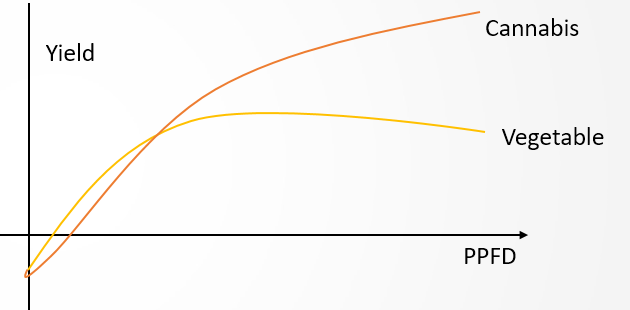
Different crops and growth stages require vastly different PPFD levels:
- Foliage plants: 50–200 μmol/m²/s for maintenance
- Leafy greens (e.g., lettuce): 150–250 μmol/m²/s
- Herbs: 200–400 μmol/m²/s
- High‑light crops (tomatoes, peppers): 600–900 μmol/m²/s
- Flowering high‑light crops: 800–1,200 μmol/m²/s
5.2 Back‑Calculate the Required PPF from Your Target PPFD
Required PPF = target PPFD × growing area (m²) ÷ optical utilization factor.
5.3 Demand a PPFD Distribution Map from Your Supplier
This is the single most important purchasing advice. Before you buy, always ask the supplier for a PPFD distribution map at a specific mounting height and coverage area – and cross‑check it against your crop's target PPFD range.
A PPFD distribution map is a grid chart showing the PPFD values at different positions across your growing area under a given hanging height. It tells you – is the light uniform? Are edges too dark? Is the center too intense?
If the supplier's spec sheet only lists lumens, color temperature, wattage, or even just PPF, but provides no PPFD distribution map, it's a red flag – the product was never designed with plant growth as the priority.
5.4 Don't Forget PPE (Photosynthetic Photon Efficacy)
PPE measures how many photosynthetic photons the fixture produces per joule of electrical energy consumed, in μmol/J. Higher PPE means more effective photons for your plants per dollar of electricity.
Top‑tier commercial LED grow lights achieve a PPE of 3.0–3.3 μmol/J, while many budget models fall below 2.7 μmol/J under real operating conditions. The PPE gap directly shows up on your electricity bill.

6. Get the Metrics Right, Get the Harvest Right
PPF and PPFD – one tells you "how much is sent out," the other tells you "how much is used." Focusing only on PPF while ignoring PPFD is like checking your gross salary but ignoring your net take‑home pay – the "discount" in between can be far larger than you expect.
A truly professional plant‑lighting solution is never defined by a single number.
It requires:
✅ Spectrum recipes precisely matched to your crop
✅ Well‑designed PPFD uniformity
✅ High PPE for energy savings
✅ A lighting plan validated in real‑world conditions
Your Growing Project Deserves a Professional Lighting Plan
Every growing project is unique – different crops, different spaces, different environments, and therefore different lighting needs.
We provide:
- Free PPFD simulation and lighting design
- Customized spectrum recipes tailored to your crop and growth stage
- High‑PPE energy‑saving solutions – we'll show you the ROI on every kilowatt‑hour
- Complete lighting solutions, from single fixtures to whole‑farm installations
Stop choosing lights by gut feeling. Tell us your growing area, crop type, and target yield – our technical team will design a data‑backed LED lighting solution that's proven to deliver.
📞 Contact us today for your custom PPFD lighting plan – so every photon lands exactly where it matters.
Your crops deserve better light. We help you put that light right where it's needed most.
Let me know if you'd like a shorter version, a more technical tone, or a version tailored for a specific crop or market.
Related product links:https://www.benweilight.com/professional-lighting/led-grow-light/t5-led-grow-light-tube-full-spectrum-red-blue.html