The best illuminance and color temperature of LED classroom lights used in classroom lighting
At present, the incidence of myopia in college students remains high. Investigation and research have found that environmental factors have a certain relationship with the incidence of myopia, and the lighting in the classroom is one of the most important factors affecting myopia.
As a special indoor lighting place, classroom lighting has special requirements for lighting. Classroom lighting not only has a great impact on students’ vision health, but also due to the non-visual effects of the eyes, the difference in spectrum and light intensity of light sources with different color temperatures will also Affect the physiological rhythm of students, make them excited or fatigued, affect learning efficiency and psychological and physical health. Therefore, classroom lighting lamps must not only consider the color temperature of the light source and the impact of light on students, but also pay special attention to the spectral safety of the light source.
The high myopia rate of adolescents is closely related to poor lighting.
At present, the myopia rate of young people in my country ranks second in the world, especially among college students, the detection rate of poor eyesight is as high as 82.68%, and the reason is related to poor classroom lighting. Compared with fluorescent lights, BenweiLED classroom lights are easier to meet the requirements of spectral safety. Related experiments have also proved that LED lights have better visual performance under the same color temperature and the same illumination. Therefore, it is conducive to the health of the eyesight of the students and relieves the tension of the students.
Its biggest advantage is that it is easier to control than traditional fluorescent lamps and LED light sources. It can flexibly use traditional blue chips with different phosphor formulations, or use a variety of different spectrum chips to mix light to form the required specific spectrum. Only through the preparation of phosphors can the fluorescence spectrometer have greater limitations. In addition, Benwei LED classroom lights have the characteristics of fast response, point-to-point control, flexible dimming, etc., which can easily obtain the required illuminance. Through this feature, not only can it achieve linkage with natural light, but also can be applied to dynamic health lighting systems.
The light source around 4000K in the classroom has the best display effect.
Psychological experiments and survey research results show that students’ preference for color temperature is not static, but varies with classroom functions and illuminance levels. It is not reliable to use it as a basis for selecting classroom lighting color temperature. When evaluating the classroom lighting effect of a light source, in addition to the subjective evaluation of the students, the impact of the accumulation of fatigue caused by the students in a specific spectrum environment for a long time and a large number of stimuli on the physical health of the students should also be considered. Regarding the visual efficacy test, it is mainly reflected in the following three aspects,
1. Classroom lighting and blackboard lighting should avoid using the same color temperature light source;
2. For the fluorescent lamp group and the LED lamp group, the light source recognition rate curve of about 4000K has the best stability and the highest recognition rate, indicating that its visual effect is the best;
3. At present, the most widely used 6500K fluorescent light source in the classrooms of Southern University in my country has the worst visual performance. Moreover, when the voltage is unstable and the work surface illumination changes slightly, it may cause the students' visual work efficiency to drop suddenly.
Six standard parameters
Classroom lighting should avoid the combination of color temperature and lighting.
According to the requirements on color temperature in "GB7793-2010 Hygienic Standard for Lighting and Lighting of Classrooms in Primary and Secondary Schools": light sources with a color temperature of 3300K~5500K should be used in the classroom, and the color rendering index of the light source should not be less than 80.
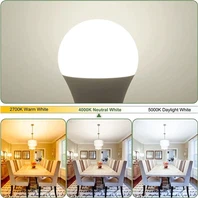
The color temperature is 3300K~5500K, and the color temperature range is large. The color temperature is around 3000K for warm light, the light at about 5000K is white, and the color temperature at 4000K is neutral light.
Various places need to choose different color temperatures. Light distribution personnel are already using a set of standard light distribution methods. Schools generally choose white light. White light is just the noon light. The light source is close to natural light. It's easy to fall asleep, and learn in a 5000K color temperature learning environment to improve students' concentration.
The best recommended color temperature: When choosing the lighting source for the classroom, you should choose a fluorescent lamp with a medium color temperature of about 4000K, with LED as the main light source. However, high color temperature and low color temperature light sources can aggravate students' brain fatigue and visual fatigue, reduce learning efficiency, and are not suitable as the main light source in the classroom.
Recommended optimal illuminance: light sources with different color temperatures have different optimal illuminance values. Fluorescent lamps and LED light sources with the same color temperature have different optimal illuminance values. The overall LED comprehensive index and sub-item compliance are better than fluorescent lamps, and the 4000K group has the least number of non-compliant light sources and the most outstanding performance. Third, the classroom lighting should avoid the combination of color temperature and light. On this basis, without considering the color temperature, blindly increasing the average illuminance of the classroom will not only not improve the light environment, but will reduce the learning efficiency of students and affect their health.