Most lighting purchasers assume that early failure of low-cost LED lights stems from poor-quality LED chips. This widespread misconception leads many buyers to focus only on chip brands while ignoring other vulnerable components inside fixtures. In fact, industry maintenance data shows that less than 8% of premature LED lamp failures are caused by defective chips. The real hidden culprits are cheap drivers, inferior capacitors, cut-corner heat dissipation systems and low-grade structural accessories. LED chips are the most durable part of an LED fixture, yet budget manufacturers cut costs on every other critical component, resulting in rapid burnout, flicker, dimness and short service life. This article reveals the real failure causes of cheap LEDs, with visual chart and comparison table to help buyers avoid procurement traps.
Visual Chart: LED Light Early Failure Cause Distribution
The following pie chart clearly shows the proportion of all premature LED failures, directly proving LED chips are rarely the problem:
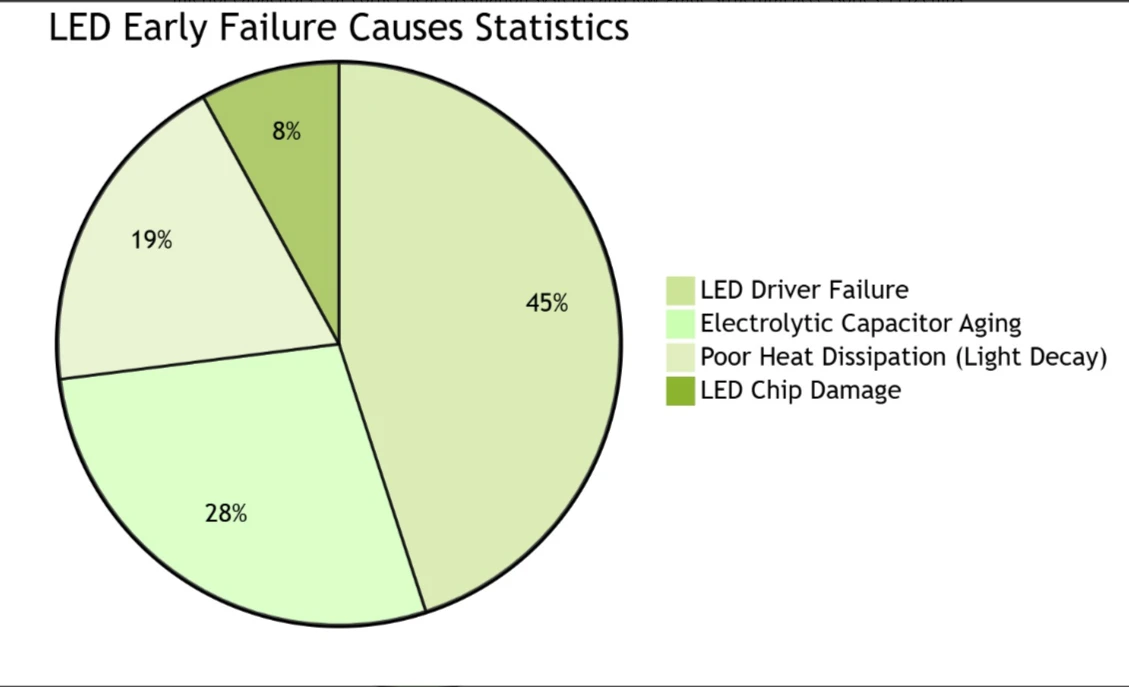
As the data reflects, over 90% of early LED failures have nothing to do with LED chips. Even equipped with qualified mainstream chips, cheap LED lights still break down quickly due to peripheral component defects. LED chips can easily last more than 50,000 hours under normal working conditions, but supporting parts in budget lamps cannot match such a long lifespan, becoming the weakest link of the whole lighting system.
Core Component Comparison: Cheap LED vs Premium Commercial LED
To show the cost-cutting gaps intuitively, the table below compares key internal parts between budget LED lights and standard commercial-grade LED fixtures, explaining why peripheral components decide overall lamp lifespan:
|
Core Component |
Cheap Low-Cost LED Lights |
Standard Commercial-Grade LED Lights |
Failure Risk Impact |
|---|---|---|---|
|
LED Chip |
Generic brand chip, stable basic performance |
Branded high-bin chip, low light decay |
Very low failure risk; rarely damaged within 5 years |
|
LED Driver |
Non-isolated simple driver, no over-current/over-voltage protection |
Isolated constant current driver, full surge protection |
Highest failure risk; easily burned by voltage fluctuation |
|
Electrolytic Capacitor |
Low-temperature resistant capacitor, short service life |
High-temperature resistant industrial capacitor |
Ages fast under continuous heat, causes lamp flicker |
|
Heat Sink |
Thin aluminum shell or plastic heat dissipation, poor thermal conductivity |
Thick die-cast aluminum heat sink, efficient heat output |
Accelerates overall light decay, shortens whole lamp life |
|
Sealing & Wiring |
Thin rubber ring, thin copper wire, rough welding |
Waterproof silicone ring, thick pure copper wire, precise welding |
Water ingress and circuit short circuit in humid environments |
Why Manufacturers Cut Costs on Drivers and Capacitors Instead of Chips
Most unprofessional buyers only ask about LED chip brands during procurement, so suppliers keep chips qualified to win customer trust. Meanwhile, they secretly reduce costs on invisible internal parts that buyers cannot check directly. The LED driver is the power heart of the lamp; unstable current and voltage output will damage the whole lighting system in a short time. Inferior capacitors cannot withstand long-hour high-temperature operation, bulging or leaking quickly to cause lamp flicker or sudden extinction.
Poor heat dissipation further amplifies all these problems. When heat cannot be discharged timely, high working temperature accelerates the aging speed of drivers, capacitors and chips at the same time. Even intact high-quality chips will suffer rapid lumen depreciation and early failure under long-term overheating.
How to Avoid Early LED Failure During Procurement
Buyers should stop only focusing on LED chip brands and start checking the full configuration of fixtures. First, prioritize lamps with isolated constant-current drivers and complete surge protection, especially for outdoor and industrial lighting with unstable grid voltage. Second, confirm high-temperature resistant capacitors are adopted for long-hour continuous operation scenarios. Third, inspect the thickness and material of heat sinks rather than only looking at exterior appearance. Finally, verify full-unit warranty instead of chip-only warranty, as most failures happen to non-chip components.
Conclusion
LED chips are not the weak point of LED lighting fixtures. The hidden early failure risks come from cheap drivers, substandard capacitors and insufficient heat dissipation. Cheap LED lights cut corners on invisible core accessories to lower prices, forming a misleading phenomenon: good chips but poor overall performance. Understanding this key fact helps lighting specifiers and project purchasers get rid of single chip-oriented judgment, select truly reliable full-structure LED lights, and reduce extra maintenance and replacement costs in the long run.
Shenzhen Benwei Lighting Technology Co,Ltd
Telephone: +86 0755 27186329
Mobile(+86)18681294064
Whatsapp : 18681294064
Email:bwzm32@benweilighting.com
Web: www.benweilight.com