The Light Beside Your Bed at Night Is Quietly Harming Your Hearts
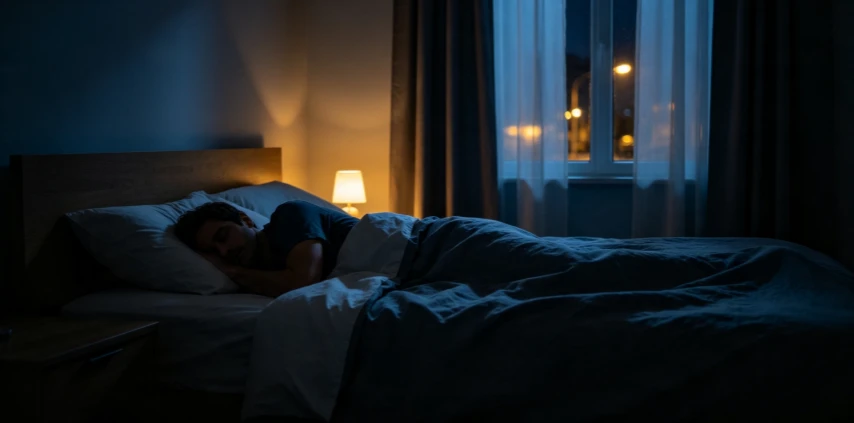
Late at night, you might be scrolling through their phones in bed, with a dim nightlight glowing on the nightstand and streetlight seeping through the curtains. They think it's just "a little light." But science tells us otherwise: that light is forcing their hearts to work the night shift.
Nearly 90,000 people, 10 years of tracking data – an alarm bell
In October 2025, JAMA Network Open published a large‑scale study jointly conducted by Flinders University (Australia) and Harvard‑affiliated hospitals. The research team fitted nearly 89,000 participants aged 40+ with wrist‑worn light sensors to objectively record their real‑world light exposure for one week, and then followed their cardiovascular health for about 8 years.
The results are staggering – compared with those who had the least night‑time light exposure, those with the highest exposure had:
- 56% higher risk of heart failure
- 47% higher risk of myocardial infarction (heart attack)
- 32% higher risk of coronary artery disease
- 32% higher risk of atrial fibrillation
- 28% higher risk of stroke
Even after adjusting for traditional risk factors such as smoking, hypertension, sleep duration, and physical activity, these associations remained significant. Night‑time light exposure itself is an independent and powerful cardiovascular hazard.
Why? How does light "steal" heart health?
The human cardiovascular system follows a precise circadian rhythm – active during the day, restorative at night. Night‑time light – especially blue‑rich spectra – directly suppresses melatonin secretion.
Melatonin is the body's "night guard," signalling to every organ: "It's dark, time to rest." Once light hits the eyes at night, the brain receives a false signal: "Daytime – wake up!"
Consequently, the sympathetic nervous system stays aroused – heart rate doesn't slow down as it should, and blood pressure doesn't dip overnight. The heart, which should be in low‑gear recovery mode, is forced to maintain daytime fight‑or‑flight status. One or two nights are tolerable, but over the long term, sustained cardiovascular stress accumulates – and risk builds up.
Even more concerning: A study published in PNAS showed that just one night of exposure to moderate indoor light (around 100 lux) – roughly the brightness of a typical bedroom nightlight – was enough to impair cardiovascular function during sleep and increase next‑morning insulin resistance. 100 lux is trivial compared to the intensity of many LED products.

Traditional LEDs are creating an invisible health crisis
A large portion of today's LED luminaires pursue "high brightness, high colour temperature, high CRI" – 4000K, 5000K, even 6500K cool white, with extremely high blue‑light content. During the day, they are efficient light sources; at night, they become biological‑clock disruptors.
The International Commission on Illumination (CIE) clearly recommends: reduce light intensity significantly 3 hours before bedtime, and aim for near‑total darkness during sleep. When night‑time illuminance exceeds 50 lux, melatonin secretion drops by more than 50%. Yet typical indoor LED lighting often reaches hundreds of lux – far beyond the safe threshold for human night‑time physiology.
Healthy lighting is becoming the next growth engine for the LED industry
This is exactly the right moment for your company to enter the healthy lighting segment.
According to TrendForce's observations, in the first half of 2025, orders for high‑value‑added products such as human‑centric healthy lighting and smart lighting performed exceptionally well, becoming a key driver for revenue and market share stability for many lighting manufacturers. While the general lighting market is slowing down, healthy lighting is growing against the trend and stands out as a critical differentiator.
Consumers are waking up – they no longer only ask "Is it bright enough?" They are starting to ask: "Is this light good for my health?"
Your opportunity is right here
Imagine this: a client walks into your showroom. You place an ordinary cool‑white LED next to a low‑colour‑temperature (≤3000K), low‑illuminance, low‑blue‑light health‑friendly luminaire designed specifically for night use – and you tell them:
"This light can reduce your cardiovascular risk by 56%. "
That is not marketing hype – it is a scientific conclusion published in JAMA Network Open.

What we can offer you
✅ Scientifically‑based healthy lighting solutions – strictly following CIE guidelines, tailored for night‑time scenarios
✅ Precise spectral tuning technology – effectively reducing blue‑light hazards and protecting circadian rhythms
✅ Comprehensive certification and testing support – so your products withstand scientific scrutiny
✅ A differentiated market position – seizing the blue ocean of healthy lighting amid red‑ocean competition
Night‑time light harms the heart – this is not fear‑mongering, it's science.
Healthy lighting – this is not a concept, it's a necessity.
Contact us now to get our complete healthy‑lighting product portfolio and market analysis reports. Let your luminaires not only illuminate spaces but also safeguard lives.
📧 bwzm88@benweilighting.com
Safeguard sleep with science, protect hearts with light – your clients deserve a truly healthy lamp.