The Relationship Between Bulb Brightness and Actual Power: A Data-Driven Study and Its Implications for Modern Lighting Solutions

Introduction
In the field of lighting technology, understanding the relationship between a bulb's brightness and its actual power consumption is crucial for both energy efficiency and product performance. Traditional experiments often rely on subjective visual observation, which can lead to inconsistent conclusions. However, with the help of modern sensors and data acquisition tools, it is now possible to analyze this relationship objectively and accurately. This article presents key findings from an experimental study that used light sensors and power meters to investigate how bulb brightness changes with power input. We also highlight how Shenzhen Benwei Lighting applies these insights to produce high-performance, energy-efficient LED lighting products.
Experimental Background and Methodology

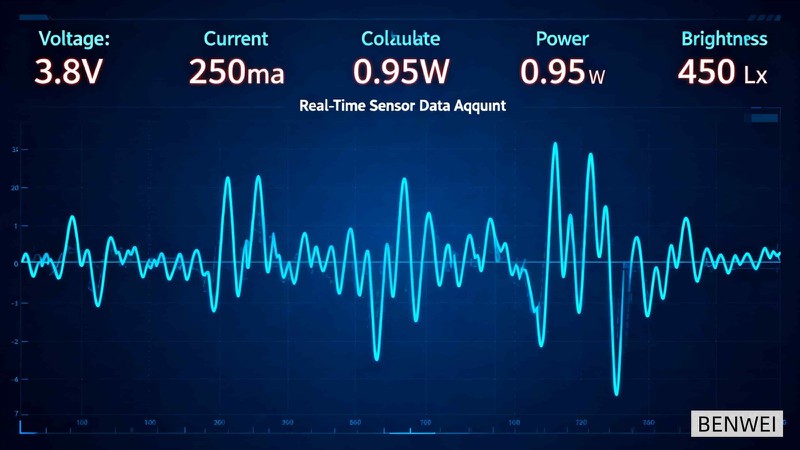
The experiment was designed to replace subjective human observation with precise sensor-based measurements. Using a DFRobot analog ambient light sensor (range: 0–6000 Lx) and an I2C digital power meter (with resolutions of 4 mV for voltage and 1 mA for current), researchers collected real-time data on light intensity and power consumption for different types of bulbs.
The setup included:
A Leonardo microcontroller with an expansion board
A computer for data logging
Incandescent and LED bulbs
A sliding rheostat and DC power supply
The bulbs were tested under controlled conditions, with the light sensor fixed close to the bulb and shielded from external light. Voltage and current were measured simultaneously to calculate actual power, while the sensor recorded corresponding illumination levels.
Key Findings from the Experiment

1. Incandescent Bulbs
For low-voltage incandescent bulbs (e.g., 3.8V and 2.5V), brightness increased with power but not in a linear fashion. At lower power levels, small increases in power led to significant gains in brightness. However, beyond a certain point-still below the rated power-the brightness plateaued, meaning further power increases did not result in noticeable illumination gains.
2. LED Bulbs
LED bulbs exhibited a more stable brightness-power relationship. Brightness increased with power, but the rate of increase gradually slowed. Once the LED reached its rated power, brightness stabilized, and additional power input did not enhance illumination.
These results confirm that LED bulbs offer more predictable and efficient performance compared to traditional incandescent bulbs, especially within their rated operating range.
Why Objective Measurement Matters
Subjective assessments of brightness can be misleading due to variations in human perception and environmental conditions. Sensor-based measurements, as used in this study, provide repeatable and quantitative data. This approach is essential for designing lighting systems that deliver consistent performance, minimize energy waste, and meet user expectations.
Shenzhen Benwei Lighting: Science-Driven Lighting Solutions
Shenzhen Benwei Lighting incorporates these scientific principles into the design and manufacturing of their LED products. By understanding how brightness correlates with power consumption, Benwei optimizes its LEDs to deliver maximum illumination with minimal energy use.

Key product features include:
High Luminous Efficacy: Benwei LEDs are engineered to provide bright, uniform light while operating below saturation points where efficiency drops.
Stable Performance: With advanced drivers and thermal management, Benwei LEDs maintain consistent brightness and longevity even under fluctuating voltage conditions.
Wide Application Range: From residential and commercial lighting to industrial and outdoor use, Benwei offers versatile solutions that align with experimental findings on power-efficient illumination.

Conclusion
The sensor-based study clearly demonstrates that both incandescent and LED bulbs exhibit nonlinear relationships between power and brightness, with LEDs showing superior control and efficiency. These insights are vital for developing next-generation lighting systems that prioritize sustainability and performance.
Shenzhen Benwei Lighting stands at the forefront of this innovation, using data-informed design to produce reliable, high-efficiency LED lighting. For distributors, contractors, and developers seeking trustworthy and advanced lighting solutions, Benwei offers products that are not only bright and durable but also grounded in solid scientific research.
References
[1] Yang Gengming, Li Jing, Wang Fang. (2020). Using Sensors to Explore the Relationship Between Bulb Brightness and Actual Power. Innovation Platform Journal.
[2] DFRobot. (2020). Analog Ambient Light Sensor and I2C Digital Power Meter Specifications.
[3] Shenzhen Benwei Lighting Co., Ltd. (2023). Product Performance and Testing Reports.
Our service:
1.Your inquiry related to our products or prices will be replied in 24 hours.
2.Well-trained and experienced staffs to answer all your enquires in fluent English.
3.OEM&ODM, we can help you to design and put into product.
4.Distributoership are offered for your unique design and some our current models.
5.Protection of your sales area, ideas of design and all your private information.
http://bwzm15@benweilighting.com
Shenzhen Benwei Lighting Technology Co.,Ltd
Telephone: +86 0755 27186329
Mobile(+86)18673599565
Whatsapp :19113306783
Email:bwzm15@benweilighting.com
Skype: benweilight88
Web: www.benweilight.com