Nighttime construction, mining operations, temporary events, emergency rescue-these scenarios share a common requirement: the need to rapidly establish a bright, stable illuminated area in locations lacking a fixed power grid. Mobile LED lighting towers are designed specifically for this purpose.
When first encountering these units, many buyers mistake them for standard floodlights. This article breaks down exactly what they are, their components, their advantages, their typical applications, and what to look for when selecting the right model.
What exactly is an LED lighting tower?
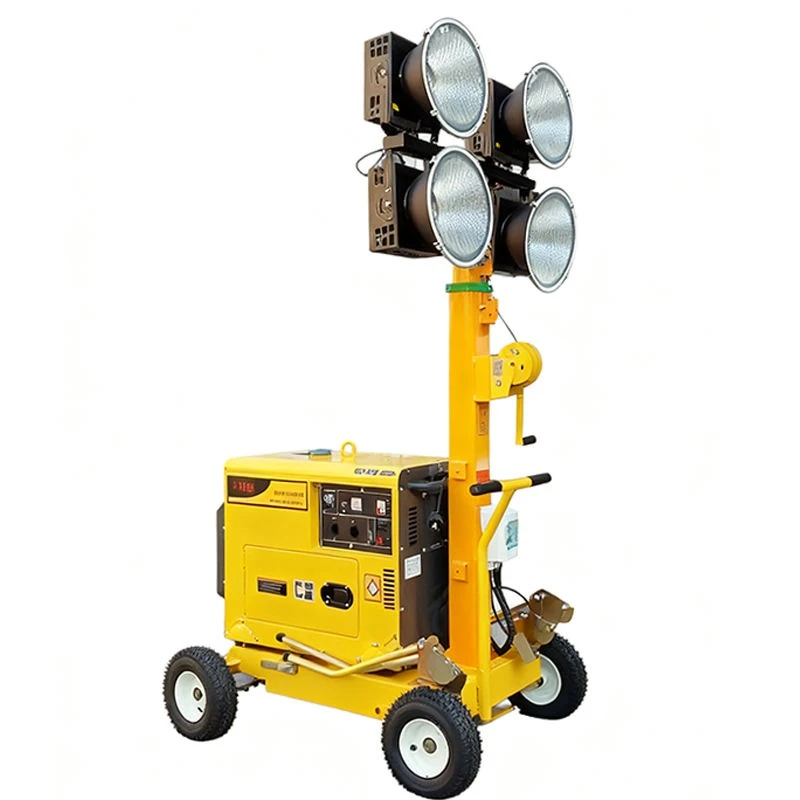
Simply put, an LED lighting tower is a high-power, mobile, and height-adjustable lighting unit with an integrated power source. A typical configuration consists of a base (usually a trailer) equipped with an extendable mast, topped with multiple LED light heads, and powered by an onboard generator or another power supply.
Its key characteristics can be summarized as follows:
Mobile: Designed for transport via trailer or forklift, eliminating the need for new wiring when moving between job sites.
Height-adjustable: The mast can be raised, allowing light to project downward from an elevation; this provides broader coverage and makes it easier to control glare.
Independent operation: It does not rely on the mains power grid-simply arrive on-site, raise the mast, and start the unit to begin operation.
What are its components?
Understanding the structure helps ensure you aren't misled when evaluating technical specifications.
LED Light Heads: The core light source; the number of units and the wattage of each determine the total luminous flux.
Mast: Can be raised via a manual winch or a hydraulic system; typical heights range from 7 to 9 meters.
Power System: Diesel generators are the most common, though hybrid, solar-powered, and battery-operated models also exist.
Chassis and Trailer: Equipped with outriggers and stabilizing mechanisms to ensure the unit remains upright when the mast is extended.
Control Box: Manages power switching and individual circuit control; some models include dimming or timer functions.
What are the advantages of LED light towers over traditional versions?
Traditional light towers typically use metal-halide or high-pressure sodium lamps. Increasingly, projects are shifting to LED technology for several practical reasons:
Greater fuel efficiency: LED fixtures consume less power, allowing a single generator to support more lights-or to operate for longer periods at the same brightness level. This reduces the frequency of refueling, thereby lowering both labor and fuel costs.
Instant-on capability: Unlike metal-halide lamps, which require a warm-up period and must cool down before they can be restarted after a power interruption, LEDs provide instant illumination.
Longer lifespan: LED light sources generally last much longer than traditional bulbs, resulting in less frequent replacements and easier maintenance.
Rugged durability: Free from fragile filaments or glass envelopes, LED units are more reliable during transport or when moved over rough, uneven terrain.
Reduced noise and emissions: Because the generator operates under a lighter load, there is less operational noise and fewer exhaust emissions-making these units better suited for sites with strict environmental regulations or noise restrictions.
Common Use Cases
Construction and roadwork: Nighttime concrete pouring, road paving, and bridge repairs-all of which require broad, uniform illumination.
Mining and quarrying: Large-scale operational areas with high dust levels, where light towers can be repositioned to follow the progress of excavation.
Ports and logistics yards: Lighting for nighttime container handling and cargo transshipment.
Oil, gas, and energy projects: Illumination for areas around drilling rigs, pipeline construction sites, and equipment maintenance zones.
Emergency response and disaster relief: Rapid deployment of temporary lighting following earthquakes, floods, or power outages to facilitate search-and-rescue and urgent repairs.
Large-scale events and competitions: Temporary lighting for outdoor performances, exhibitions, marathons, and similar events.
Airport and railway maintenance: Nighttime inspection and repair of runways or tracks, requiring equipment that can be deployed and removed quickly.
Summary
An LED light tower is a mobile, height-adjustable, and self-powered high-intensity lighting unit. Its primary value lies in its ability to provide stable, wide-area illumination in locations that lack access to a fixed power grid. Compared to traditional metal-halide light towers, LED light towers offer significant advantages in terms of fuel consumption, startup speed, service life, and durability. Consequently, they are becoming increasingly popular for use in construction, mining, port operations, the energy sector, emergency response, and event management. When selecting a unit, simply evaluate factors such as illumination area, mast height, power supply method, runtime, and ingress protection (IP) rating against your specific operational requirements to ensure you choose the right equipment.
Looking for an LED light tower for your project?
Since every job site differs in terms of area, power availability, and required duration of use, the figures found on a standard spec sheet may not always align with your specific needs. If you are currently selecting equipment for a project-or would like to obtain quotes and lead times for various configurations-please feel free to contact us directly. Simply let us know your intended application, the required illumination range, and your power supply requirements; our engineers will recommend the ideal solution and provide detailed specifications and pricing.