Whether it is LED lamps or energy-saving lamps, each has its own advantages and disadvantages
The primary reason is the high-energy short-wave blue light in the LED lamp.
The white light emitted by the LED lamp mainly relies on the blue light of 450-455nm wavelength to excite the phosphor, and the lower the wavelength, the stronger the firing. Usually the wavelength of the LED light source is controlled within 500nm, generally 450-455nm or 455-460nm, which belong to the relatively strong transmission wavelength band. If the wavelength becomes larger, the ability to excite the phosphor will decrease, and the luminous power will decrease. In order to pursue brightness, some manufacturers usually increase the blue light intensity of the LED light source. If the human eye looks at such a light source for a long time, the eye will be harmed by blue light.

In addition, the longer the LED light is turned on, the greater the attenuation of the phosphor in the light source, which will cause the blue light to become more and more intense, which will harm the human eye. Therefore, if the eyes look at the LED light source for a long time, dazzling and uncomfortable feelings will simply occur, and even eye damage will occur, which increases the chance of eye disease. So, don't stare at an LED light source that is too bright for a long time. [2]
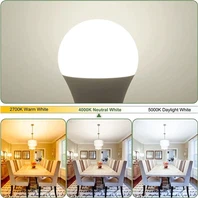
The cool white light announced by some LED lights is too intense (the color temperature of the light is too high). Reading under this light will make your eyes dazzling and cause visual fatigue. Why is this so? In fact, the yellow spot area inside the human eye, the macular area has a thin retina, dense pigment epithelial cells, and dense capillaries behind the retina with weak reflections, so the color is dark red. For younger children, the color is reddish brown. The most tolerable is yellow light rather than white light. This is the fundamental reason why reading and writing under yellow light will feel soft and comfortable, while under white light it will feel dazzling or fatigue.
Electromagnetic signal
Fluorescent lamps using electronic rectifiers: Although this type of fluorescent lamps make no flicker visible to the naked eye, they generate electromagnetic interference signals of 30-50kHz.
Many "eye protection lamps" on the market are actually fluorescent lamps that use electronic rectifiers. To put it plainly, they are energy-saving lamps. Its primary feature is no flicker, which is relative to fluorescent lamps. The eye protection lamp uses a high-frequency electronic rectifier to adjust the current frequency to 30k-50kHz, and the light shining speed is very fast; and because of the afterglow effect of the phosphor, the light change range is significantly reduced, so the human eye does not feel the light shining at all. It feels stable. But strictly speaking, energy-saving lamps are not absolutely free of flicker, but small amplitude and high frequency flicker. It is this characteristic that the light it announces is more stable and comfortable than fluorescent lamps. However, high-frequency electronic rectifiers generate high-frequency electromagnetic signals.
For fluorescent lamp products to achieve "no flicker and no electromagnetic interference signal", this is a technical difficulty, and it is also a difficult topic in the world.
Summary: Whether it is an LED lamp or an energy-saving lamp, each has its own advantages and disadvantages. For general households, try to choose a mixed light source to avoid the shortcomings of a single light source. In addition, whether the "eye-protection lamp" protects the eyes or not depends primarily on the method of use of the lamp, not the lamp itself. Normally, the lamp holder should not be too high to avoid glare or the tabletop light is too dark; the lamp holder should not be too low, otherwise the tabletop light is too strong and it is not good for the eyes. If you can't confirm whether the brightness of the light is appropriate, you can use an eye-protecting photometric pen to do some tests.