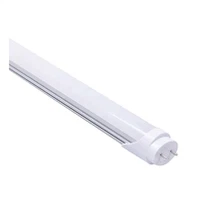
Why Are T8 Emergency LED Tubes the Smarter Choice for Your Building's Safety and Energy Bills?
If you manage a commercial building, hotel, hospital, or factory, you know that emergency lighting is not optional - it's a life-safety requirement. But many facility owners still rely on old fluorescent emergency tubes that waste energy, fail too soon, and barely meet modern codes.
Today, T8 emergency LED tubes are changing the game. Let's look at the hard data on why switching makes sense for your bottom line and your safety compliance.
1. Energy Savings That Show Up on Your P&L
A standard 4-foot T8 fluorescent tube consumes around 32W during normal operation and the same full power during emergency. A T8 emergency LED tube uses only 18W normally, and drops to 9W in emergency mode while still delivering required illumination.
Table 1 – Power & Efficacy Comparison (4ft tube)
| Parameter | Traditional T8 Fluorescent | T8 Emergency LED | Improvement |
|---|---|---|---|
| Normal power | 32W | 18W | 44% less |
| Emergency power | 18W (full output) | 9W (optimized) | 50% less |
| Luminous efficacy | 60–80 lm/W | 120–160 lm/W | 2× brighter per watt |
| Annual energy use | 140 kWh | 79 kWh | 61 kWh saved |
For 500 tubes (typical in a mid-sized retail store), the annual saving is over 30,000 kWh – real money.
2. Lifespan: Install Once, Forget for Years
Fluorescent tubes last about 8,000 hours. In a 24/7 facility, that's less than one year. T8 emergency LED tubes are rated for 50,000+ hours – that's over 5 years of continuous operation, or 10+ years in normal daily use.
Fewer replacements mean lower maintenance costs, less downtime, and no need for lift trucks every few months.

3. Emergency Performance That Meets (and Exceeds) Global Standards
Different markets have their own codes (UL 924 in North America, EN 60598-2-22 in Europe, IEC 62034 international). The best T8 emergency LED tubes meet or exceed all major standards.
Key performance metrics you should demand:
Table 2 – Critical Emergency Performance Data
| Parameter | Typical LED Tube Value | Common Code Requirement | Status |
|---|---|---|---|
| Emergency switch-on time | ≤0.3 seconds | ≤0.5 sec (UL/EN) | Exceeds |
| Duration (full emergency) | 90–180 min | ≥90 min | Up to 2× longer |
| Battery recharge | ≤24 hours | ≤24 hours | ✅ Compliant |
| Battery cycle life | 500+ cycles (≥80% capacity) | 500 cycles (IEC) | ✅ Compliant |
| Luminous efficacy in emergency | ≥120 lm/W | Not always specified, but high efficacy saves battery | ✅ Best-in-class |
| Color rendering (CRI) | ≥85 Ra | ≥80 Ra (EN 12464) | ✅ Better |
| Power factor | ≥0.95 | ≥0.90 (commercial lighting) | ✅ Excellent |
Note: Always check the specific certification marks for your region (cULus, CE, TUV, SAA, etc.).
4. Real-World Application: Where T8 Emergency LED Tubes Shine
- Parking garages – cold temperatures reduce fluorescent output; LEDs handle -20°C without issues.
- Hospitals – need high CRI and instant emergency response.
- Hotels & shopping malls – want low maintenance and safe evacuation lighting.
- Factories & warehouses – high bay areas benefit from long life and vibration resistance.
5. The Global Market Trend: LED Dominates Emergency Lighting
According to the latest industry report, the global emergency lighting market reached $8.45 billion in 2025, with LED products accounting for 51% of the market share. By 2034, the market size is projected to grow to $15.66 billion (CAGR of 7.83%).
Why? Because regulators worldwide are phasing out fluorescent technology due to mercury content and poor efficiency. Upgrading now future-proofs your building.
6. How to Choose the Right T8 Emergency LED Tube – 6 Key Checks
When talking to suppliers, ask these questions:
- Certification – Does it have UL 924 (US), EN 60598-2-22 (EU), or local equivalent?
- Battery type – Lithium-ion with overcharge, over-discharge, and short-circuit protection.
- Emergency duration – 90 min minimum; request 180 min for critical areas.
- Housing material – 6063 aluminum alloy (≥1.2mm thick) for heat dissipation.
- Warranty – 3–5 years indicates quality.
- Installation – Direct "plug-and-play" replacement for existing T8 fluorescent fixtures (bypass ballast or ballast-compatible? Confirm with supplier).

Summary Table – LED vs. Fluorescent for Emergency T8 Tubes
| Feature | T8 Fluorescent Emergency | T8 LED Emergency |
|---|---|---|
| Normal power | 32W | 18W |
| Emergency power | 18W | 9W |
| Lifespan | 8,000 hrs | 50,000+ hrs |
| Emergency duration | 30–90 min | 90–180 min |
| CRI | ~70 | ≥85 |
| Mercury | Yes | No |
| Cold temperature performance | Poor | Excellent |
| Maintenance frequency | High | Very low |
| Payback period | - | Often <1 year (energy + maintenance) |
Final Takeaway
Upgrading to T8 emergency LED tubes is not just about compliance – it's about reducing operating costs, improving safety, and cutting maintenance headaches. With 50%+ energy savings, 6× longer life, and double the emergency backup time, the ROI is clear.
If you are specifying lighting for a new project or retrofitting an existing building, choose T8 emergency LED tubes with proper certifications and a solid warranty.