A Guide to Light Bulb Sizes, Shapes, and Codes
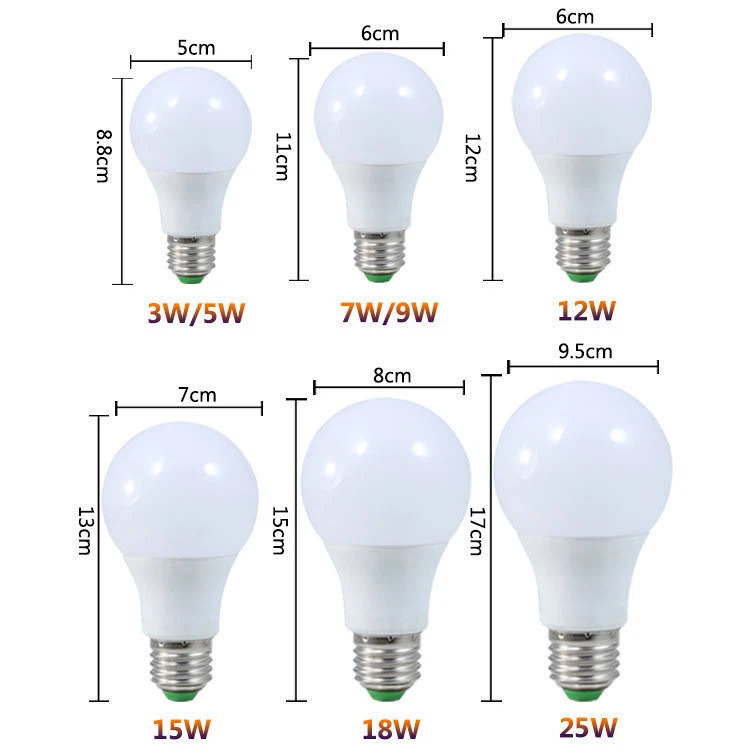
Looking to add extra flair to your home's lighting design? It might feel hard to explore limitless alternatives while simultaneously attempting to match aesthetic and function. Our helpful guide to light bulb sizes, however, is here to assist you in making the best decision.
Let's begin by learning how to distinguish between various light bulbs. Every kind has distinct properties indicated by a letter, or series of letters, and a number, referred to as light bulb codes. You can check the codes on the packaging to see if the bulb is the right kind for your fixture.
The letters in a bulb code identify its form and specific properties such as reflector type. Depending on the bulb, the numbers in a bulb code represent the size of the base, which is expressed in millimeters or eighths of an inch. An A19, for instance, indicates that the base is 19/8ths of an inch in diameter and that the bulb has a standard household shape (the letter "A").
The most common light bulb shapes you'll see include:
- A for Standard Household/Arbitrary
- C for Candle
- R for Reflector
- MR for Multifaceted Reflector or Quartz Reflector Lamp
- PAR for Parabolic Aluminized Reflector
- G for Globe
- T for Tubular
Additionally, there are several diameters for light bulb bases. Light bulb base codes are used to identify them, with the letter designating the base's shape and the number designating its size. If you're unclear if the base of your bulb will fit, ask a store employee for guidance on the optimal fit.
The most common light bulb base sizes include:
- Standard-Medium, a regular sized screw in base: E26 or E27
- Candelabra, a smaller screw in base: E12
- Intermediate: E17
- Bi-pin, a pin-in base with two points of contact: G4 or GU24
- Twist-And-Lock base: GU10

Type A light bulbs: A15, A19, A21, and A25 Bulbs from the A group are frequently used for interior illumination in homes. They perform nicely in different household fixtures, hall lights, ceiling fans, and more. They're typically compatible with medium screw bases (E26 and E27) or the candelabra base (E12). You are more likely to see the A19, which is the common light bulb size. However, due to their increased energy efficiency, CFL Twists or Spirals are increasingly replacing A19s.
CFLs generally come in a spiral-shaped form and consume minimum amounts of energy to give a softer glow. They're normally more budget-friendly than fluorescent bulbs but contain mercury and might take a while to warm up to maximum brightness.
Type B and C Light Bulbs: Because the shapes of the B10, C7, C9, C15, and CA10 B and C group bulbs all resemble candle flames, they are sometimes referred to as candle bulbs. They're often found in chandeliers, wall sconces, accent or pendant lights, and other decorative fixtures. Like bulbs in the A group, their most frequent base types include the E26 and E27 medium screw in bases, the E12 candelabra base, as well as the E17 base.
Type BR Light Bulbs: BR20/R20, BR30, BR40
Reflectors and bulged reflectors are examples of bulbs of the R and BR groups, respectively. Even though they aren't as prevalent as A19 bulbs, you're still fairly likely to find these bulbs in recessed lighting or outside floodlights in your house. The most common are the BR30 and R20 bulbs, and they typically connect with the E26 or E27 bases.
Type PAR Light Bulbs: PAR16, PAR20, PAR30, PAR36, PAR38
PAR group bulbs are typically used as outdoor lighting, like BR lights. PAR, parabolic aluminized reflector, are often higher wattage bulbs which may offer a lot of light. The focus of PAR and BR lights differs significantly; although BR lights give a wider wash, PAR lights have the potential to produce more concentrated beams. The most common base types include the E26 and E27, as well as the G53 screw pin base.
Type MR Light Bulbs: MR11, MR16
The MR group of bulbs can produce a broad spectrum of colors and emit a concentrated beam of light that is directed in a specific direction. Because of this, multifaceted reflectors are popularly used in track lights, recessed lights, desks, and display cases. They usually use low voltage wiring systems, making them an excellent choice for landscaping applications like path and driveway lighting, gazebo lights, and paver lights. The MR16 of this group will probably be seen in indoor settings due to their svelte design and spotlighting abilities. The most common base types for MR bulbs inside low-voltage AC/DC systems is the GX5.3 bi-pin or GZ4 bi-pin, and the GU10 bi-pin for 120-volt systems.
LFL and T light bulb types: T: T7, T8, T10, T12, T14; LFL: T5, T6, T8, T12
T and LFL group lights, referring to tubular and linear fluorescent lights, respectively, comprise specialized and vintage lighting. The T8 or T12 may also be found in a kitchen, garage, or laundry area. They often feature magnetic or electronic ballasts which assist restrict the amount of current in an electrical circuit. These are typically fluorescent and consume a tiny amount of energy while providing maximum brightness and a crisp, white glow for up to 20,000 hours. However, hybrid LED light bulb replacements have recently become more popular due to their increased efficiency. The E26 and E27 medium screw bases, E12 candelabra bases, E17 bases, BA15D bayonet bases, or the G13 bi-pin base are the most frequent connections for T group lights.
G11, G14, G16/G50, G60, G25, G80, and G30 Type G Light Bulbs
Lastly, G group, or globe lights, are commonly used for aesthetic purposes. You may recognize the G30 as lighting for bathroom vanities. They're usually available in vintage-styles, which are distinguished by an antique-looking filament in the middle and may lend flare to any fixture. Globe bulbs with a dramatic or antique feel are suitable for bespoke lighting setups in the dining room or den. G group lights most typically connect with E26 and E27 medium screw bases and E12 candelabra bases.
How to Pick the Right Bulb: A 3-Step Quick Guide
Three Easy Steps:
Check the base – Look at your fixture's socket type (screw-in, pin, or bayonet) and match the code (like E26 or GU10).
Match the shape – Pick a bulb shape that fits your fixture and space. Use PAR for spotlights, Candle for decorative fixtures, A19 for ceiling lights.
Get the brightness and mood right – Choose lumens for brightness and Kelvins for color temperature. Go warm (2700K) for bedrooms, neutral (4000K) for kitchens.
Still unsure? Snap a photo of your old bulb or the fixture label and ask a store employee, or check the code chart on the packaging.
Congrats! We're happy to report that you're now prepared to select the ideal lighting for your residence. Don't be afraid to approach a store employee for further details if you have any more queries. For further advice on lighting design and ideas, you can also get in touch with our customer care.