The Global Power Puzzle: Why Voltage Compatibility Decides Project Viability
The Fragmented Grid Landscape Across Continents
Anyone who has sourced lighting for more than one country knows that the world's electrical grid is anything but uniform. At the low end, Japan and parts of Taiwan operate on a nominal 100V system. North America uses a split system: residential single-phase circuits commonly run at 120V, while commercial and industrial lighting circuits frequently tap 277V from a three-phase 480V supply-the reason U.S. warehouse and sports facilities so often specify 277V fixtures. Europe, the United Kingdom, the Middle East, most of Africa, and large parts of Asia and Latin America cluster around 220–240V. Meanwhile, markets such as Brazil, the Philippines, and portions of the Caribbean mix 110V and 220V circuits within the same building stock.
For a global buyer, this fragmentation is not an abstract trivia fact. It is the single most common cause of "the fixture arrived but we cannot energize it" failures on real projects. A fixture rated only for 120V cannot be safely connected to a 230V circuit without a transformer; a fixture rated only for 220V must be re-engineered for North American sites. Every such mismatch adds procurement complexity, inventory duplication, and on-site electrical risk.
The Real Cost of Voltage Mismatch
Voltage mismatch costs more than the price of a transformer. Consider the full chain of consequences:
Transformer and conversion hardware add upfront equipment cost, installation labor, and an extra failure point between the grid and the luminaire.
Inventory fragmentation forces a distributor to stock multiple SKUs for the same wattage class-one for 120V markets, one for 230V markets, one for 277V-tying up working capital and raising the risk of shipping the wrong variant.
Scheduling risk increases when a project team must wait for the correct variant or for conversion gear to arrive.
Safety exposure grows whenever installers are tempted to run a fixture outside its rated voltage window, which can stress the driver, accelerate LED degradation, and void protection guarantees.
A genuinely wide-voltage platform collapses all of this into a single inventory line that any of these grids can energize directly.
What "Universal" Actually Means in Specification Terms
In practical spec terms, a universal or wide-voltage fixture must do more than merely tolerate a range of inputs. It must maintain consistent luminous output, stable color temperature, and full protection across the entire window. For the fixture examined here, the confirmed rating is AC100–277V, which covers the overwhelming majority of the world's residential and commercial lighting circuits in one unit. When a spec sheet shows this range, the buyer is effectively purchasing multi-market readiness as a standard feature rather than a customization.

Engineering the Wide-Voltage Platform: Inside the AC100–277V Architecture
The Active Power-Factor-Corrected Power Supply
A fixture that operates across 100V to 277V cannot rely on a simple linear power supply. The practical implementation demands a switched-mode driver with an active power-factor correction (PFC) front end, which continuously adjusts the input stage to hold stable DC bus voltage regardless of the incoming AC level. The benefits cascade beyond compatibility: active PFC keeps the harmonic content low and improves the power factor, which matters to utilities, building codes, and facility energy audits-particularly in European and Asian markets where harmonic limits and power-factor requirements are enforced.
For the buyer, the practical result is that the same 500W unit delivers near-nominal output whether it is fed from a 100V Japanese outlet, a 220V European feeder, or a 277V North American commercial circuit. This is the engineering foundation that makes "one SKU, all markets" viable.
Wide-Input Driver Design and Surge Protection
Wide-voltage operation also demands a driver with generous input tolerance and transient resilience. Real-world grids are not clean lab sine waves: they carry brownouts, voltage sags, switching transients, and lightning-induced surges. A professional stadium and outdoor-area fixture should therefore include robust surge protection on the input stage to shield the LED array and driver electronics. While the precise surge rating must be confirmed against the manufacturer's datasheet, the architectural principle is clear: a fixture built for global deployment must survive the electrical environment of the least-ideal grid in its intended market, not just the cleanest one.
Thermal Management Under Full Voltage Range
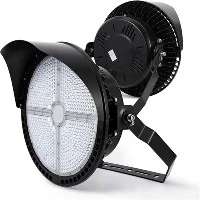
One of the quiet killers of LED fixtures is heat, and heat is exactly what a wide-voltage, constant-output design must manage carefully. At lower input voltages, input current rises for the same power draw, placing additional stress on the driver stage. The confirmed design addresses this with a high-tech heat-sink system for better heat dissipation, combined with an aluminum housing. Aluminum's high thermal conductivity draws heat away from the LED chips and driver, keeping junction temperatures lower and preserving lumen output and color consistency over thousands of operating hours.
A lower operating temperature also protects the driver electronics that make wide-voltage operation possible. In simple terms: the wide-voltage architecture works reliably only if the fixture can shed the heat that constant-power operation generates, and the aluminum heat-sink platform is precisely what enables that.
Aluminum Housing and the Light–Dust Protection Cap
Beyond cooling, the confirmed build includes an aluminum cap designed to avoid light and dust pollution. In outdoor and stadium environments, this serves two distinct functions. First, it prevents stray upward light from washing out the night sky or spilling into residential areas-an increasingly regulated concern for sports and industrial sites. Second, the cap shields the optics and interior from airborne dust and debris that would otherwise degrade reflectors and reduce light output over time. The result is a fixture that keeps its photometric performance and its light-control behavior intact through years of outdoor exposure.
Performance Profile of the 500W Stadium Light
Luminous Efficacy and Color Temperature: 150LM/W and 5700K
The headline performance figures confirm this is a serious high-efficiency fixture. At 150LM/W, the unit converts electrical energy into light with the kind of efficiency that matters on a large project, where every watt-hour translates directly into operating expense. Applied to a 500W fixture, that efficacy means substantial lumen output per fixture and, crucially, fewer fixtures and less total wattage to achieve a target illumination level when compared with older metal-halide or sodium installations.
The 5700K daylight color temperature is the professional standard for sports and high-visibility applications. Daylight-white light renders colors accurately, enhances depth perception for athletes and spectators, and provides the crisp, uniform brightness that broadcast cameras and night-time play demand. For facility operators, 5700K is also the neutral choice that works across field lighting, parking areas, and perimeter applications without a jarring color cast.
Beam Control and Uniformity: The 60° Beam Angle
A stadium fixture must do more than produce raw lumens; it must place them where they are needed. The confirmed 60° beam angle delivers a medium-narrow distribution that suits area, sports, and high-bay applications-enough spread to cover a defined zone evenly, yet concentrated enough to reach meaningful illuminance at mounting heights where stadium lights are typically installed. Combined with the adjustable optics described later, the 60° beam gives project designers the control to build uniform horizontal and vertical illuminance without excessive glare or wasted spill light.
Environmental Hardiness: IP65 Protection
Outdoor fixtures live a hard life-rain, humidity, dust, temperature swings, and the occasional pressure wash. The confirmed IP65 rating certifies that the fixture is dust-tight and protected against low-pressure water jets from any direction. This makes it appropriate for open stadiums, training grounds, industrial yards, parking lots, and other exterior locations where a lesser-sealed product would fail prematurely. For buyers comparing offerings, IP65 is a durable shorthand for "built to be mounted outside and forgotten about."
Installation and Deployment Flexibility
The 240° Rotational Bracket and Adjustable Focus Head
Mounting flexibility is where good fixtures become great projects. The confirmed fixture pairs a 240° rotational bracket with an adjustable focus head capable of 240° of rotation. This combination means the installer can aim the light accurately on site-tilting and rotating to hit the target zone-rather than forcing the structure to fit a rigidly oriented fixture. For retrofit projects on existing poles, trusses, and walls, this adjustability is the difference between a clean install and a fabrication headache.
Mounting Options: Wall, Ceiling, and Floor
The confirmed design explicitly supports wall mount, ceiling mount, and floor mount configurations, and the included U-mount bracket enables multi-install setups. This versatility lets a single product family cover stadium perimeter walls, high-bay ceilings, and ground-level perimeter installations alike. For distributors, that means one product line can satisfy multiple application zones on the same project, simplifying quoting and reducing the number of line items in the bill of materials.
Wiring Made Simple
Professional installers value a fixture that wires cleanly. The unit's wiring is laid out for straightforward termination, with the live (pink), neutral (blue), and earth (green-yellow) conductors clearly identified. The manufacturer's guidance is explicit and practical: confirm wire colors against the label before energizing. Clear identification, combined with the wide-voltage input, lets a qualified electrician terminate the fixture directly onto the local supply without transformer stage, while still observing standard lockout/tagout and earthing practice.
Market-Specific Application Playbook
North America: One Fixture for 120V and 277V
North America is where the AC100–277V rating earns its keep most visibly. A distributor serving U.S. commercial and industrial sites can stock a single 500W fixture that serves both 120V general circuits and 277V commercial lighting circuits-the two voltages most commonly encountered in warehouses, gymnasiums, parking structures, and light industrial facilities. This consolidation reduces inventory and removes the classic "which voltage did the client specify?" question from the sales conversation.
Europe, the Middle East, and Africa: Straight 220–240V Deployment
Across the 220–240V band that dominates Europe, the Middle East, and Africa, the fixture connects directly with no conversion. For project contractors upgrading stadiums or industrial sites, the wide range also future-proofs the purchase: the same stock can be redeployed to another country or site with a different grid without scrapping fixtures. When budgets are tight and projects are cross-border, this portability is a genuine asset.
Latin America and Asia-Pacific: Navigating Mixed-Voltage Territories
Markets such as Brazil, the Philippines, and parts of the Caribbean present a patchwork of 110V and 220V circuits within the same national territory. For buyers there, a wide-voltage fixture is not a convenience-it is the only practical way to maintain a single SKU while serving customers on different grid standards. The AC100–277V platform resolves this cleanly, letting one catalog item address both sides of the divide.
A Procurement Perspective: TCO, Certification, and Sourcing
Total Cost of Ownership
The business case for wide-voltage boils down to total cost of ownership (TCO). The savings compound across four lines:
Energy: at 150LM/W with daylight color, fewer fixtures and fewer watts deliver target illumination with lower operating cost than legacy technologies.
Installation: direct grid connection eliminates transformer hardware and associated labor.
Maintenance: IP65 sealing and aluminum thermal management reduce premature failure and the labor cost of re-lamping or re-setting fixtures at height.
Inventory: one universal SKU replaces multiple voltage variants, reducing working capital and mis-shipment risk.
For a facilities manager or distributor running the numbers over a five-year horizon, the wide-voltage platform typically wins on every line.
Certification and Compliance Considerations
Any fixture destined for global export should be checked against the electrical safety and EMC standards of the target market-CE for the European Economic Area, UL or ETL for the U.S. and Canada, and the applicable regional marks elsewhere. Wide-voltage capability does not, by itself, prove compliance in every territory; the responsible buyer confirms the specific certifications the manufacturer holds for each destination market before committing inventory. This is a verification step for the procurement team, not a claim this article makes on the product's behalf.
Choosing the Right Supply Partner
For importers and distributors, the wide-voltage 500W fixture is most valuable when sourced from a partner who can deliver consistent quality across batches, provide clear wiring and installation documentation, honor reliable lead times, and stand behind the product with responsive support. When comparing quotes, prioritize the supplier who can document the thermal design, the driver topology, and the protection rating-because those are the details that determine whether the fixture performs in the field as well as it does on a spec sheet.
Conclusion: Standardizing on a Universal Platform
The modern lighting buyer no longer needs to think in terms of one voltage per market. The AC100–277V wide-voltage platform transforms a potential sourcing problem into a single, universal inventory decision. When that compatibility is combined with 150LM/W efficiency, 5700K daylight color, IP65 protection, a 60° beam angle, a 240° rotational bracket, and an aluminum heat-sink housing, the 500W LED stadium light becomes more than a lamp-it becomes a standardized asset a distributor can deploy across continents and a contractor can install with confidence.
The commercial logic is simple and powerful: one fixture, every grid, lower total cost, and less risk. For teams building a lighting portfolio for global markets, standardizing on a universal wide-voltage platform is not just a specification choice. It is a strategic decision that simplifies operations, protects margins, and keeps projects on schedule from the first connection to years of reliable service.

How To Cooperate With Us?
We are happy to have total control over the manufacturing process and the calibre of our products since we have our own facilities. Since we are producers rather than just brokers, we are dedicated to providing our customers with the best pricing. Since we are certain that the price and quality of our products are clear, we invite customers to see our samples first. Our commitment to quality and customer satisfaction drives us to continuously provide top-notch goods.
Our address
3rd Floor, 5th Building, Hebei Industrial Park, Hualian Community, Longhua District, Shenzhen, China