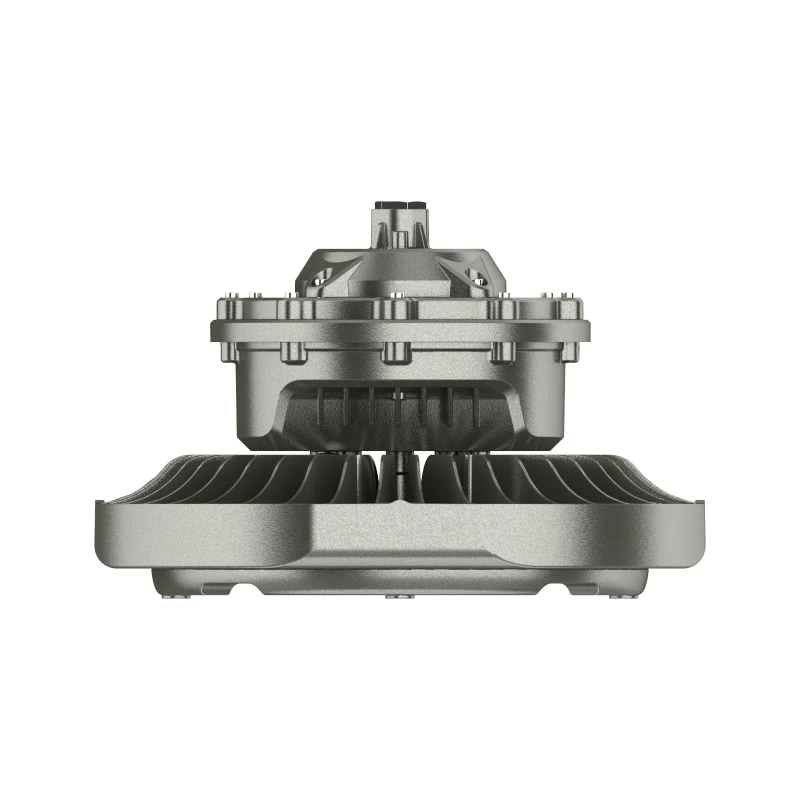
In outdoor settings such as petrochemical plants, oil and gas storage tank farms, terminals, and gas stations, explosion-proof floodlights are typically installed at height and exposed to open environments. It is not uncommon at such sites for these fixtures to suffer inexplicable damage-such as burnt-out LED drivers or frequent, recurring malfunctions-following a thunderstorm. Many procurement and engineering professionals often ask: "Since the explosion-proof light already carries an explosion-proof certification, is additional surge protection really necessary?"
The answer is yes; in most outdoor applications, it is an essential requirement. Let's examine this issue by looking at the underlying principles, associated risks, and selection criteria.
Explosion-proof certification is not the same as surge protection
Explosion-proof certification (covering protection types such as Ex d or Ex e, or standards like ATEX and IECEx) addresses one specific concern: ensuring that any sparks, electric arcs, or high temperatures generated inside the fixture do not ignite explosive gases or dust in the surrounding atmosphere.
Surge protection addresses a different issue: preventing transient high voltages-caused by the external power grid or induced by lightning strikes-from damaging or destroying the electronic components inside the fixture.
These two types of protection serve different purposes. A certified explosion-proof light might remain physically intact on the outside, while its internal LED driver has already been destroyed by an overvoltage event. Therefore, the existence of an explosion-proof certificate should not be taken as an indication that the device is inherently surge-resistant.
Where do surges in outdoor explosion-proof floodlights come from?
Surges in outdoor environments generally originate from three sources:
Direct and induced lightning strikes: Even if lightning does not strike the light pole directly, a nearby strike can induce high voltage in the power cables, which then travels along the lines into the fixture.
Grid-related switching surges: The starting, stopping, or switching of large motors, transformers, or capacitor banks can generate transient overvoltages on the power supply lines-a phenomenon particularly common in industrial facilities.
Coupling effects in long-run cabling: In hazardous (explosion-proof) areas, lighting fixtures are often widely dispersed, requiring long power supply lines. The longer these outdoor cables are, the greater the surge energy they are likely to pick up.
Consequences of Lacking Surge Protection
Damage caused by surges can be either immediate or cumulative:
Direct burnout of the LED driver: This is the most common scenario, where the LED chips remain intact, but the driver fails.
Accelerated light degradation and shortened lifespan: Repeated, minor surges may not cause immediate failure, but they gradually damage internal components.
High replacement costs: Explosion-proof lights are often installed in elevated or hazardous areas. Replacing a single unit may require halting operations, obtaining work permits, and setting up access equipment-making the maintenance cost far higher than the price of the light fixture itself.
Safety risks due to lighting interruption: In hazardous areas where operations continue at night, a sudden loss of lighting poses an immediate safety risk.
Scenarios Requiring Priority Surge Protection
Risk levels vary by installation environment; surge protection should be prioritized in the following scenarios:
High-mast or tower-mounted lights in open areas, such as storage tank farms, loading/unloading zones, and docks.
Regions prone to frequent lightning or a high number of thunderstorm days.
Installations with long power supply lines or overhead cabling.
Industrial sites where high-power motors or variable-frequency drive (VFD) equipment share the same power grid.
Offshore platforms, coastal refineries, and petrochemical plants, where lightning strikes are frequent.
While the risk is relatively lower for indoor installations or environments with effective shielding, surges caused by power grid operations (switching surges) can still occur.
Implementing Surge Protection
In practical applications, a multi-layered protection strategy is commonly used:
Built-in surge protection: Many explosion-proof floodlights feature integrated surge suppression within their LED drivers-typically rated for 6kV, 10kV, or higher. This serves as the first line of defense and should be a key criterion during product selection.
External Surge Protective Devices (SPDs): Installing SPDs at the distribution board or the base of the light pole allows for the absorption of higher-energy surges, complementing the protection built into the light fixtures.
Proper grounding: Surge protective devices require a reliable ground connection to dissipate energy; if the grounding resistance does not meet standards, even the best SPD will be ineffective. Pay attention to explosion-proof requirements for the installation location: Any Surge Protective Device (SPD) placed within a hazardous area must itself meet the appropriate explosion-proof rating; alternatively, it should be installed inside a power distribution cabinet located in a safe area.
Conclusion
Is surge protection necessary for explosion-proof floodlights installed outdoors? The answer is yes. An explosion-proof certification only ensures that the luminaire will not act as an ignition source; it does not guarantee that the unit can withstand lightning strikes or power grid surges.
In practice, the approach can be summarized in three points: select luminaires with built-in surge protection, install additional SPDs at the power distribution end, and ensure reliable grounding. This combination requires minimal extra investment while significantly reducing failure rates and long-term maintenance costs.
Need assistance with product selection for your project?
If you are planning a lighting project for a petrochemical facility, oil and gas site, terminal, or any other outdoor hazardous area, please share the site conditions with us-including the explosion-proof zone classification, installation height, power supply method, and local lightning activity. Our technical team can recommend suitable explosion-proof floodlight models and surge protection solutions tailored to your specific operating environment, and provide quotations along with relevant certification documentation. Please feel free to reach out to us with your inquiry.
https://www.benweilight.com/industrial-lighting/led-high-bay-light/4000k-led-bay-lights.html