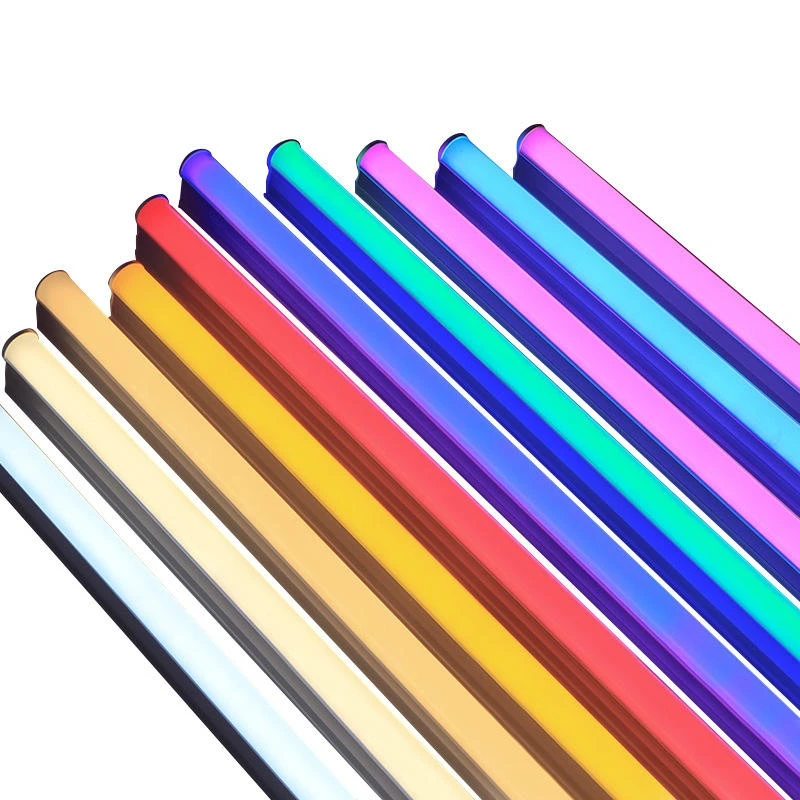
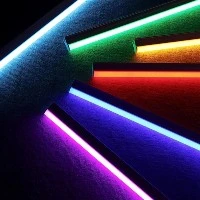
Many clients ask the same question when inquiring about our products: Can RGBW waterproof LED tubes be used in car washes, bars, or for outdoor signage? Our answer is generally "yes"-but because each environment has different requirements, focusing on the wrong criteria during selection can easily lead to the need for costly rework. This article breaks down the considerations for each scenario, helping you clarify the key factors before placing an order.
How do RGBW LED tubes differ from standard RGB tubes?
Standard RGB tubes create white light by mixing red, green, and blue. This often results in a "white" that appears too cool or tinted-a flaw that becomes especially noticeable when placed against a white wall or a vehicle's bodywork. RGBW tubes add a dedicated white LED chip alongside the red, green, and blue ones, offering three main advantages:
• The white light is purer; you don't have to rely on mixing the three primary colors to achieve neutral or warm white tones.
• Pastel and light-colored hues appear softer, avoiding a "muddy" (grayish) or harsh, glaring look.
• At the same brightness, the dedicated white component is more energy-efficient and generates less heat.
These benefits are highly relevant to the scenarios discussed below.
Understanding IP ratings: Don't just look for the word "waterproof."
The term "waterproof LED tube" is quite broad; the true benchmark is the IP (Ingress Protection) rating.
• IP65: Withstands low-pressure water jets from any direction; suitable for general outdoor use or areas subject to occasional splashing.
• IP67: Can be submerged in water for short periods without water ingress; suitable for areas prone to standing water or long-term dampness.
• Materials and Construction: Factors such as whether the housing is made of silicone, polycarbonate (PC), or a combination of aluminum and PC-and whether the end caps are sealed with resin-often have a greater impact on the product's actual lifespan than the stated IP rating alone.
In short: The IP rating sets the baseline, but the manufacturing quality determines whether that baseline is truly achieved.
Car Washes: The ultimate test-water, foam, and cleaning agents.
Car washes present a unique lighting environment. LED tubes here are constantly exposed to high humidity, water mist, foam, and even airborne alkaline cleaning agents.
• Ingress Protection (IP) Rating: An IP66 or IP67 rating is recommended, especially for fixtures located near wash-down areas.
• Housing Corrosion Resistance: Cleaning agents can accelerate the degradation of low-quality plastics-causing them to yellow or become brittle-so it is crucial to verify the material of the housing.
• The Value of White Light: Car owners are highly sensitive to the true color of their vehicle's paint. An independent white channel (in an RGBW system) provides clean, accurate illumination for paint inspection and detailing, while the RGB channels can be used for ambient lighting to attract customers.
• Electrical Safety: In such environments, low-voltage (e.g., DC24V) fixtures should be prioritized to minimize the risk of electrical leakage.
Bars: Focus on Atmosphere and Control, Not Just Waterproofing
While bar interiors are generally not subject to direct water jets, areas near bars, terraces, or entrances are prone to spills, cleaning-related moisture, or even exposure to rain (in outdoor sections), making basic waterproofing still necessary. The key differentiators, however, are as follows:
• Color Performance: RGBW systems allow for more nuanced warm tones and smooth gradients, avoiding the "plasticky" look often associated with standard RGB lighting.
• Dimming Smoothness: The light should remain flicker-free and transition seamlessly even at low brightness levels, ensuring comfort for those seated nearby.
• Control Options: The ability to integrate with DMX or other control systems-enabling features like music synchronization and scene switching-determines the versatility and creative potential of the lighting.
• Installation Form: Linear fixtures are ideal for outlining bars, accentuating ceiling designs, or highlighting feature walls; the required lengths and the handling of corners should be planned in advance.
Outdoor Signage: Weather Resistance is Paramount
Signage lighting is typically installed for years at a time, leaving little room for frequent maintenance. • UV Resistance: Under prolonged sun exposure, standard plastics tend to yellow, which directly alters the color of the emitted light. Therefore, it is essential to choose housings that have been UV-treated.
• Temperature Adaptability: Since surfaces can reach high temperatures in summer and drop to low temperatures in winter, the operating temperature range of the light tubes must accommodate the local climate.
• Brightness and Uniformity: The lights must remain clearly visible even during the day. Additionally, the spacing between LED chips and the light-diffusion method should ensure a smooth, uniform glow without any visible "dotting" or pixelation.
• Color Consistency: When multiple light tubes are combined to form a single sign, color variations between different production batches can become very noticeable. It is highly recommended to source the entire quantity for a single project at once.
Key Questions to Ask Suppliers Before Purchasing
• What is the actual ingress protection (IP) rating, and is there supporting test documentation?
• What material is the housing made of? Is it UV-resistant and corrosion-resistant?
• What are the operating voltage and power consumption? What is the maximum length that can be connected in a single run?
• Which control protocols are supported, and are they compatible with your existing controllers?
• Can they provide samples, and is it possible to customize the length and connectors to your specific requirements?
Often-Overlooked Details During Installation
The fact that the light tubes themselves are waterproof does not mean the entire system is waterproof. Connectors, cable entry points, and power supply units are the most common entry points for water.
• Use waterproof connectors, or apply potting compound or heat-shrink tubing at connection points.
• Place power supplies and controllers in a dry location, or select units that carry an appropriate waterproof rating.
• For outdoor installations, account for wind loads and thermal expansion/contraction to prevent the light tubes from being subjected to excessive tension.
• When routing cables, incorporate a "drip loop" to prevent water from running along the cable and into the connection points.
Summary
• Car Washes: Prioritize IP ratings, corrosion-resistant housings, and low-voltage safety.
• Bars: Focus on color nuance, smooth dimming capabilities, and control methods.
• Outdoor Signage: Emphasize UV resistance, temperature adaptability, and batch-to-batch color consistency.
• While waterproof RGBW light tubes are suitable for all three scenarios, the specific configuration should be tailored to the unique requirements of each environment-with careful attention paid to connectors and power supply systems.
Need help selecting the right light tubes for your project? If you are working on a lighting project for a car wash, bar, or outdoor signage, please share the application scenario, installation length, voltage requirements, and control method with us. Our engineers will recommend the most suitable waterproof RGBW LED tubes for your needs, and we can also provide samples for testing. Send us a message or an inquiry today, and we will get back to you within one business day.