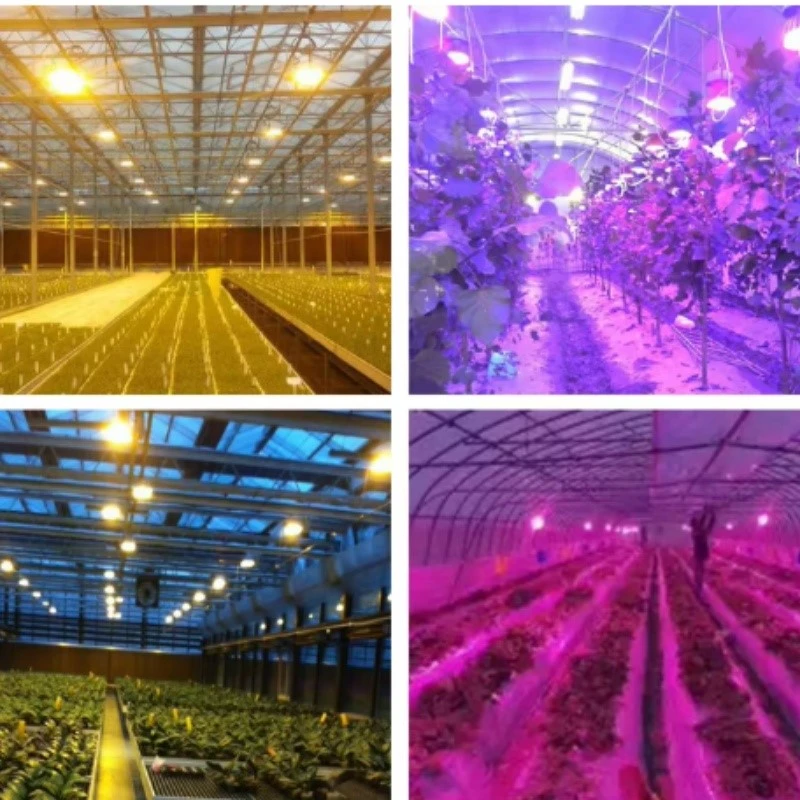
Many growers have asked us the same question: "I have a 50W supplemental grow light-how long should I keep it on each night to induce early flowering or to get plants to bloom during the off-season?"
To start with the conclusion: there is no single duration that applies to all plants. The required duration depends on whether your plants are "long-day" or "short-day" species, and whether you are using the light for "night interruption" or "day-length extension." Here is a breakdown to help you determine the right approach for your specific crops.
First, identify your plant type: Is it a long-day or short-day plant?
The "switch" that triggers flowering is actually the length of the night, not the length of the day. Plants use internal photoreceptors (phytochromes) to sense the duration of darkness, which dictates how you should apply supplemental lighting:
Long-day plants: These require a sufficiently short night to bloom (e.g., petunias, snapdragons, marigolds, and some strawberry varieties). Supplemental lighting is used to "trick" the plant into perceiving a shorter night.
Short-day plants: These require a sufficiently long night to bloom (e.g., chrysanthemums, poinsettias, and cannabis). For these, the issue is usually that the darkness is being interrupted by light, rather than a lack of light.
Day-neutral plants: These are largely unaffected by day length; adjusting the photoperiod is generally not useful, so it is better to focus your efforts on temperature and nutrition.
Before you begin, be sure to verify the photoperiodic requirements of your specific variety-this is a step you shouldn't skip.
Long-day plants: Night interruption (2–4 hours per night)
This is the most energy-efficient method and the most common way to utilize a 50W grow light.
Timing: Position the light to activate during the middle of the night-for example, from 10:00 PM to 2:00 AM. The goal is to "interrupt" the period of darkness, so the timing is more critical than the total duration.
Duration: A common practice is to run the light for 2–4 hours each night. Many growers start with 4 hours and then adjust (reduce) the duration based on the observed results.
Cyclical Supplemental Lighting: To save more electricity, you can set the lights to a cycle-for example, "on for 6 minutes, off for 24 minutes." This significantly reduces the total duration the lights are on while achieving an effect similar to continuous illumination. This requires a timer with a cycle function.
Duration: Supplemental lighting generally needs to be applied for several weeks-until flower bud differentiation is stable-rather than just for a night or two.
Long-Day Plants: Extend the photoperiod to a total of 14–16 hours of light.
Another approach is to supplement natural daylight by extending it into the evening or starting it earlier in the morning.
Method: Use artificial lighting to bring the total duration (natural daylight + supplemental light) to 14–16 hours. For instance, if natural daylight in winter is only 9 hours, you would need to provide 5–7 hours of supplemental light daily.
Pros: It provides photosynthetically active radiation (PAR), which also supports overall plant growth.
Cons: The lights remain on for much longer than with the "night-interruption" method, resulting in higher electricity costs.
Best for: Plants that have already entered their growth phase and require both vegetative growth and flowering stimulation.
If your sole objective is to trigger flowering, the "night-interruption" method is the more cost-effective choice.
Short-Day Plants: Focus on "Ensuring Darkness" Rather Than Adding Light
Many people get this backward. For short-day plants-such as chrysanthemums or poinsettias-turning on lights at night will actually inhibit flowering.
To induce flowering: Ensure the plants receive about 10–12 hours of continuous darkness daily (the exact duration depends on the specific variety). Use blackout cloth to completely block any light leaks.
To prevent flowering: If you want to focus on vegetative growth (letting the plant mature further), you can provide a period of supplemental light during the night to keep the plant in a vegetative state.
The Role of a 50W Light: For short-day plants, such a light is primarily used to "delay flowering" rather than "trigger" it. To induce earlier flowering, you should instead use shading to shorten the daily light exposure.
Therefore, if you are growing short-day plants, the question shouldn't be "how many hours should the lights be on," but rather "is the period of darkness sufficiently continuous?"
Don't Overlook Light Intensity and Coverage Area for 50W Lamps
Timing is key, but it's useless if the light is too weak.
For "night interruption" (interrupting the dark period), high light intensity isn't required. Generally, an intensity of about 100 lux (roughly equivalent to a photon flux density in the low tens of μmol/m²/s) at the plant canopy level is sufficient-far less than what is needed for photosynthetic supplemental lighting.
A 50W lamp has a limited coverage area. Hanging a single lamp higher increases the illuminated area, but the light intensity at the canopy level will decrease. It is recommended to take actual measurements at the canopy level using a light meter or a smartphone light-meter app.
For larger areas, use multiple lamps: don't try to force one lamp to cover several square meters. It is better to use several lamps spaced evenly to ensure consistent results-you don't want a situation where some plants are successfully affected by the light interruption while others are not.
If you are using the "day-length extension" method (extending the photoperiod), higher light intensity is required. Consequently, the effective coverage area for a 50W lamp will be much smaller than it would be for night interruption; keep this in mind when planning your setup.
Choosing the Right Spectrum and Timer
Spectrum: Red light (approximately 660nm) is most effective for stimulating phytochromes. LED lights with a high proportion of red light, or "warm white" lights, are suitable for night interruption. Pure blue light is less effective.
Timer: Use a timer that allows for minute-by-minute precision-ideally one that supports recurring (cyclic) schedules. Relying on manual switching is prone to error, and even a slight deviation in timing can compromise the results.
Manage Light Spillage: When using night interruption, ensure the light doesn't reach plants you *don't* want to affect. Keep the photoperiods for different plant zones separate.
Summary
Long-day plants: Use night interruption for 2–4 hours each night, centered around midnight; this is both energy-efficient and effective.
For simultaneous growth promotion: Use day-length extension to achieve a total photoperiod of 14–16 hours, though this will consume more electricity.
Short-day plants: The priority is ensuring a continuous period of darkness. Supplemental lighting should only be used to delay flowering, not to trigger it. Whether a 50W grow light will be effective depends on the light intensity at the canopy level and the area covered. We recommend conducting a test run first before determining the optimal number of lights and their mounting height.
Choose a spectrum that includes red light, and ensure your timer is precise and supports a recurring (cycle) schedule.
The ideal duration can vary based on the plant variety and temperature conditions. When using these lights for the first time, we suggest testing them on a small batch of plants before scaling up to the entire growing area.
Looking for the right supplemental grow light for your setup?
We offer LED grow lights in 50W and various other power ratings, with customizable spectrums and timer settings tailored to your specific crop type, growing area, and mounting height. Simply share your plant variety, growing area, and location with us; our technical team will provide a free recommendation for the most suitable model and lighting configuration, along with a price quote and samples. Feel free to leave a message or send us an inquiry.
https://www.benweilight.com/lighting-tube-bulb/led-gym-stadium-light-1500-2500w.html