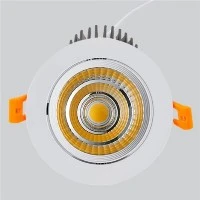
COB downlights can indeed be used in high-temperature environments, but "can be used" and "perform well" are two different matters. This article aims to clarify exactly what happens to COB light sources at high temperatures, how manufacturers typically address these issues, and what details to consider when selecting a product. If you are choosing downlights for kitchens, saunas, industrial plants, or outdoor areas with high temperatures, this information should help you avoid common pitfalls.
Heat Generation Principles of COB Light Sources
COB (Chip on Board) technology involves packaging multiple LED chips directly onto a single substrate to create an integrated light source. While this structure offers the advantages of a large light-emitting area and uniform light distribution, it has a distinct drawback: heat is concentrated on a small substrate rather than being dissipated across a distributed array, as is the case with discrete LEDs.
Simply put, COB chips generate "junction temperature" during operation; the higher this temperature, the faster the light output degrades and the shorter the lifespan becomes. The industry often relies on LM-80 and TM-21 test data to predict LED lumen depreciation curves at various temperatures. This explains why many COB downlight specifications include conditions such as "50,000-hour lifespan at an ambient temperature (Ta) of ≤25°C"-temperature is a critical variable.
Issues Caused by High-Temperature Environments
If downlights are exposed to high temperatures for extended periods (such as in un-air-conditioned warehouses during summer, near kitchen stoves, or inside saunas), three main types of problems typically arise:
Accelerated Lumen Depreciation: Elevated junction temperatures cause luminous flux to drop faster than the rated specifications, leading to a noticeable dimming effect over time.
Color Temperature Shift: Some COB light sources exhibit slight color shifts at high temperatures; this is particularly noticeable in products with lower Color Rendering Index (CRI) ratings.
Driver Power Supply Aging: While many people focus solely on the LED chips themselves, the electrolytic capacitors within the driver power supply are actually more sensitive to heat. High temperatures significantly increase the risk of capacitor bulging or failure, which is often the real reason for a downlight's "premature retirement."
Common Heat Dissipation and Protection Designs Used by Manufacturers
Reputable manufacturers typically address high-temperature conditions in COB downlight designs through the following methods:
Aluminum alloy heat sinks: Rapidly dissipating heat by increasing the heat sink's surface area and optimizing fin structure; this is the most fundamental and effective approach.
Thermal grease/thermal pads: Filling microscopic gaps between the COB substrate and the heat sink to reduce contact thermal resistance; this detail is easily overlooked but significantly impacts heat dissipation performance.
Driver isolation design: Some products feature a driver installed separately from the light body, or utilize high-temperature-rated capacitors (such as electrolytic capacitors rated for 105°C or even 125°C) specifically selected for high-temperature environments.
IP-rated protection: For areas that are both hot and humid-such as kitchens and bathrooms-moisture and dust protection ratings of IP44 or higher are required; high-temperature resistance alone is insufficient.
Suitable and Cautionary Scenarios for COB Downlights
From a practical application perspective:
Suitable: General commercial lighting, offices, kitchens with adequate ventilation, and industrial facility ceilings (provided they are not directly above a heat source). In these scenarios, mainstream COB downlights with proper heat dissipation designs generally perform well.
Requires careful assessment: Locations subject to sustained high temperatures (ambient temperatures frequently exceeding 50–60°C), such as saunas, drying workshops, or areas directly above stovetops. You should explicitly ask the supplier about the product's rated operating temperature range; do not assume all COB downlights can withstand such conditions.
Key Questions to Ask Suppliers When Purchasing
If your application involves high temperatures, it is advisable to clarify the following points during your inquiry:
What is the product's rated ambient operating temperature (Ta) range?
Is there a third-party LM-80/TM-21 test report available?
What is the temperature rating of the electrolytic capacitors used in the driver?
Can specifications regarding the heat sink material and thickness be provided?
Asking these questions helps filter out suppliers who merely claim "high quality and long lifespan" but cannot provide concrete data.
Conclusion
The inherent structure of COB downlights imposes stricter heat dissipation requirements compared to traditional lighting fixtures; however, this does not mean they are unsuitable for high-temperature environments. Success depends on whether the product design incorporates targeted heat dissipation optimizations and appropriate component selection. For environments characterized by sustained high temperatures or a combination of high heat and humidity, we recommend looking beyond aesthetics and price-instead, base your decision on specific temperature parameters and test data.
If you are selecting COB downlights for a specific project and are unsure about suitability for the environment, please share the application details with us (including temperature range, installation location, and moisture protection requirements). We can recommend suitable heat dissipation solutions and product models based on actual operating conditions and provide relevant test reports for your reference.
https://www.benweilight.com/lighting-tube-bulb/recessed-cob-led-downlight.html