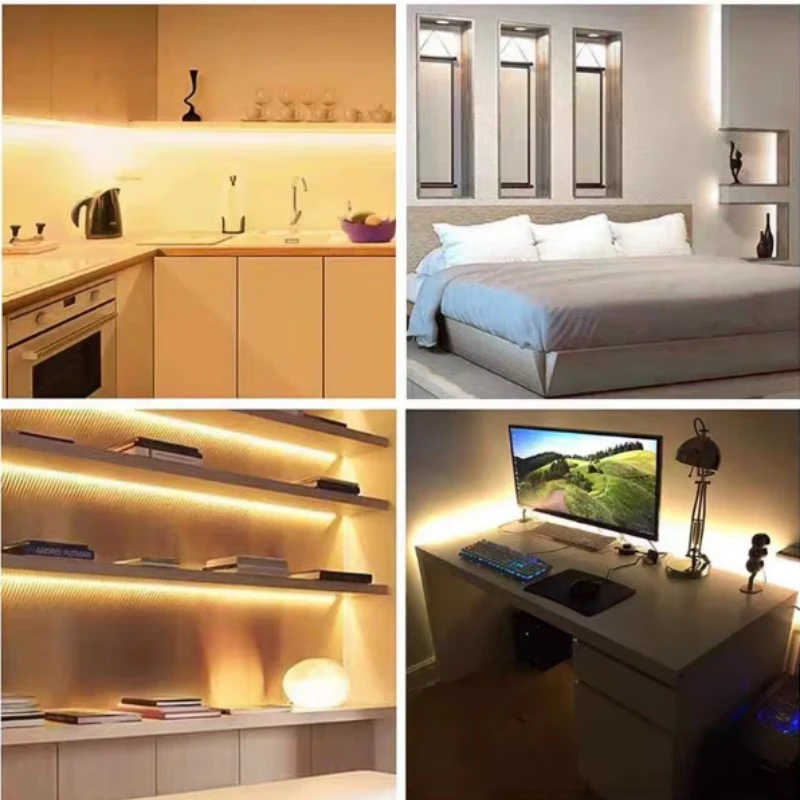

When purchasing LED strip lights, many customers frequently ask: Can these be installed behind a TV? Will they get too hot under a bed? Are they safe to use on stairs where people walk over them?
The short answer is: Yes, they can be used in all three scenarios, but each requires different considerations. When the right product is chosen and installed correctly, LED strip lights are perfectly safe; however, choosing the wrong product or installing it improperly can lead to premature failure or, in more serious cases, safety hazards. Let's look at each scenario in detail.
Behind the TV: Key Considerations for Ambient Lighting
Installing LED strips behind a TV-often referred to as "backlighting" or "bias lighting"-is one of the most common home applications. It is inherently safe, as these strips operate at a low voltage and generate minimal heat. Keep the following points in mind:
Opt for 5V USB-powered strips: These can be plugged directly into a TV's USB port, allowing the lights to turn on and off in sync with the TV. This eliminates the need for a separate power adapter and removes an additional heat source.
Choose a color temperature of around 6500K: This aligns closely with the standard white point used for TV displays, providing a more natural viewing experience. Warm white or light with a distinct color tint can interfere with your perception of the colors on the screen.
Avoid blocking the TV's ventilation vents: While the LED strips themselves don't generate much heat, placing them in the wrong spot could obstruct the air vents on the back of the TV. It is generally safest to apply the strips along the inner edge of the TV's back panel.
Clean the surface before application: The back of a TV often collects dust; if the adhesive backing doesn't stick properly, the strips may fall off after a few months. Wiping the surface with alcohol before application ensures a much more secure hold.
Do not force sharp 90-degree bends: Standard LED strips cannot be folded at a 90-degree angle, as this can damage the internal circuitry. When you reach a corner, either cut the strip at the designated cutting points and use a connector, or opt for a flexible, bendable version.
Under the Bed: Safety Considerations for Nighttime Lighting
Installing LED strips under the bed provides illumination for nighttime movement without being overly bright or glaring. The primary concerns here are not heat, but rather physical pressure, moisture, and accidental contact.
Opt for motion-sensor activation: The lights should turn on automatically when someone approaches the bed and switch off when they move away. This is both practical and limits the duration the lights remain powered on.
Avoid high-pressure areas on the bed frame: Ensure the LED strips are not placed where they might be crushed or pinched-such as near crossbeams, drawer slides, or storage bins that are frequently moved. Pressure can cause the wiring to break or the insulation to wear away.
Secure the wiring: Do not leave power cords trailing loosely under the bed. Use cable clips or cord management channels to keep them fixed in place, preventing them from being snagged by feet or chewed on by pets.
Keep power adapters away from mattresses and bedding: Adapters must be placed in a well-ventilated area where they will not be covered-for example, near a bed leg close to a wall outlet.
For households with children, prioritize low-voltage options: 12V or 24V LED strips are safer than those connected directly to mains voltage. Additionally, any exposed solder joints should be covered with silicone or heat-shrink tubing.
Stairs: Safety Considerations for Step Lighting
Among the three scenarios, stairs place the highest demands on LED strips due to the risks of direct foot traffic, physical impact, and exposure to moisture during routine cleaning-all while serving the critical function of providing visibility to prevent slips at night.
Always use aluminum profiles: Never attach bare LED strips directly to the edges of steps. An aluminum profile equipped with a diffuser protects the strips from being crushed underfoot and ensures a uniform glow, eliminating the "dotted" appearance of individual LED beads.
Choose an IP65 (or higher) ingress protection rating: Stairs are subject to mopping, scrubbing, and occasional water spills. LED strips with a silicone coating or protective sleeve are better suited to withstand such conditions. For long runs, 24V is recommended: If there are many steps and the total length of the installation is significant, 12V LED strips may suffer from dimming at the far end (due to voltage drop); 24V systems offer much better stability in this regard.
Keep brightness moderate: The primary purpose of stair lighting is to make the edges of the steps visible; a low-brightness output-just a few watts per meter-is sufficient. Excessive brightness can cause glare, which may impair your judgment when walking down the stairs.
Ensure wiring is well-concealed: Power cables should not be left exposed on the surface of the steps. Route them inside the walls or behind the baseboards to eliminate tripping hazards.
Position strips away from foot-traffic areas: Install the strips along the underside or the side edge of the steps, rather than in the middle of the tread. This is more aesthetically pleasing and helps extend the lifespan of the lights.
Summary
In short: LED strips can be used safely in these three types of settings, provided you "choose the right specifications, install them in the correct locations, and use the appropriate power supply." Their low-voltage design inherently minimizes risk; most issues arise from poor-quality power supplies, substandard wiring, or minor oversights during installation.
Need custom solutions or bulk procurement? Get in touch with us.
If you are selecting LED strips for a home, hotel, retail space, or engineering project and are unsure which specifications are best, we can provide tailored recommendations based on your specific requirements-including voltage, ingress protection (IP) ratings, color temperature, length, and compatible power supplies. We also offer sample testing and custom development services.
Feel free to leave a message or send an inquiry detailing your intended use and requirements; our team will get back to you promptly.
https://www.benweilight.com/professional-lighting/led-strip-light/led-strip-lights-20w.html