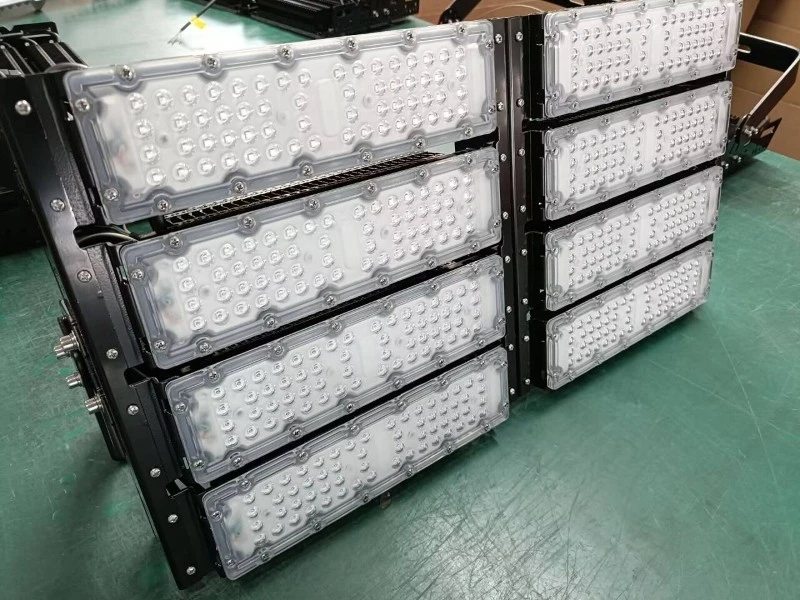
The amount of light a riding arena needs depends heavily on how the space is used, ranging from basic exercise to televised competition. There is no single "correct" lux level, but industry guidelines provide clear targets based on the activity level.
1,Recommended Lux Levels by Activity
A common benchmark for general training and safe riding is around 200 lux of even light across the arena surface. The table below breaks down specific recommendations from various lighting and equestrian sources.
| Activity / Use Case | Recommended Illuminance (Lux) | Notes / Source |
|---|---|---|
| Paddock / Turnout Checks | 30 – 50 lux | Basic visibility for checking horses. |
| Private / Recreational Riding | 100 – 150 lux | Suitable for walk, trot, and canter work. |
| Recreational Schooling (Dressage) | 100 lux | CIBSE guidance for outdoor arenas. |
| Recreational Schooling (Showjumping) | 150 lux | CIBSE guidance for outdoor arenas. |
| General Training / Dressage & Jumping | ~200 lux | A widely cited target for balanced, safe training. |
| Indoor Arena (General) | 325 – 430 lux | Measured at 5 ft (1.5 m) above the floor, per University of Kentucky extension. |
| Competition (Dressage) | 200 lux | CIBSE guidance for outdoor arenas. |
| Competition (Showjumping) | 300 lux | CIBSE guidance for outdoor arenas. |
| National Level Competition | 300 – 500 lux | Requires higher uniformity for officials and spectators. |
| Televised Competition | 750 – 1000 lux | Broadcast-quality lighting with strict uniformity. |
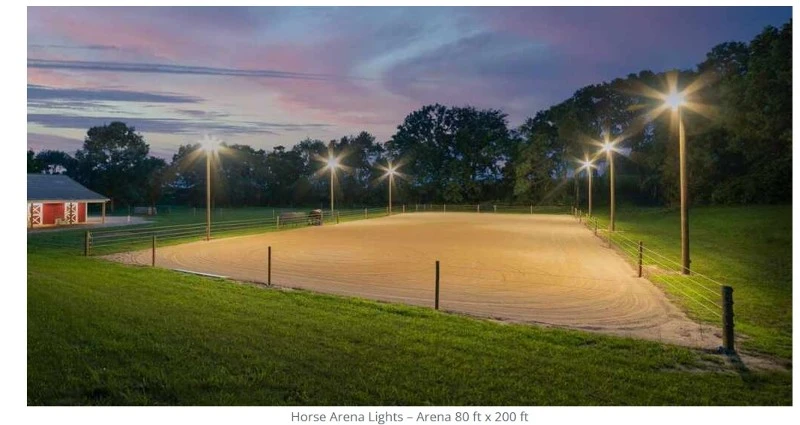
2. Key Considerations Beyond Raw Lux
Achieving the target lux number is only part of the equation. For a safe and effective riding environment, two other factors are critical:
Uniformity: Bright spots and deep shadows can distract or spook horses. Lighting should be evenly distributed across the entire arena surface. A common target is a minimum-to-average uniformity ratio (Emin/Eavg) of 0.50 for training and 0.60 for competition.
Indoor vs. Outdoor: Indoor arenas are generally easier to light evenly because fixtures can be mounted overhead. Outdoor arenas require more strategic pole placement (typically at the corners) to ensure light reaches all areas from multiple directions and to minimize glare.
Glare control is critical - horses and riders are sensitive to glare.
Color temperature is usually preferred around 4000–5000K (neutral to cool white).
Vertical illuminance also matters for jumping (so horses can clearly see the top of obstacles) , you can see more riding arena lighting on https://www.benweilight.com/industrial-lighting/led-stadium-light/led-stadium-light-1000w-180lm-w.html