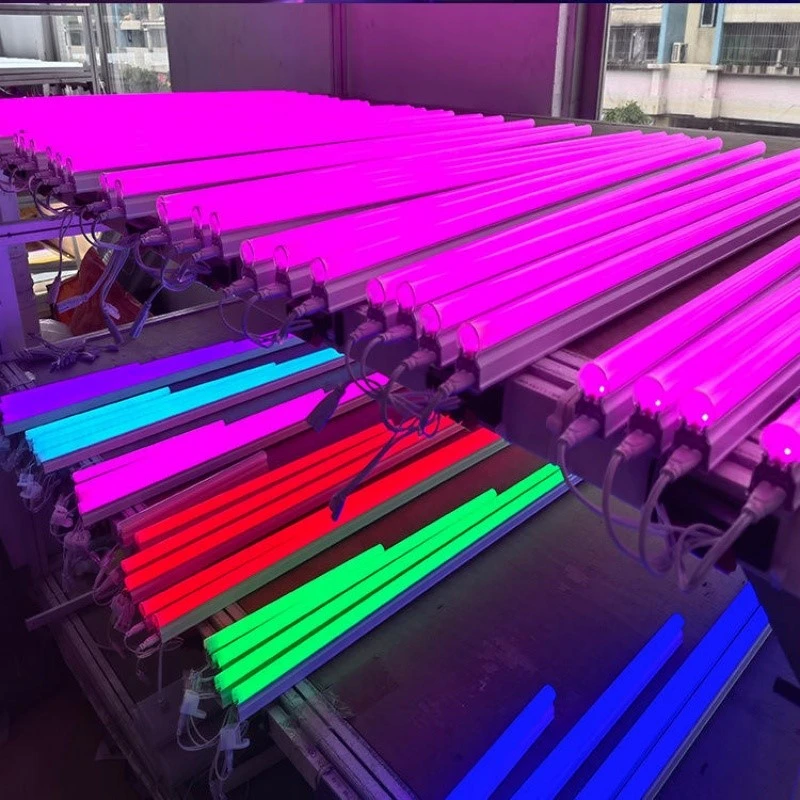
If you are selecting ambient lighting for a bar, a car wash, or an outdoor sign, you will likely come across RGBW light strips. Capable of producing both vibrant colors and clean white light, they appear highly versatile-but "versatile" does not mean "suitable for every situation." Different environments have distinct requirements regarding waterproofing, brightness, and installation methods; choosing the wrong product can lead to subpar visual effects or the need for costly rework shortly after installation.
Below, we examine these three types of settings to determine whether RGBW light strips are the right choice and highlight the key details to look for when making your selection.
How do RGBW light strips differ from standard RGB strips?
Standard RGB strips create various colors by mixing red, green, and blue light. The issue is that the "white light" produced by combining these three colors often appears cold or tinted; when cast onto a wall or a light-colored object, it is immediately apparent that the white is not pure.
RGBW strips add a dedicated white LED chip alongside the red, green, and blue ones. When white light is required, the system uses the white channel, resulting in a cleaner, more natural-looking white. When colored light is needed, the white channel can also be used to adjust saturation and brightness-ensuring that pastel shades, such as pink or light blue, do not appear dull or grayish.
Therefore, for any space that requires both colorful ambient effects and occasional functional white lighting, RGBW strips are a better choice than standard RGB strips. The three scenarios discussed below all fall into this category.
Use in bars: Balancing ambiance with white light
Bars are among the most common settings for RGBW light strips, for several practical reasons:
Seamless scene transitions: You can use warm or cool white light during the day or while cleaning after hours, then switch to purple, blue, red, or other atmospheric colors when the bar is open-all with a single lighting system.
Ideal for linear decoration: The strip format allows for installation along the edges of a bar counter, behind liquor displays, along ceiling contours, or on the sides of staircases. They provide uniform light distribution, avoiding the "spotting" effect often seen with point-source lighting.
Dynamic control: When paired with a DMX controller or other control systems, the lights can perform smooth fades, sharp color jumps, or even pulse in sync with the rhythm of the music.
Keep these two points in mind when making your selection. First, ensure the brightness is not too high; since bar environments are typically dim, overly bright light tubes can be glaring-models that support dimming are a better choice. Second, high ingress protection (IP) ratings are generally unnecessary for indoor settings; an IP rating between IP20 and IP44 is usually sufficient, so there is no need to overspend on higher-rated products.
Use in Car Washes: Waterproofing and Corrosion Resistance Are Key
Car washes and bars are vastly different environments. Whether RGBW light tubes can be used in a car wash depends primarily on the adequacy of their protective features.
Sufficient waterproof rating: Car wash areas involve high-pressure water spray, mist, and standing water. An IP65 rating or higher is recommended, with IP67 preferred for areas near the spraying equipment.
Corrosion-resistant materials: Car wash detergents, foam, and humid air can corrode housings and connectors. Fixtures with PC or silicone housings and well-sealed connectors are more reliable; any metal components must be treated to prevent rust.
Functional color-coding: Colors can be used to designate specific zones-for example, green for the entrance, yellow for the waiting area, and red for active washing. This creates a visual impact while providing intuitive guidance for vehicle owners. White light is ideal for tasks like inspecting paintwork or performing final wipe-downs, as it provides clear, bright illumination.
It is important to note that power connectors and controllers in a car wash must also be waterproofed. Even if the light tube itself is waterproof, water ingress at the connection points will still lead to failure.
Use in Outdoor Signage: Brightness, Protection, and Weather Resistance
Outdoor signage places the most comprehensive demands on lighting equipment. While RGBW light tubes can be used, they must meet the highest standards.
High brightness: Under direct sunlight, low-brightness light tubes are barely visible. Signage requires tubes with higher lumen output, ensuring that colors remain distinct even from a distance.
Minimum IP65 rating: Exposure to rain and dust is standard. In coastal or high-rainfall regions, a higher rating is advised; additionally, ensure that both ends of the light tube and the cable entry points are properly sealed.
UV resistance and temperature tolerance: Prolonged sun exposure can cause standard plastic housings to yellow and become brittle, which impairs light transmission. Choose housings with UV-resistant treatment and verify the operating temperature range-the equipment must be capable of stable performance in both high summer temperatures and low winter temperatures. Dynamic effects enhance visibility. By using RGBW lighting for outlines or the edges of lettering, you can create effects like "flowing" light or a "breathing" (pulsing) glow-far more eye-catching at night than static, single-color lighting.
General Checklist for Purchasing RGBW LED Strips/Tubes
Regardless of the application, it is worth verifying the following specifications before placing an order:
Ingress Protection (IP) Rating: Ensure it matches the specific environment; do not rely solely on promotional materials.
Operating Voltage: Common options include 12V and 24V. For long-distance installations, 24V is preferable as it results in less voltage drop and more uniform brightness.
Control Method: Check for compatibility with protocols such as DMX512, SPI, or others used by your existing control system.
LED Type and White Light Color Temperature: Ensure the white light channel (warm white, natural white, or cool white) aligns with the overall aesthetic of the space.
Length and Cutability: Confirm whether custom lengths are available and if the design allows for minimizing connection points during installation.
Heat Dissipation and Lifespan: For installations requiring long hours of operation, the thermal design directly impacts the rate of light degradation (lumen depreciation).
Conclusion
Returning to the initial question: RGBW LED strips/tubes are suitable for bars, car washes, and outdoor signage-provided you select the right type for the specific application. Bars prioritize ambiance and dimming capabilities; car washes require superior waterproofing and corrosion resistance; and outdoor signage demands high brightness, robust protection, and UV resistance. While all three settings use the same core light source technology, the specific requirements for IP ratings, materials, and brightness parameters differ.
Need selection advice or a quote?
If you are planning a lighting project for a bar, car wash, or outdoor signage, please let us know the installation environment, required length, and preferred control method. Our team will recommend the most suitable RGBW LED products for your specific needs and provide samples and a formal quote. Simply reach out via the contact information on this page to submit your inquiry, and we will get back to you promptly.