Do Explosion‑Proof Lights Really "Prevent Explosions"? No, They Just Silently Avert a Catastrophe
Many people, when they first hear the term "explosion‑proof light," picture a lamp as tough as tank armour-one that won't shatter no matter how hard you hit it. So they assume it "prevents itself from exploding."
That is completely wrong.
If an explosion‑proof light were merely "self‑proof," it would be nothing more than a particularly sturdy bulb. But its real mission is far more profound and delicate: the fundamental job of an explosion‑proof light is to prevent itself from becoming the ignition source for a much larger explosion. It doesn't protect itself; it protects the entire chemical plant, the fuel station, the coal mine gallery-every life and every asset in the surrounding area.
To put it dramatically: if an explosion‑proof light ever "fails" in its duty, it will probably remain intact-but everything around it could be reduced to rubble.
So what "magic" makes this possible? The answer lies in two completely different design philosophies.

Chapter 1: Two Philosophies, One Common Goal
In hazardous locations such as petrochemical plants, fuel stations, coal mines, paint booths, and even flour mills (yes, flour dust can explode), the air is often laden with flammable gases, vapours, or combustible dusts. An ordinary lamp can produce electrical sparks when switched on or off, and its surface temperature may reach 150–200 °C during normal operation. In an ordinary office, that might only cause a minor burn, but in the environments just described, a single spark is like pressing the detonator.
The sole purpose of an explosion‑proof light is to permanently disable that detonator. How? Engineers have followed two radically different paths:
-
Route 1: Flameproof Enclosure (Ex d) – "I allow internal explosions, but I never let the flame out"
This is probably the "toughest" design philosophy in the explosion‑protection field. Its logic is: Since we cannot guarantee that sparks will never occur inside the lamp (e.g., from a burnt‑out bulb or loose wiring that produces an arc), we build a rugged "prison" that contains any internal explosion and prevents flame from escaping.
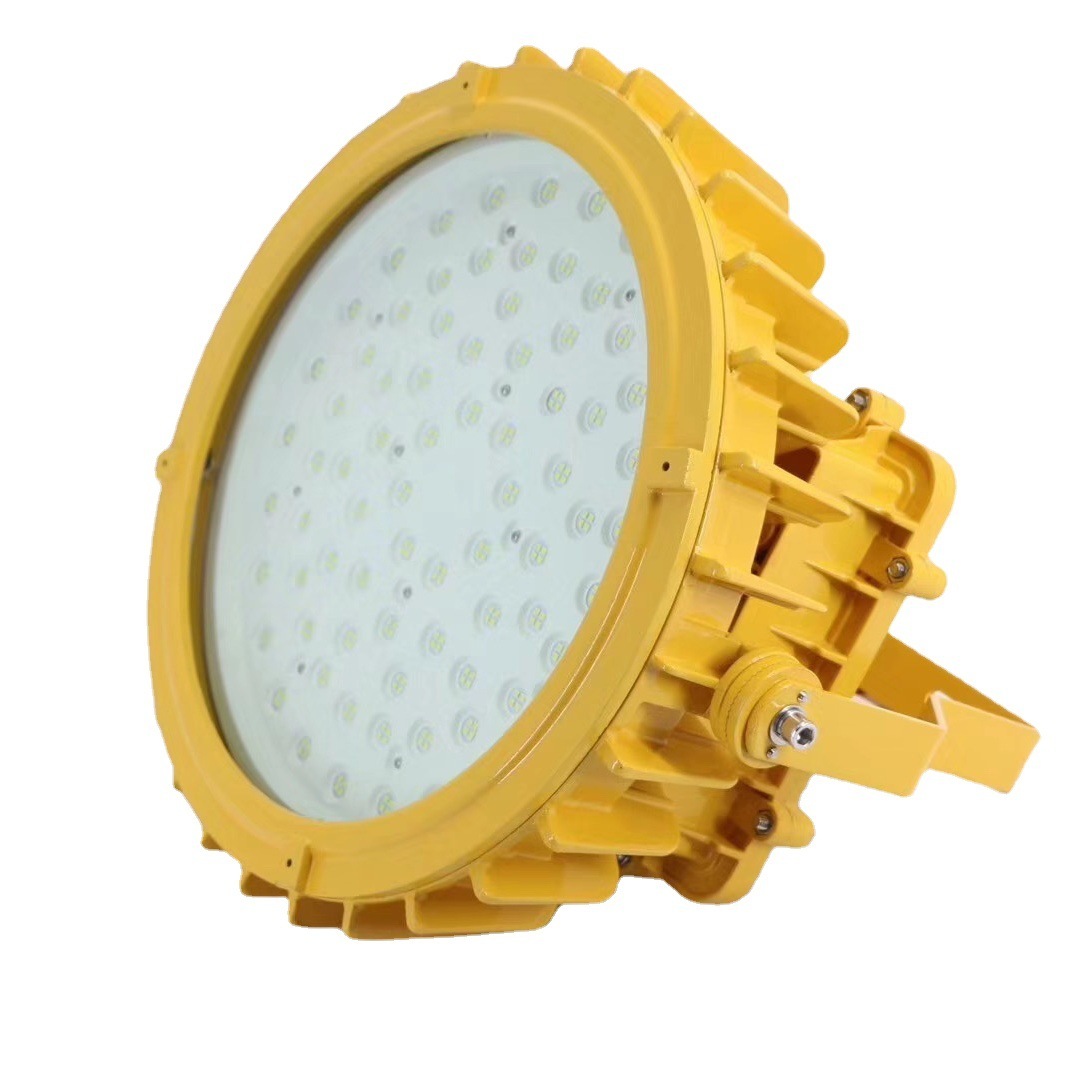
This "prison" is made of high‑strength die‑cast aluminium alloy or stainless steel, with wall thickness far exceeding that of ordinary luminaires. It can withstand internal explosion pressures of several megapascals without deforming or cracking. But thickness alone is not enough-the real technical secret lies in the joint surfaces of the enclosure.
If you disassemble a flameproof (Ex d) lamp, you will find that the joint between the cover and the housing, as well as that between the terminal box and its lid, are precision‑machined mating surfaces. These surfaces are not completely sealed; they leave a carefully calculated gap length and gap width (typically in millimetres, precisely engineered). When an internal explosion generates flames at temperatures up to 1000 °C and high‑pressure gases that try to escape through these gaps, the flame passes through a long, narrow, and tortuous path. During this passage, it exchanges heat intensely with the cold metal walls, cooling down to a temperature below the ignition point of the external flammable atmosphere-the flame is "quenched." At the same time, the high pressure is significantly reduced upon release, so it cannot trigger an external explosion.
This is the famous "quenching gap principle." A flameproof (Ex d) lamp does not avoid internal explosions-it simply makes them undetectable to the outside world.
-
Route 2: Increased Safety (Ex e) – "I never allow sparks or high temperatures to occur"
Compared with the "hard‑hitting" approach of flameproof enclosures, the increased‑safety design takes a gentler defensive line. Its logic is straightforward: Since sparks and high temperatures are the root cause, we eliminate them entirely at the design stage.
An increased‑safety (Ex e) lamp does not produce any arcs, sparks, or dangerous overheating during normal operation. How is this achieved? First, all electrical connections use special terminals with enlarged creepage distances and clearance distances, ensuring that even minor overvoltages do not cause sparking across air gaps. Second, all live parts are encapsulated in reinforced insulation. Most critically, the thermal design is exceptionally refined-large cooling fins and high‑thermal‑conductivity materials are used to ensure that the maximum surface temperature at any point remains safely below the ignition temperature of the corresponding gas or dust (for example, T6 rating requires ≤85 °C).
Increased‑safety lamps do not need heavy flameproof enclosures, so they are lighter and more economical. They are suitable for less hazardous Zone 2 areas (we will explain zone classifications shortly). However, they have one critical limitation: no internal fault is allowed to occur-if a short circuit or severe overload happens, the increased‑safety design loses its protective capability. Therefore, they must be used in conjunction with appropriate protection devices, such as fuses.
-
Route 3: Intrinsic Safety (Ex ia/ib) – "I reduce the energy so low that even a spark cannot ignite anything"
This is arguably the most "elegant" approach in electrical explosion protection. Intrinsically safe (Ex) designs do not contain explosions, nor do they eliminate sparks altogether. Instead, they limit the electrical energy (voltage, current, and power) to such a low level that even if any short circuit or open circuit occurs, the resulting spark energy is below the minimum ignition energy of the atmosphere.
In other words, if such a spark can even be called a spark, it is too weak to ignite even the most sensitive flammable gas. Intrinsically safe devices are usually small, lightweight, and can be used in Zone 0 (the most hazardous zone). However, their power output is limited, so they are generally used for sensors, instruments, and communication equipment-not for high‑power lighting. That said, recent advances in low‑power LED technology are gradually making intrinsically safe luminaires more feasible.
-
Route 4: Pressurised (Ex p) – "I keep hazardous gases out"
This type of protection is like wrapping the lamp in an "iron‑vest." The enclosure is purged with a protective gas (e.g., clean air or inert gas) to maintain an internal pressure higher than the external atmosphere. As a result, external flammable gases simply cannot enter. If the internal pressure drops, the power supply is automatically cut off. Pressurised enclosures are suitable for large control cabinets or high‑power luminaires, but they require auxiliary gas supplies and monitoring systems, making them relatively complex.
-
Route 5: Sand‑Filled (Ex q) and Encapsulated (Ex m)
These two are less common but quite interesting. In a sand‑filled (Ex q) design, the enclosure is filled with quartz sand or glass beads that completely bury all live parts-even if a spark occurs, the sand isolates it from oxygen. In an encapsulated (Ex m) design, the entire circuit is cast into a solid block with epoxy resin or similar insulating material, sealing it off completely from the outside environment. Both are used for special small luminaires or components.
Chapter 2: The Mysterious String of Characters – Decoding the Explosion‑Proof Marking
If you look at a genuine explosion‑proof lamp, you will see a combination of letters and numbers on the nameplate, such as "Ex d II C T6 Gb." This is not a manufacturer's product code-it is an internationally recognised safety passport. Let us break it down:
| Symbol | Meaning | Example Interpretation |
|---|---|---|
| Ex | Explosion‑proof equipment mark (IEC standard) | Mandatory prefix |
| d / e / ia / p / q / m | Type of protection | d = flameproof, e = increased safety, ia = intrinsic safety (Zone 0 capable), ib = intrinsic safety (Zone 1) |
| II | Equipment group | II = non‑mining (industrial); I = underground coal mining |
| A/B/C | Gas group | A (propane) = least sensitive, B (ethylene) = medium, C (hydrogen/acetylene) = most easily ignited – Group C demands the highest level of protection |
| T1~T6 | Temperature class | T6 ≤85 °C, T5 ≤100 °C, …, T1 ≤450 °C. The higher the number, the lower the allowable surface temperature, hence safer |
| Gb / Da | Equipment protection level (EPL) | Gb = suitable for Zone 1 (gas); Da = suitable for Zone 20 (dust) |
For example: Ex e II C T6 means this is an increased‑safety industrial lamp suitable for hydrogen/acetylene environments, with a maximum surface temperature not exceeding 85 °C-that is top‑tier safety.
Chapter 3: Zone 0, Zone 1, Zone 2 – How Are Hazardous Areas Classified?
Many users become confused when they first encounter the terms "Zone 0", "Zone 1", and "Zone 2". Here is a simple explanation:
- Zone 0: Flammable gases or vapours are continuously present or present for long periods (e.g., the space above the liquid level inside a storage tank). Extremely hazardous-only intrinsically safe (Ex ia) or specially approved equipment may be used.
- Zone 1: Flammable atmospheres are likely to occur occasionally during normal operation (e.g., near a filling point). Permitted types include flameproof (Ex d), increased safety (Ex e) with suitable protection, and intrinsic safety (Ex ib).
- Zone 2: Flammable atmospheres are not likely to occur in normal operation, and if they do, they persist only for a short time (e.g., an occasional leak from a pipe flange). Increased safety (Ex e), type‑n (non‑sparking), and other types are acceptable.
Choosing the wrong zone classification is equivalent to treating an explosion‑proof lamp as an ordinary one-with potentially catastrophic consequences. In reality, many accidents have occurred because someone "assumed" they were in Zone 2, used an increased‑safety lamp, and then an unexpected leak happened. That is why experienced engineers often add a safety margin-for example, preferring flameproof (Ex d) in Zone 1 even though it is heavier and more expensive.
Chapter 4: Explosion‑Proof ≠ Waterproof/Dustproof – A Common and Fatal Misconception
Many people confuse "explosion‑proof" with the ingress protection (IP) rating (e.g., IP65). Even some salespeople may blur the distinction. But the truth is: the IP rating only addresses the ingress of solid objects and water; it has absolutely nothing to do with explosion protection. An IP68‑rated lamp can be submerged, but if it does not meet Ex standards, it can still ignite the entire chemical plant.
Conversely, an explosion‑proof lamp may have an IP rating of only IP54 (dust‑protected and splash‑proof), yet it can be perfectly safe in a hazardous area. The two are independent technical indicators-both must be satisfied simultaneously if the lamp is to be used in wet or outdoor hazardous locations. Therefore, when selecting a product, you must verify both the Ex marking and the IP rating-never omit either.
Chapter 5: Major Incidents That Explosion‑Proof Lights Helped Prevent (or Could Have Prevented)
You may not know that in many major industrial explosion disasters, the initial ignition point was often an inconspicuous lighting fixture.
In the 1980s, at a European oil refinery, a maintenance crew used an ordinary extension cable and a standard work light inside a storage tank area that was being cleaned. The moment the worker switched it on, the electrical spark ignited residual oil vapour, triggering a chain of explosions that caused multiple casualties. The subsequent investigation concluded that if an explosion‑proof light (even an increased‑safety type) had been used, the tragedy could have been completely avoided.
Closer to home, a flour mill in China experienced a dust explosion-flour dust suspended in the air at a certain concentration met the hot surface (about 180 °C) of an ordinary lighting fixture and instantly deflagrated. Dust explosions can be as devastating as gas explosions. The very first corrective action ordered after the incident was: replace all luminaires throughout the workshop with dust‑explosion‑proof types (Ex tD).
These cases are not alarmist stories; they repeatedly prove a fundamental rule: in hazardous environments, lighting is not a question of "brightness" but of "survival."
Chapter 6: The LED Era – Explosion‑Proof Lights Get Smarter
Traditional explosion‑proof lights mostly used fluorescent or high‑pressure sodium lamps. They generated a great deal of heat, consumed substantial energy, and contained fragile glass tubes and mercury pollution. The widespread adoption of LED technology has completely transformed the landscape of explosion‑proof lighting. LEDs are solid‑state light sources-no filaments, no fragile bulbs, and high impact resistance. More importantly, LEDs have excellent luminous efficacy and much lower surface temperatures than traditional sources. This makes increased‑safety (Ex e) designs far more reliable, and even opens the door for intrinsically safe (Ex ia) high‑power lighting.
Moreover, smart explosion‑proof lights are emerging-by integrating temperature sensors and gas detectors, they can not only illuminate but also monitor environmental anomalies and provide early warnings. In the future, explosion‑proof lights may no longer be passive metal enclosures but active intelligent safety nodes.
Conclusion: Explosion Protection Is an Art of Delicate Compromise
Looking back, the so‑called "explosion‑proof" nature of an explosion‑proof light is never about making itself "indestructible"-that would be clumsy. The real intelligence lies in one of the following: either it quenches the flame through precisely engineered gaps (flameproof), or it eliminates the risk of ignition through rigorous thermal management (increased safety), or it reduces spark energy to a harmless level (intrinsic safety).
Each type of protection is the result of a careful trade‑off among safety, cost, weight, and longevity. It does not aim for absolute invulnerability; it aims for failure without disaster-and that is the most mature and rational attitude in industrial safety.
 If you are looking for a reliable lighting solution for chemical plants, fuel stations, pharmaceutical workshops, paint lines, or any other hazardous area, do not let "selection" become a safety risk. We offer a full range of Ex d, Ex e, and Ex ia luminaires, together with free on‑site surveys, zone classification assessments, and customised photometric designs. Leave us an enquiry-you will be trading a few minutes of your time for the safety of an entire facility. Every quote you request, we treat as a responsibility. Click to contact us, and let safety have no blind spots.