Effects of LED Light Combinations on Growth and Postharvest Stability of Barley Grass in Plant Factories
This study investigated how different LED light combinations affect the germination, growth, photosynthetic efficiency, and postharvest quality of barley grass (Hordeum vulgare L.) grown in a closed plant factory system, and evaluated the role of packaging methods in preserving postharvest stability. The research aimed to identify optimal lighting and packaging strategies for stable year-round production and extended shelf life of barley grass. The experiment was conducted in a controlled plant factory with a constant environment of 23±1 °C, 60±10% relative humidity, and a 12-hour light/12-hour dark photoperiod.
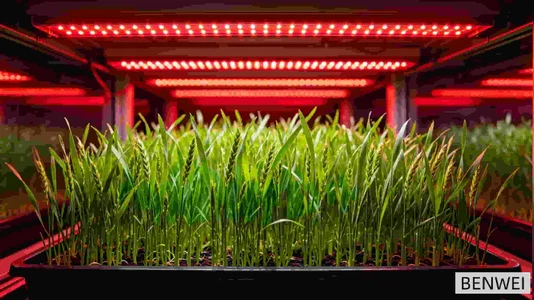
Five LED light treatments were tested: 100% red (R10), 100% blue (B10), and three red-blue mixed spectra (R7B3, R5B5, R3B7), all at a photosynthetic photon flux density of 160 μmol m⁻² s⁻¹. Barley seeds were soaked for 6 hours before sowing, and germination and growth indicators were measured for 7 days. Photosynthetic performance was assessed via the maximum quantum yield of photosystem II (Fv/Fm). For postharvest testing, harvested seedlings were stored at 8±1 °C for 14 days using three packaging methods: control, corrugated boxes, and modified atmosphere packaging (MAP) with an oxygen transmission rate (OTR) of 40,000 cc·m⁻²·day⁻¹·atm⁻¹. Weight loss and microbial counts were recorded during storage. Experimental results showed that monochromatic red LED (R10) significantly outperformed other treatments. It achieved the highest germination rate (95.3%), germination energy, and germination rate, along with the best growth performance including the tallest plant height, heaviest shoot fresh and dry weights, and longer root length.
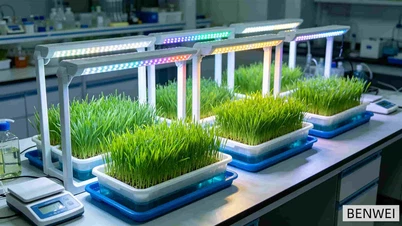
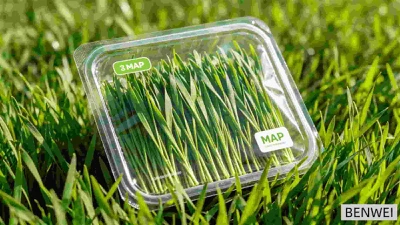
The Fv/Fm value reached 0.81 under R10, indicating the strongest photosynthetic efficiency, while blue-rich treatments (R3B7, B10) had lower Fv/Fm (0.79) and poorer growth and germination. In postharvest storage, packaging type had a far greater impact on quality and microbial safety than pre-harvest LED treatments. MAP effectively reduced fresh weight loss to 4.4–5.1%, much lower than the control (10.9–11.7%) and box packaging (7.1–7.6%). It also significantly inhibited the growth of total aerobic bacteria, coliforms, and fungi, meeting microbial safety standards for ready-to-eat foods. No significant interactive effects were found between LED treatments and packaging methods. In conclusion, monochromatic red light (R10) is the optimal lighting regime for barley grass in plant factories, promoting uniform germination, robust growth, and high photosynthetic efficiency.
For postharvest preservation, MAP with OTR 40,000 is highly effective in minimizing weight loss and microbial proliferation. Integrating R10 LED lighting during cultivation with optimized MAP storage can support stable, year-round industrial production of barley grass with extended shelf life and improved quality.
https://www.benweilight.com/lighting-tube-bulb/best-grow-lights-for-indoor-plants.html