Why Does Your Office Lighting Make Everyone Drowsy? - How RGB T8 Tunable LED Tubes Boost Efficiency and Save Energy
1. The Overlooked "Light Fatigue": Fixed Color Temperature Is the Biggest Efficiency Killer
Many offices, schools, and libraries still use traditional fluorescent tubes or fixed‑color‑temperature (e.g., 6500K cool white) LED tubes. The result? Employees feel sleepy in the afternoon, students lose concentration, and eyes become strained and tired. This is not a coincidence - it is a physiological response caused by poor lighting design.
Research shows that the human circadian rhythm is highly sensitive to light color temperature. Morning and late morning require cool white above 5000K to suppress melatonin and increase alertness. Afternoon needs a transition to neutral white around 4000K to maintain moderate focus. If working late into the evening, warm white below 3000K helps relaxation and does not disturb night‑time sleep.
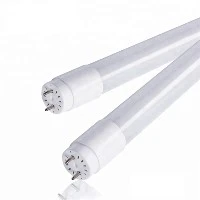
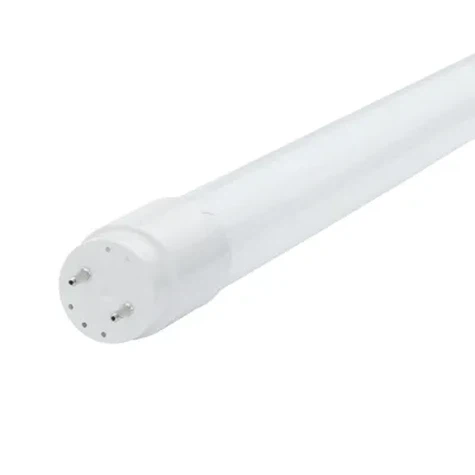
Traditional tubes cannot do this - they stay at one color temperature from morning to night, unable to match the human biological clock. The Benwei 18W RGB T8 LED tube supports stepless tunable color temperature from 2700K to 6500K. Combined with a timer controller, it can automatically simulate natural light changes, keeping staff at their best throughout the day.
2. Core Technical Parameters of the RGB T8 Tube
Taking the Benwei 18W RGB T8 LED tube as an example, its key parameters for office and educational lighting are as follows:
| Parameter | Specification | Benefit for Office/Education |
|---|---|---|
| Power | 18W | Replaces 40W fluorescent, saves 55% energy |
| Luminous efficacy | 90–100 lm/W | Total flux 1620–1800 lm, meets national illuminance standards |
| CRI (Ra) | ≥80 (≥90 optional) | High CRI reveals true colors of documents, charts, products, reduces eye strain |
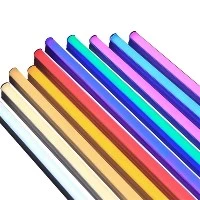
| Color temperature range | 2700K–6500K tunable + RGB full color | Matches circadian rhythm - cool white in morning, neutral in afternoon, warm in evening |
| Flicker | Flicker‑free (high‑frequency constant‑current driver) | Protects vision, reduces fatigue during long working/studying hours |
| Beam angle | 160° | Wide distribution, reduces glare, uniform illuminance |
| Power factor (PF) | 0.5 / 0.9 optional | High PF suitable for large‑scale installation, lowers line losses |
| Lifespan | 50,000 hours | At 10h/day → lasts 13.7 years, virtually maintenance‑free |
| Dimming control | RGB controller / DMX512 / timed dimming | Programmable scenes, automatic color temperature and brightness adjustment by time of day |
| Installation type | Type A+B | Direct replacement for existing fluorescent tubes, easy retrofit |
Key advantages: Flicker‑free + high CRI + tunable color temperature - three elements creating a healthy light environment. 50,000‑hour lifespan means no tube replacement for over a decade.
3. How Tunable Color Temperature Improves Work Efficiency - Scientific Basis of Circadian Rhythms
Research evidence: A study by the Lighting Research Center (LRC) at Rensselaer Polytechnic Institute found that in offices with tunable color temperature, employees' afternoon alertness scores were about 20% higher than in fixed cool‑white environments, and self‑reported fatigue dropped by 15%. An experiment at Reutlingen University in Germany found that in classrooms with dynamically adjusted color temperature (gradually reducing from 5000K to 3000K), students' attention span was about 25% longer than in fixed‑color‑temperature classrooms.
Recommended time‑based tuning schedule (offices / classrooms) :
| Time Period | Recommended CCT | Recommended Illuminance (lux) | Physiological Effect | Result |
|---|---|---|---|---|
| 08:00 – 10:00 | 5000K–6500K (cool white) | 500–750 | Suppresses melatonin, increases alertness | Rapid entry into work/study mode |
| 10:00 – 14:00 | 4500K–5000K (neutral white) | 400–600 | Maintains focus, reduces glare | Sustains high productivity |
| 14:00 – 17:00 | 4000K–4500K (neutral‑warm) | 300–500 | Gentle relaxation, fights afternoon slump | Reduces error rate, keeps steady |
| 17:00 – 19:00 (overtime) | 2700K–3000K (warm white) | 200–300 | Does not disturb night‑time melatonin | Easier to fall asleep after work |
How to achieve: Use an RGB controller or DMX512 system to set timed tasks. The system automatically switches color temperature and brightness by time of day - no manual intervention.
4. Flicker‑Free + High CRI: Hard Metrics for Eye Protection
The harm of flicker: Traditional fluorescent tubes and some low‑quality LED tubes have visible or invisible flicker (100Hz–400Hz). Long‑term exposure to flickering light can cause:
- Eye strain, headaches, lack of concentration
- Increased myopia rates among students
- Decreased work efficiency
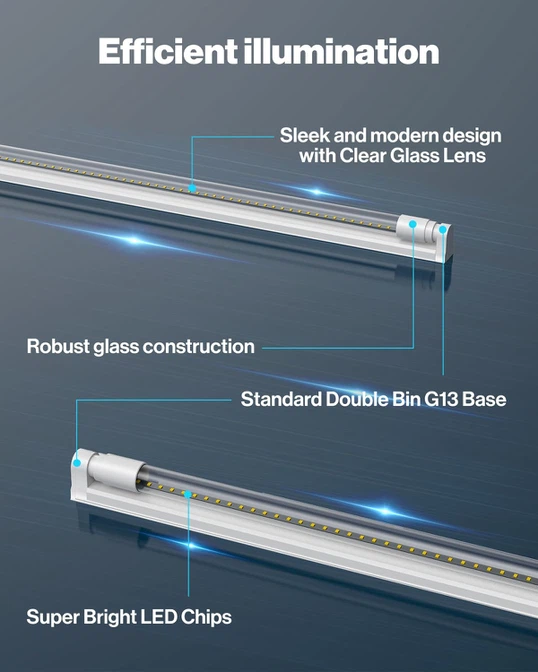
National standards: China's GB50034‑2013 and IEEE 1789‑2015 impose strict requirements on lamp flicker. The Benwei 18W RGB T8 uses a high‑frequency constant‑current driver with flicker depth <5% (the "no significant effect" level per IEEE), completely imperceptible to the human eye.
Importance of CRI (Ra): CRI measures how accurately a light source reveals the true colors of objects. Ra100 equals natural light. For office and education, Ra≥80 is recommended; for professional scenarios like design, printing, medical, Ra≥90 is advised.
| CRI Range | Performance | Recommended Scenes |
|---|---|---|
| Ra < 70 | Colors clearly distorted, severe eye strain | Not recommended for office/education |
| Ra 70–80 | Fair color rendering, acceptable | General warehouse, corridors |
| Ra 80–90 | Good rendering, true colors | Offices, classrooms, libraries |
| Ra ≥ 90 | Excellent rendering, close to natural light | Design studios, art rooms, labs, high‑end offices |
Benwei RGB T8 tubes are available in Ra≥80 standard version and Ra≥90 high‑CRI version - choose based on budget and application.
5. One‑Sentence Buying Recommendation
When upgrading office and educational lighting, don't just focus on "energy savings". Prioritize flicker‑free, high‑CRI (Ra≥80), tunable‑CCT (2700K–6500K), ≥50,000‑hour‑life RGB T8 LED tubes. They match the human circadian rhythm to boost daily efficiency, protect vision, and reduce long‑term operating costs. A smart tuning system can recover the incremental investment within two years through electricity savings and reduced maintenance.
Final advice: If you manage an office, school, library, or any space where people use their eyes for long hours, stop using old tubes with severe flicker, poor CRI, and fixed color temperature. Spending 20%–30% more on Benwei 18W RGB T8 tunable LED tubes gives you healthier employees/students, higher productivity, and a decade of maintenance‑free peace of mind.