Floodlight or spotlight?
Introduction
Currently, LED lighting is employed in a wide range of places, such as stadiums, shopping malls, retail stores, parking lots, and plazas. A combination of many LED lamp types may be employed in a single application to produce greater lighting effects. Due to their high efficiency and little energy usage, floodlights and spotlights are common options for lighting requirements. The distinction between spotlights and floodlights, however, seems to be frequently misunderstood. The best light for your application scenario may also be something else you're considering. We'd like to explain the differences between spotlights and floodlights as well as how to choose the right one for your lighting project. I hope you found this essay useful.
What are spotlight and floodlight?
When a wider amount of illumination is needed, floodlights are frequently employed because of their wider beam distribution. In most cases, the beam distribution is greater than 45 degrees and can even be as high as 120 degrees. Floodlights produce soft, transparent shadows because they don't produce a clearly defined beam of light but rather a highly diffuse, non-directional light. Larger areas can be lit thanks to the wider beam angle. A few examples include stadiums, billboards, gardens, and illumination in the factory's immediate vicinity.
Spotlights are lamps that are used to indicate that the lighting on the lit surface is greater than that of the surrounding area. In contrast to LED floodlights, the beam spread is often limited to 45 degrees. A focused, well-defined beam of light is produced by spotlights to illuminate a particular area. For instance, you would need spotlights rather than floodlights if you wanted to install lighting to draw attention to your favorite landscape features right now. Decorative lighting for commercial spaces, settings with lots of decorative elements, and architectural lighting are all application possibilities for Spotlight.
A floodlight casts a wide beam of light over a large area, whereas a spotlight casts a tiny beam of light on a single point. This distinction should help you recall the difference between the two types of lighting. When planning your lighting strategy, this could be useful.
How do floodlights and spotlights differ from one another?
We may learn about floodlights and spotlights and approximate differences between them by knowing the concepts behind them. Their components are application, beam angle, and beam width. A difference between them, in addition to these, is, in my opinion, the wattage.
Beam angle
Using a beam angle of up to 120 degrees, LED floodlights may spread light. With the same amount of power and lumen output as a spotlight, it can light up a bigger area.
A beam that is typically no wider than 45 degrees is produced by LED spotlights. The concentration and control of this beam angle are better.

Beam width
to determine the size of my light's beam at a specific range. This has an impact on beam width. It would be much simpler to know the beam width in feet or meters, from a particular distance, rather than the beam width in degrees, which isn't always useful. Fortunately, there is a straightforward formula you may use to determine this:
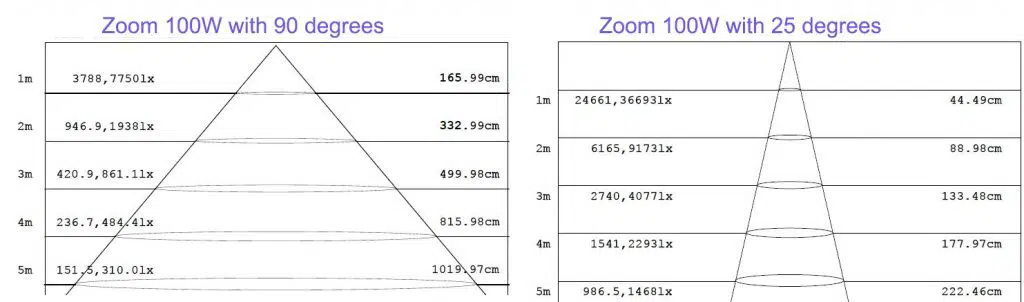
Beam Width = Angle of Beam x 0.018 x Distance from Light
Therefore, use the following calculation to determine the beam's width from 10 feet distant if you have a 90-degree, 100-watt floodlight:
90 degrees x 0.018 x 10 feet = 16.2 feet wide=4.89 meters wide
Here's how to determine the width of a spotlight's beam from 10 feet distant if it has a 25-degree beam angle:
25 degrees x 0.018 x 10 feet = 4.5 feet wide=1.36 meters
Wattage
Typically, floodlights have a higher power than spotlights. The typical wattage for a spotlight and a floodlight is listed below.
Floodlight, 10W, 20W, 50W, 100W, 150W, 200W, 300W, 500W, 750W, 1000W or even more.
Spotlight, often less than 20W; 6W, 9W, 12W, 15W, or 18W.
Application
Use LED lighting with a wide beam angle, broad beam width, and even light coverage to illuminate larger areas like roads, stages, warehouses, parking lots, or any other place.
Choose LED lighting with a narrow beam angle when accentuating particular areas, such as wall art, architectural details, or landscape aspects.
Our opinion is that when an area needs to be lit, LED lights with either a narrow beam angle (spotlight) or a broad beam angle (floodlight) can be used in conjunction to provide the area with good uniform lighting. For example, we can utilize both LED flood light and LED spotlight when designing the illumination for a football field, stadium, or port (We call LED stadium light).
The summary table comparing floodlights and spotlights is shown below.
| LED Flood Light | LED Spot Light | |
| Beam angle | 45-180° | Less than 45° |
| Beam width | Broad | Narrow |
| Wattage | Normally less than 20W | 10w to 1000W or even more |
| Application | driveways, stages, warehouses, parking lots, sports field | Wall artwork, architectural details, or landscape features |
Which elements should we consider more carefully while selecting LED floodlight and spotlight?
Beam angle
Generally speaking, it is advisable to have a greater beam angle if you need to illuminate a large region. Instead, pick a narrow beam angle if you simply need to illuminate a small area.
However, in real-world scenarios, we also need to be aware of the separation between the light source and the illuminated surface. We already noted that the beam width is inversely related to the installation distance in the section on beam width. The floodlight's irradiation range is directly influenced by the installation height. The beam width (irradiation range) of a ZGSM Zoom series 200W floodlight installed on a tennis court with a pile height of 10 meters is a circle with a diameter of 20 meters. This indicates that there are numerous lights outside the tennis court, which is barely 10.97 meters wide. Consequently, our lighting plan is a flop. As a result, the beam angle should be chosen based on the intended use. We require Zoom with a 25° or 60° beam angle for this tennis court. Please get in touch with us if you have any questions about picking the beam angle for a tennis court or other sporting area.
Wattage
When explaining the distinction between spotlights and floodlights, we pointed out that spotlights typically have lower wattages whereas floodlights typically have higher wattages. Would you select a spotlight if we needed to light up a stadium right now? You might believe that the spotlight can illuminate the sports field because of its small beam angle. A comparable test was conducted by ZGSM. A 20W spotlight positioned at a height of 10 meters illuminates an area of 5 by 5 meters below it on average with just 50 lux, which is obviously insufficient for stadium illumination. The spotlight's inadequate wattage is the cause. We therefore require high-wattage floodlights. For instance, a ZGSM 100W Zoom floodlight with a 25° beam angle has an average illuminance of 200lux (5*5m area underneath the floodlight), whereas a 400W Zoom floodlight has an average illuminance of 800lux, which can satisfy the stadium lighting specifications. However, we believe a 20W spotlight is appropriate for landscape illumination (such as TV background walls or wall lighting).
CRI
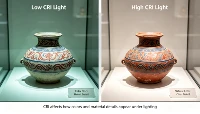
Because spotlights are frequently used to illuminate certain exhibit objects, architectural details, and landscape features, it is ideal to utilize CRI80 or higher for spotlights in order to more accurately display the color of the object itself.
However, the majority of applications only require floodlights with a CRI of 70. However, in other cases, high CRI is required for stadium or sports field lighting in order to get a decent visual impression. For instance, we often require a higher CRI on a tennis court field that has a TV broadcast. Verify the lighting on the tennis courts.
Other elements
Along with beam angle, wattage, and CRI, other factors to take into account include luminous efficiency, heat dissipation, waterproofness and dustproofness, flickering problem, CCT, lighting uniformity, and warranty. In our other articles, we'll talk about this in relation to LED floodlights.
Summary
Depending on your demands, you can choose between spotlights and floodlights. Keep in mind that spotlights and floodlights sometimes can't be utilized separately. The pros and disadvantages of using spotlights and floodlights together are more suited to enhancing the lighting effect and enhancing the visual effect. Each component of a lighting project has specific lighting needs. For instance, a gallery's hallways and aisles require uniform, floodlighting to illuminate the area, yet the artwork itself requires sharper lighting to set it apart from the background. Therefore, knowing what kind of illumination you require is crucial to your decision. Select the ideal fixture for your application after determining the lighting effects you actually desire.