The application of 365nm UV tubes in the food industry is rapidly moving from laboratory research to commercial deployment. As LED UV technology matures, 365nm UVA tubes are replacing traditional mercury lamps in multiple areas such as food processing, packaging, inspection, and preservation. Their advantages-non‑thermal sterilization, low energy consumption, mercury‑free environmental compliance, and instant on/off-make them the preferred light source for industry upgrades. This article systematically analyzes four core application scenarios, technical benefits, and procurement considerations for 365nm UV tubes in the food sector.
1. Surface Sterilization of Food and Conveyor Belt Disinfection
On food processing lines, surfaces such as conveyor belts, cutting boards, and worktables are high‑risk areas for cross‑contamination.Traditional chemical disinfectants are effective, but they have drawbacks: chemical residues, equipment corrosion, and required drying time. 365nm UV LED technology offers a zero‑chemical‑residue alternative – after food passes along the conveyor belt, high‑intensity 365nm UV light directly irradiates the surface, rapidly inactivating residual pathogenic microorganisms.
Studies have shown that a combined system of UVA‑LED (365nm) and pulsed ohmic heating can enhance the inactivation of foodborne pathogens in phosphate buffer, milk, and orange juice. For conveyor belt surface disinfection, high‑intensity 365nm LED output reduces maintenance workload, provides consistent and reliable results, and significantly increases production speed (Phoseon research indicates that combining 365nm with 275nm produces a synergistic effect, making the disinfection reaction faster and more stable).
Why choose 365nm for food surface disinfection?
- Non‑thermal processing – Does not change surface temperature of food, suitable for heat‑sensitive ingredients.
- No chemical residues – UV directly damages microbial DNA/RNA or causes oxidative damage via ROS; no rinsing required.
- Continuous production – Instant on/off, no warm‑up, can be embedded in assembly lines for inline operation.
- Safe and environmentally friendly – Mercury‑free, ozone‑free, meets food‑grade safety requirements.
2. Food Packaging UV Curing – 365nm Is the Core Wavelength
Food packaging is one of the largest single application areas for 365nm UV tubes. UV LED curing technology is widely used in food packaging printing, lamination adhesion, and coating curing. 365nm and 395nm are the two most common wavelengths, with 365nm being particularly suitable for deep curing and thick film materials due to its stronger penetration.
In food packaging production, 365nm UV LED curing lamps emit specific UV wavelengths that trigger photoinitiators in photosensitive materials (inks, adhesives, coatings), causing them to change from liquid to solid within milliseconds. Compared to traditional mercury lamps, this technology offers significant advantages:
- Mercury‑free and ozone‑free – Compliant with the Minamata Convention and RoHS directives, suitable for sensitive fields like food.
- Instant on/off – No warm‑up, ready for use, adapts to high‑efficiency production rhythms.
- Low‑temperature curing – 365nm LED cold sources generate almost no infrared heat radiation, thus they do not damage heat‑sensitive food packaging substrates.
- Long lifetime – LED tubes can last 30,000+ hours, far longer than the 1,000‑2,000 hours of mercury lamps.
In UV curing formulations, the choice of photoinitiator must match the wavelength output of the LED lamp – 365nm requires photoinitiator systems with high absorption at that wavelength. Allnex, a global leader in coatings and resin supplies, has specifically developed LED‑boosted technologies for food packaging applications to enhance the reactivity of 365nm UV LED curing formulations while meeting regulatory requirements for food contact materials.
The FDA has explicitly approved certain UV curing formulations for use as coatings on polymer substrates, paper and paperboard, or as components in adhesives through Food Contact Notification (FCN 772). This means compliant 365nm UV LED curing processes can be legitimately used for printing and bonding on food packaging.
3. Non‑Thermal Sterilization of Liquid Foods
Conventional thermal sterilization (pasteurization, UHT) is effective, but often leads to flavor loss, nutrient degradation, and color changes in liquid foods. Photodynamic inactivation (PDI) using 365nm UVA combined with natural photosensitizers is emerging as a novel non‑thermal processing solution for liquid foods.
Multiple academic studies have confirmed the effectiveness of this technology:
- Chlorogenic acid (CGA) + 365nm UVA – Achieved >8‑log complete inactivation of Listeria monocytogenes in greengage juice, with minimal impact on juice color, pH, and antioxidant activity. The treatment induced membrane depolarization, ATP depletion, and lipid peroxidation, leading to cell death.
- Resveratrol + 365nm UVA – At a dose of 10 J/cm², achieved >5‑log inactivation of foodborne pathogens in apple juice without significant changes in color, pH, or antioxidant activity. Notably, the photoactivation effect of resveratrol showed wavelength dependence – the enhancement was significant at 365nm, but not observed at 385nm or 405nm. This means 365nm is irreplaceable for resveratrol‑mediated photodynamic sterilization.
- Protocatechuic acid (PCA) + 365nm UVA – Effectively inactivated microorganisms in grape juice (a low‑transmittance food matrix), without significant effects on pH, color, or anthocyanin content.
The common conclusion of these studies is that photodynamic sterilization using 365nm UVA combined with natural plant polyphenols can achieve efficient pathogen inactivation while preserving food quality. This provides a "clean‑label" sterilization pathway for heat‑sensitive liquid foods such as fruit juices and beverages. From an industrial perspective, UVA non‑thermal processing avoids nutrient degradation and flavor loss caused by heat treatment, which is particularly important for premium juice and dairy markets.
4. Safety Purification of Powdered Food Ingredients
Powdered food ingredients (spice powders, onion powder, garlic powder, milk powder, etc.) typically undergo no further heat treatment before reaching consumers, making microbial purification critical. Traditional methods such as ethylene oxide fumigation or long‑duration hot‑air drying either involve chemical residues and environmental concerns, or degrade product quality.
365nm UVA‑LED is more effective at inactivating dry bacteria under low water activity (aw) conditions than 395nm LED. Studies show that after UV‑LED treatment, low‑aw foods (pet food, grains, spice powders, etc.) exhibit bacterial reductions of 0.75–3 log CFU. The inactivation kinetics are non‑linear, and the effectiveness depends on the combination of powder type and microorganism species.
This provides a chemical‑residue‑free, non‑thermal, continuous processing purification solution for powdered food ingredients, which is especially commercially valuable for markets such as Europe and North America that have strict restrictions on chemical disinfectants.
5. Summary of Technical Advantages of 365nm in the Food Industry
| Feature | Traditional Mercury Lamp | 365nm UV LED Tube |
|---|---|---|
| Mercury content | Yes | None |
| Warm‑up time | 5‑15 minutes | Instant on/off |
| Lifetime | 1,000‑2,000 hours | 30,000‑50,000 hours |
| Heat radiation | High (60‑90°C rise) | Cold source (5‑15°C rise) |
| Ozone generation | Possible | None |
| Wavelength purity | Broad (±20‑50nm) | Narrow (±5nm) |
| Food contact compliance | Limited | Compliant with FDA FCN 772, RoHS |
| Maintenance cost | High (frequent tube replacement) | Low (years of maintenance‑free operation) |
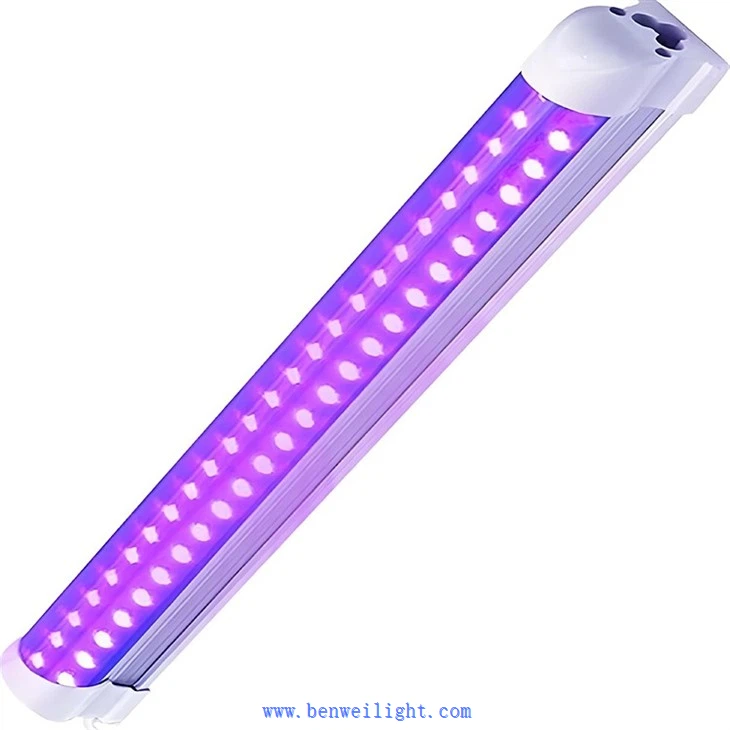
For food processing companies, upgrading from traditional mercury lamps to 365nm UV LED tubes is not just a light source replacement – it is a comprehensive enhancement of production processes and food safety standards. Each Benwei 365nm UV tube (10W/18W/24W, lengths 60/120/150cm) uses high‑purity LED chips that emit stable 365nm narrow‑band UV light, with an operating life of 30,000‑50,000 hours, supports 85‑265V wide input voltage, and is suitable for various food processing equipment and packaging production lines.
6. Procurement and Compliance Considerations
The food industry imposes stricter quality and regulatory requirements on UV light sources. When evaluating 365nm UV tubes, professional buyers should pay special attention to:
- Compliance certifications – For export to North America, UL/cUL or ETL certification is required; for Europe, CE/RoHS/ENEC certification. For UV curing processes used in food contact packaging, ensure that the formulations comply with FDA FCN 772 or 21 CFR 176.170, etc.
- Irradiance and dose – Sterilization and curing efficiency depend on the actual UV power density (μW/cm² or mW/cm²) reaching the target surface, not just the rated power of the tube.
- Wavelength purity – The full width at half maximum (FWHM) of a 365nm LED should be controlled within ±5nm to ensure precise matching with the absorption peaks of specific photoinitiators or photosensitizers. As resveratrol experiments have demonstrated, even shifting to 385nm or 405nm can significantly reduce the efficacy of some photosensitizers.
- Thermal management – Food processing environments may be temperature‑sensitive; the LED tube itself must have good heat dissipation design. Benwei UV tubes use an aluminum substrate heat sink structure, maintaining stable output even under continuous operation.
Conclusion
The value of 365nm UV tubes in the food industry is being validated by an increasing body of scientific research and commercial practice. From eliminating foodborne pathogens on conveyor belts to driving instant curing of food packaging inks, from providing non‑thermal preservation solutions for fruit juices to purifying hidden contaminants in powdered spices, 365nm LED technology is reshaping food safety standards across multiple dimensions.
As global restrictions on mercury lamps tighten and consumer demand for "clean label" and "minimally processed" foods continues to grow, the application prospects for 365nm UV LED tubes will become even broader. The Benwei 365nm UV tube series – with its stable wavelength output, long LED lifetime, mercury‑free environmentally friendly design, and flexible power options – offers food processors an efficient, safe, and compliant technology upgrade path.
Contact Benwei today for a customized 365nm UV tube solution tailored to your food production line.
✨Contact✨
🙋♀️Harriet
📫Email: bwzm88@benweilighting.com
📞Whatsapp: +8613007285242