Introduction: The Panel Above Your Head Decides How Your Day Feels
Look up in almost any office, clinic, school or supermarket refurbished in the past decade and you will see the same object: a flat, white, rectangular sheet of light set into the ceiling grid. The LED panel became the default interior luminaire of the 2020s because it is thin, neutral in shape, drops into a standard 600 × 600 mm module and draws far less than the fluorescent troffer it replaced.
That single format now spans an extraordinary price range. Two panels can look identical in a catalogue photograph, carry the same dimensions and the same claimed wattage, and still differ three or four times in cost. The difference is almost never visible from outside. It lives in the optics, the driver and the thermal path - and it becomes visible the moment people spend eight hours a day underneath them.
From "Bright Enough" to "Comfortable Enough"
Facility specifications are still written in photometric language: illuminance on the work plane, watts per square metre, lumens per watt, simple payback. None of this should be abandoned, but it describes the room rather than the experience of being in it. A space can hit 500 lux on the desk and still leave its occupants rubbing their eyes by mid-afternoon.
Visual comfort is not a soft claim. The muscles controlling the pupil and lens work continuously to keep the retinal image stable, and every avoidable glare source, invisible flicker cycle and colour the eye must mentally correct adds to that workload. Over a working day the cost appears as fatigue, dryness and headaches.
Three Ways a Cheap Panel Fails the Eye
Strip away the marketing language and almost every complaint about flat panel lighting traces back to one of three physical properties:
Glare - the emitting surface is too bright relative to its surroundings for the eye to adapt to both.
Flicker - output is modulated at a frequency the viewer does not consciously perceive but the nervous system registers.
Poor colour rendering - the spectrum is incomplete, so objects lose their true colour.
A fourth property sits behind all three: uniformity. Hot spots and dark corners force the eye to scan an uneven field, and no extra lumen output makes that comfortable.
Why the Eye Complains: Glare, Flicker and Colour Fidelity
Glare Is a Luminance Problem, Not a Brightness Problem
Glare has little to do with how many lumens a panel produces and almost everything to do with how those lumens are spread across the emitting surface. The quantity the eye reacts to is luminance - candelas per square metre - and it decides whether looking up at a ceiling is restful or painful.
Hence the unified glare rating. UGR combines luminaire luminance, the solid angle it subtends at the observer's eye and background luminance into one index, and EN 12464-1 sets a limit of UGR ≤ 19 for typical office tasks. A panel that spreads its flux over a large, softly luminous face meets that limit at high output; one that concentrates it in a small brilliant core cannot, however carefully the wattage is chosen.
Excessive luminance usually comes from a short optical path: LEDs packed together behind a single thin opal sheet leave the diffuser only a few millimetres to work with, producing a bright centre, a visible LED image and a surface that photographs beautifully and glares badly.
Flicker: Invisible to the Eye, Visible to the Brain
Flicker is the most under-specified parameter in the panel market and the easiest to hide, because most people cannot consciously see it. It is reported as percent flicker, the depth of modulation between maximum and minimum output, and as flicker index, which weighs the proportion of the cycle spent above and below the average. Frequency alone is not an answer.
The mechanism is well understood. A low-cost driver with little bulk capacitance passes the 100 Hz rectified mains ripple straight into the LED string, producing deep modulation at twice the mains frequency; low-frequency pulse-width dimming does the same and worsens as the dimmer is turned down. To the conscious eye the room looks lit; to the pupil reflex and visual cortex, the light is strobing.
The consequences are cumulative: eye strain, headaches, restlessness and the stroboscopic effect that makes a fan appear to stand still. Cameras expose it instantly, which is why flickering panels produce banded video in meeting rooms and retail shoots. IEEE 1789-2015 set modulation limits as a function of frequency precisely because "no visible flicker at full brightness" is not an adequate specification - a panel must also stay clean at 10 percent dimming.
Colour Rendering: The Difference Between "White" and "True"
Ra averages eight pastel test colours, which is useful for comparison and misleading in practice: a luminaire can score Ra 80 and still render saturated reds badly, because red is largely carried by R9, a colour excluded from the average. In a showroom the difference between Ra 80 and Ra 90 is the difference between a red apple and a brown one; in a clinic it is the difference between skin that looks healthy and skin that looks grey.
Poor spectral completeness also shifts the apparent whiteness of walls, which is why some installations feel subtly dingy even when the meter says the room is bright. Specification increasingly looks to R9 and TM-30, but for most commercial work an honest threshold does the job: Ra ≥ 90 with a meaningful R9 value.
How an Eye-Care Panel Is Engineered
None of these problems can be solved on a datasheet; they are solved by the optical stack, lens geometry, driver and heat path. Here is how a properly engineered 30 mm panel is built.
The Six-Layer Optical Stack
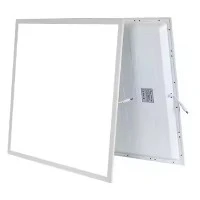
The heart of a good panel is not the LED but the sequence of films between the LED and the room: a metal back cover, pearl cotton, a light guide board, a refractive membrane, a diffusion board and an aluminium cooling frame.
What Each Layer Contributes
Metal back cover - provides rigidity, shields the driver and LED string, and spreads heat laterally so no area runs hotter than its neighbours.
Pearl cotton - a high-reflectance diffuse reflector that sends light back into the optical path instead of absorbing it.
Light guide board - converts a line or array of point sources into an area source, mixing light by total internal reflection.
Refractive membrane - extracts and redirects light out of the guide, breaking up residual hot regions.
Diffusion board - the element the eye sees: it hides the LED image, lowers peak luminance and sets a soft, structure-free surface.
Aluminium cooling frame - the structural and thermal spine, carrying heat away from the strip and holding the stack square.
Why the Order Matters
Light has to be mixed before it is extracted, extracted before it is diffused and diffused before it is seen. Reverse the sequence and the result is a panel with a bright centreline and a hot spot no diffusion sheet can repair. A well-designed stack also recovers interface losses through the reflector and the guide rather than adding more LEDs, which is why a careful panel can be softer and more efficient than a brighter-looking competitor.
Circular Lens Optics: 180 Degrees Without Dark Spots
Uniformity depends on how light enters the guide. A bare LED die emits in a narrow forward lobe, so the area above it receives far more light than the gaps between LEDs, a pattern that survives every downstream layer as a faint ripple.
The solution is secondary optics at the source. Circular lenses over each LED spread the emission into a wide, rotationally symmetric distribution - a 180 degree beam angle in the plane of the panel - so the guide receives a smooth carpet of flux instead of a row of spots. The results: no dark spots or bright bands on the diffuser, even luminance across the face, and a panel that looks the same from every direction rather than only from directly below.
Driver Design: Where Flicker Is Actually Decided
Flicker is a power-supply problem. Any ripple in the LED current becomes ripple in the light. A good driver filters the mains with enough bulk capacitance that the 100 Hz component is largely removed, drives the string at constant rather than pulsed current, and dims by adjusting that current or by switching far above the range the eye can integrate.
Three details separate a flicker-free driver from a merely functional one: performance at low dimming, where poorly filtered designs degrade most; behaviour on a dimmer that is not itself clean; and harmonic performance against EN 61000-3-2, since poor power factor both wastes energy and disturbs the supply. A panel that is clean at full output and dirty at 20 percent is not an eye-care product; it is a product with a good datasheet.
Thermal Engineering and Lumen Maintenance
Every LED loses output as its junction temperature rises, and a slim panel has little room to dissipate heat. With an inadequate thermal path the light dims, the colour shifts and the panel ages faster than its rating suggests - which is why some installations look tired after two years while others still look new after six.
The aluminium cooling frame is the difference. Being metal and in contact with the LED strip along its full length, it moves heat away from the junctions and spreads it across the panel face, where the large area dissipates it instead of concentrating it at the edges. A well-managed junction temperature keeps output stable, keeps the colour point on target and keeps depreciation inside a curve that LM-80 data can support and TM-21 can project - the basis of a genuine L70 or L80 claim.
The Specifications That Separate Good Panels from Cheap Ones
Marketing adjectives are cheap. The four specification areas below are where the engineering either exists or does not, and each can be checked against a photometric report rather than taken on trust.
Luminance Uniformity and Light Decline
Uniformity is normally expressed as minimum to average luminance across the emitting face, measured on a standard grid. A figure of 0.8 or better separates a panel that reads as a single sheet of light from one that shows bands, edges or a bright core. Low uniformity is not cosmetic: it is a luminance contrast the eye must resolve every time it looks up, and the most common reason a nominally bright installation still feels uncomfortable.
"Low light-declining" is the second half of the same promise. A panel should hold uniformity not only on day one but after thousands of hours, when thermal ageing has touched both LEDs and films. Yellowing diffusers, hazing guides and warping frames degrade uniformity before they degrade output, so ask for data at beginning and end of life.
One Panel, Three Colour Temperatures
Colour temperature is usually fixed, which creates a stock problem: a distributor serving offices, clinics and residential projects has to carry three SKUs of the same panel. A CCT selection switch solves it at the source. A DIP switch on the driver sets the panel to 3000 K, 4000 K or 5000 K, so one reference can be stocked, installed and adjusted on site to match the space.
The value is practical rather than decorative. 3000 K suits hospitality and residential spaces where warmth is part of the brief; 4000 K is the neutral default for offices and classrooms; 5000 K suits inspection and clinical work where crisp light aids discrimination. Changing the setting after the ceiling is closed removes a common source of project delay.
Formats, Depth and Installation
Two formats cover most of the commercial market. The 595 × 595 mm panel fits the standard 600 × 600 mm ceiling grid with the clearance a grid needs; the 1195 × 295 mm panel does the same job in a 1200 × 300 mm module, common in corridors, linear ceilings and retail runs. At 30 mm deep both fit plenums that leave little room above the ceiling - often the deciding constraint in a retrofit.
The same body can be recessed into a grid, surface mounted or suspended on cable kits. A range supporting all three is easier to specify across a project, and suspended installations benefit most from the 180 degree distribution because the panel is seen from the side as well as from below.
Where Eye-Care Lighting Becomes a Business Case
Eye comfort is easiest to argue where people stay for hours, because there the specification is not an aesthetic preference but a productivity, compliance or safety decision.
Offices and Open Workplaces
The office is the hardest test, because occupants look at a screen all day. Screen work makes the eye sensitive to luminance above the line of sight - exactly where a ceiling panel sits - and makes flicker and colour shift more noticeable. A UGR ≤ 19 installation with high uniformity and clean dimming reduces the pupillary adjustment behind end-of-day fatigue and removes the banding that ruins video calls.
Classrooms and Training Rooms
In education the stakes are different. Pupils cannot move away from a glare source, whiteboards and printed materials depend on colour fidelity, and lessons increasingly involve projection and video where flicker appears on camera. Panels with Ra 90 and stable output keep diagrams legible at the back of the room and the space comfortable through a full timetable.
Healthcare, Retail and Hospitality
Clinical spaces need high colour rendering because skin, wound and medication colour are diagnostic information. Retail needs it because the product a customer judges must look like the one they take home. Hospitality needs the 3000 K end of the switch, where a warm panel reads as welcome rather than as a technical installation. One range covering all three cuts both the SKUs a distributor carries and the decisions a project makes.
How to Verify the Claims Before You Buy
Every claim in this article is measurable, which is the point. Eye-care lighting is not a position a supplier can assert; it is a set of photometric and electrical results that can be requested, compared and checked.
The Standards Behind the Words
EN 12464-1 defines the lighting of indoor work places, including UGR limits and colour rendering requirements, and is the reference most export projects are written against. IEEE 1789-2015 sets practices for modulating LED current to mitigate health risks to viewers - the closest thing the industry has to a numerical definition of "flicker-free". IEC 62471 covers photobiological safety, including blue light exposure limits, and EN 61000-3-2 limits harmonic emissions, where a poor driver reveals itself.
Behind these sit the practices that make numbers reproducible: LM-79 for photometry, LM-80 for lumen maintenance, TM-21 for projecting it into a lifetime figure and CIE TN 006:2016 for time-modulated light. A supplier who can point to results in these formats has actually tested the product.
A Ten-Point Buyer's Checklist
The table below turns the argument into questions for a supplier. The benchmarks are industry guidance for commercial interiors, not a substitute for the supplier's own test report.
|
Specification to request |
Benchmark worth aiming for |
What it protects |
|---|---|---|
|
UGR value |
UGR ≤ 19 for offices and screen work |
Direct and reflected glare on displays |
|
Percent flicker and flicker index |
Low single-digit modulation at 100 percent and 10 percent output |
Headaches, eye strain, camera banding |
|
Stroboscopic measure |
SVM at or below 1 |
Visible artefacts on moving objects |
|
Colour rendering |
Ra ≥ 90 with a declared R9 value |
Colour of skin, food, textiles and print |
|
Luminance uniformity |
Minimum to average ≥ 0.8 across the face |
Hot spots, dark edges, visual scanning |
|
Peak luminance |
Consistent with the UGR claim at intended output |
Comfort when the panel is in view |
|
CCT consistency |
Tight MacAdam step, stable across switch settings |
Patchy walls and mismatched batches |
|
Lumen maintenance |
L70 or L80 declared with LM-80 and TM-21 support |
Premature dimming and colour shift |
|
Driver quality |
Power factor and harmonics within EN 61000-3-2; stable deep dimming |
Supply disturbance and flicker at low output |
|
Photobiological safety |
IEC 62471 assessment available |
Exposure limits and blue light questions |
One further question matters: whether the same optical construction is used across the whole size range, because a supplier who changes the stack between formats delivers a different quality of light in a 1200 mm panel than in a 600 mm one.
Conclusion: Eye-Care Is a Specification, Not a Slogan
"Eye-care lighting" has been used loosely enough to risk becoming another decorative label. Behind it sit three measurable properties - luminance controlled inside the UGR limit, a driver clean enough that the light does not modulate at frequencies the nervous system registers, and a spectrum complete enough that Ra 90 means something in the room - plus uniformity, which decides whether the eye can rest.
A panel delivering all four is not a more expensive version of the same product. It is a different product, built from a six-layer stack, lens-shaped injection, a low-ripple driver and a metal thermal path, and its cost is recovered in fewer complaints and fewer replacements.
If you specify or import panel lights, judge them on four numbers and ask for the reports: UGR, flicker, Ra with R9 and uniformity. Then take a sample, put it in a room with a screen and a camera, dim it to 10 percent and look up. The panel that survives is the one worth writing into the purchase order.
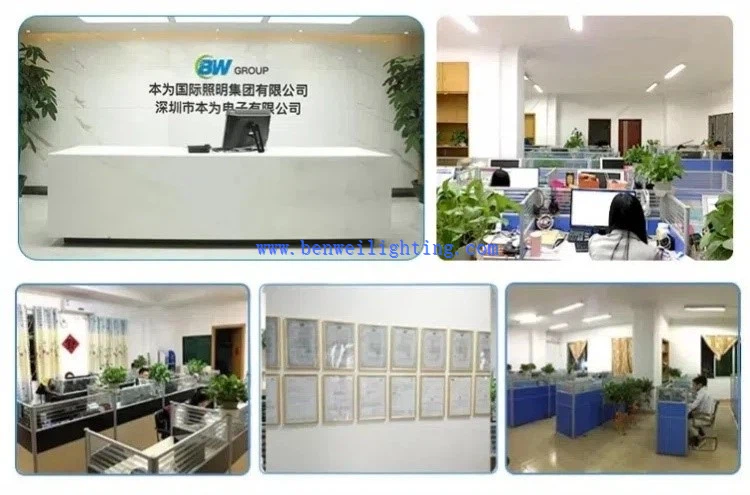
How To Cooperate With Us?
We are happy to have total control over the manufacturing process and the calibre of our products since we have our own facilities. Since we are producers rather than just brokers, we are dedicated to providing our customers with the best pricing. Since we are certain that the price and quality of our products are clear, we invite customers to see our samples first. Our commitment to quality and customer satisfaction drives us to continuously provide top-notch goods.
Our address
3rd Floor, 5th Building, Hebei Industrial Park, Hualian Community, Longhua District, Shenzhen, China