High CRI and Low M/P Ratio: Can You Have Both in LED Lighting?
Recently, a lighting designer told us about a job in which the customer had two requests. To accurately render artwork, the gallery lighting required to be at least 95 CRI. In order to protect visitors' health, it had to reduce blue light exposure. These two requests are at odds with one another. This article discusses why it is the case and offers solutions.
The Disagreement Between Two Useful Measures
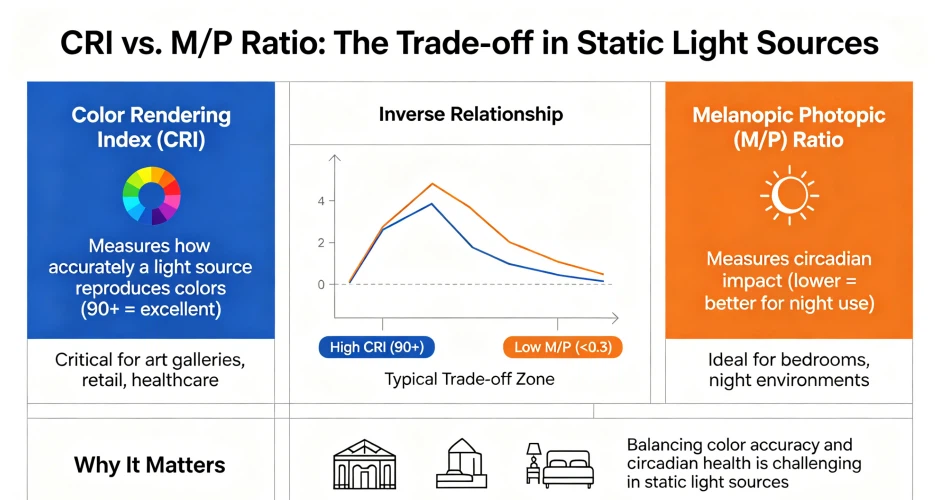
Both a low M/P ratio and a high CRI are ideal. The issue is that it is physically challenging to accomplish both in a single static light source. You must grasp what each metric actually measures in order to comprehend why.
When a light source has a high CRI, it precisely reveals object colours when compared to a reference light. A score of more than 90 is regarded as exceptional. This is crucial for situations where colour fidelity is important, such as art exhibitions, retail displays, and medical exams.
A light's possible effect on circadian rhythm is measured by the M/P ratio, which stands for melanopic lux to photopic lux. Less blue light energy in relation to perceived brightness is indicated by a lower M/P ratio. This applies to hospital wards, bedrooms, and any area used at night.
The Trade-Off's Physics
The manufacturing process of LED light is the source of the conflict. An very low M/P ratio of about 0.12 can be attained using a low CRI LED, such as an amber LED with a narrow 590nm spectrum. The photopic curve, which measures brightness, accounts for the majority of its energy, whereas the melanopic curve, which measures blue light that causes alertness, accounts for very little. However, this amber LED is not suitable for general lighting due to its poor colour rendering.
Manufacturers need to add more wavelengths to increase CRI. Warm colour rendering is enhanced by red and deep red. Cool tones are affected by gaps in the spectrum that are filled by cyan and blue wavelengths. The spectrum gets fuller and the CRI rises when additional wavelengths are added. However, there is also an increase in the energy beneath the melanopic curve.
This was directly tested by Waveform Lighting. They contrasted a halogen lamp with a perfect CRI of 100 with three 3000K LED lamps with CRI values of 82, 91, and 97. M/P ratios of 0.513, 0.546, 0.548, and 0.581 were found in the data. The M/P ratio rose in tandem with CRI. There will always be more blue light energy in a larger spectrum.
The Limitation of Static Choice
Any single, static light source necessitates a compromise due to this physical limitation. Excellent colour and greater circadian stimulation are provided by a high-CRI, high-M/P lamp. Although blue light is reduced with a low-CRI, low-M/P lamp, colours appear erroneous and lifeless.
The importance of this is demonstrated in a hospital patient room. To effectively analyse skin tone and wound healing at 10 a.m., a physician needs 95 CRI light at 4000K. To encourage attentiveness, the light should have a greater M/P ratio. To promote comfortable sleep at 10 p.m., the same patient need 95 CRI light at 2700K with a low M/P ratio. In the same room on the same day, there are two entirely distinct spectral demands.
Dynamic White Lighting is the Answer
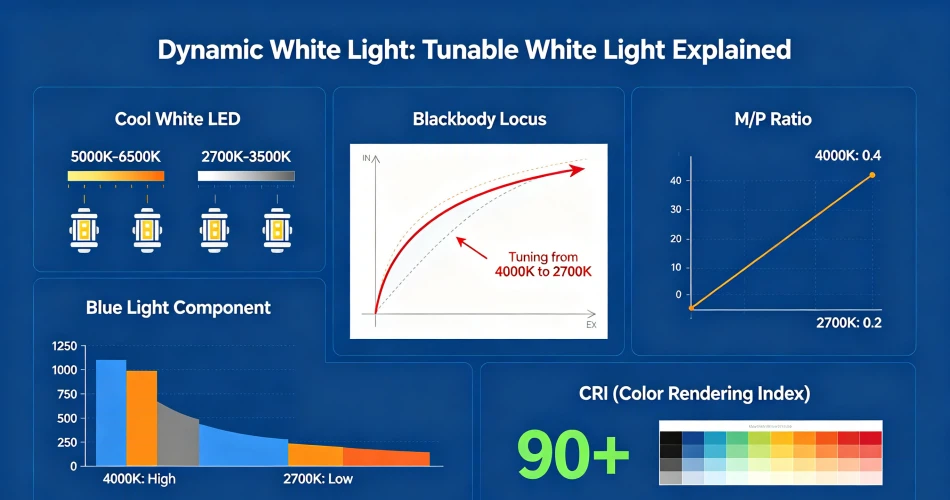
The solution to this dilemma is to cease considering light to be static. Cool and warm white LEDs are combined in multi-channel LED systems to create dynamic white, also known as tunable white. To create any colour temperature along the Planckian curve, a control system modifies the mixture.
The blue spectral content considerably decreases when a tunable white system is dimmed from 4000K to 2700K. Because less short-wavelength energy is being released, the M/P ratio naturally drops. The light has a significantly less circadian effect and is visually warm at 2700K. It is more visually appealing and cooler at 4000K.
The biggest benefit is that CRI stays high over the whole spectrum. The M/P ratio changes in step with colour temperature, and a well-designed tunable white system may maintain 90 CRI or more from 2700K to 5000K.
A Framework for Circadian Design
Different lighting schedules are required for different locations. The recommendations listed below serve as a foundation for design specifications.
For alertness, office environments benefit from 4000K at 90 CRI minimum in the morning and 3000K in the late afternoon. Healthcare facilities' patient rooms should utilise 4000K to 5000K during examinations throughout the day and 2700K after 8 p.m., with a minimum of 90 CRI throughout. During business hours, art galleries and retail establishments can utilise between 3500K and 4000K, switching to warmer tones if events are conducted in the evening. With all settings at 90 CRI or higher, residential bedrooms should utilise 4000K in the morning and 2700K or less after sunset.
Make sure the CRI remains over 90 throughout the whole colour temperature range when choosing goods for a dynamic white installation. Check for compatibility with your control system (DALI, DMX, or wireless protocols) and confirm the dimming range. Additionally, make sure that at all dimming settings, the driver and LED combo produces true flicker-free performance.
The choice between a low M/P ratio and a high CRI is no longer up for debate. Both cannot be delivered simultaneously by a single static bulb. However, an intelligent system can provide both at various periods of the day, matching the appropriate spectrum to the appropriate activity at the appropriate time.
FAQ
Q: Do high CRI LEDs really produce more blue light?
A: A higher CRI LED typically has a more complete spectrum, which includes more energy across all visible wavelengths, at the same colour temperature. Testing has shown that this frequently leads to a somewhat greater M/P ratio when compared to a lower CRI LED. Although not significant, the difference is measurable.
Q: Is it possible to obtain a single LED bulb with an extremely low M/P ratio and 95 CRI?
A: Not at all. Energy is inevitably added in the blue region by the mechanics of producing a full spectrum for high CRI. A high CRI 2700K bulb can have a reasonably low M/P ratio because the blue content is already quite low at a warm colour temperature like 2700K. This gets much more difficult to accomplish around 4000K.
Q: What is the ideal M/P ratio for a bedroom?
A: Choose warm white bulbs with a temperature of 2700K or less for usage in the evening. The M/P ratio is naturally lower at these colour temperatures, usually less than 0.45. The secret is to utilise warmer, lower M/P light as nighttime draws near and cooler, higher M/P light during the day.
Q: Do smart bulbs resolve the problem between M/P and CRI?
A: The dim-to-warm method used by the majority of consumer smart bulbs reduces colour temperature when dimmed but does not ensure excellent CRI at all settings. A specialised tunable white system with a specified CRI throughout the entire spectrum is the dependable method for controlling both colour quality and circadian influence in professional projects.
Contact
Kevin Rao
Email:bwzm12@benweilighting.com
Tel/Whatsapp:+8619972563753