Are LED Lights Safe? A Science-Based Guide to Health Risks and Safer Choices
There are two extremes to the question of whether LED lights are dangerous. According to one article, they are a quiet murderer, while another maintains that they are totally harmless. There is actual confusion. While some worries are misinterpreted or overstated, others are supported by reliable evidence. This book will explain the science underlying each concern, help you distinguish between them, and provide you with specific standards for selecting safer lighting.
LED Blue Light: Exaggerated or Actual Risk?
When it comes to LED safety, blue light is the most discussed issue. You must distinguish between two different questions in order to comprehend the problem: can blue light interfere with sleep, and does it harm your eyes?
The Effects of Blue Light on Sleep
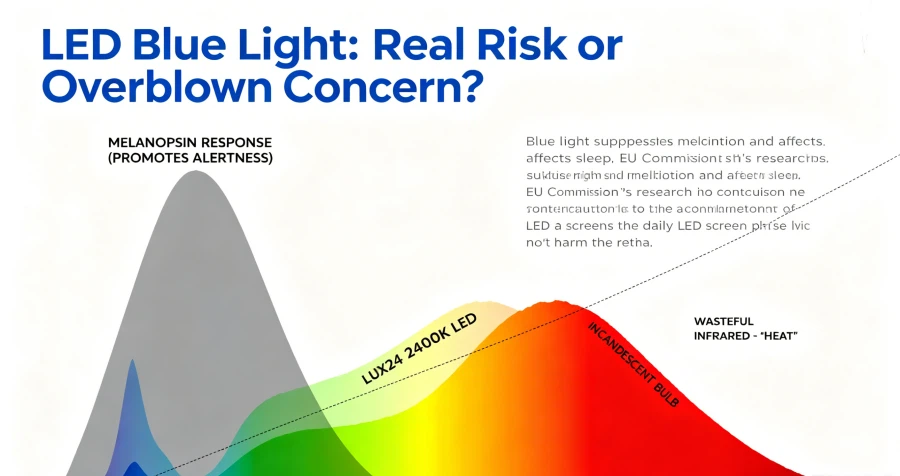
Melatonin, the hormone that tells your brain it's time to go to sleep, is suppressed by blue light. Your body remains vigilant when exposed to blue-rich light in the evening, which makes it more difficult for you to naturally fall asleep. This is a proven scientific truth.
However, the dose determines the effect. The influence is determined by three factors: the time of night, the duration of exposure, and the brightness of the light. At 11 p.m., a bright, cool-white above LED poses a serious issue. At 7 p.m., a warm-white, dim lamp does not. The risk is unique to extended, high-intensity exposure in the late evening. It's not a cause for panic; it's manageable.
Does Your Retina Get Damaged by LED Screens?
There is a common concern that regular LED screens would permanently harm people's eyes. This subject was directly investigated by the Scientific Committee on Health, Environmental and Emerging Risks (SCHEER) of the European Commission. They came to the conclusion that the answer is no for screens like those found on phones, tablets, and laptops.
Less than 10% of the threshold that could result in photochemical damage to the retina is reached by the illumination from these screens. Furthermore, the eye does not focus on one spot for long stretches of time. It disperses the light energy and avoids focused exposure by moving and blinking. There is no harm to the retina from regular use of LED screens.
Blue Light Also Has Advantages
There is nothing intrinsically dangerous about blue light. It is crucial during the day. It increases alertness, elevates mood, and aids in circadian rhythm regulation. Seasonal affective disorder may be exacerbated by a lack of blue light exposure throughout the day, which is typical in the winter. Timing is crucial: blue light should be reduced late in the evening but is advantageous in the morning and afternoon.

Evaluation of Blue Light Risk
There is a clear conclusion to be drawn from the evidence. When exposure is high, the colour temperature is cold, and the timing is around bedtime, the blue light from LEDs poses a real risk to sleep. Regular screen use does not pose a risk to the retina. You only need to select the appropriate lightbulbs for the appropriate time of day, so you don't have to be afraid of them.
LED Flicker: An Unseen yet Serious Problem
The majority of attention is focused on blue light, but flicker is another problem that may have an impact on your health and comfort.
What Flicker Is and Why It's Important
LED lights have the ability to flicker and quickly turn on and off. Because it happens 100 to 120 times per second or more, this flicker is frequently undetectable to the unaided eye. Your brain and visual system can still recognise it, though. Headaches, eye strain, and overall visual discomfort have all been connected to invisible flicker. According to certain research, it may even cause migraines in those who are vulnerable. Particularly in settings where you spend a lot of time in artificial light, the effect is small but cumulative.
A Basic Flicker Test
You can use your smartphone to check for flicker. Select slow-motion video mode after launching the camera app. Point the camera at the problematic LED light. The light has a lot of flicker if you observe dark bands or stripes moving across the screen. The light output is stable when the image is clear and steady. This test is effective because the fast on-off cycles that your eyes overlook are captured by slow-motion recording's high frame rate.
How to Select Lights Without Flickering
Look for the phrase "flicker-free" in the specification sheet or on the package when purchasing LED lights or fixtures. The flicker percentage-ideally less than 5%-will be disclosed by reputable manufacturers. Flickering is more likely with dimmable lights, particularly with inexpensive dimmers. Look for products that use high-frequency PWM (pulse-width modulation) exceeding 25,000 Hz, which is much beyond human vision, or that specifically indicate flicker-free dimming.
Additional Dangers to Be Aware of
In addition to flicker and blue light, two further issues are commonly seen.
Glare from headlights and streetlights
Disabling glare can result from poorly built LED streetlights and car headlights. Certain LEDs disperse light inside the eye due to their high brightness and point-source design, which lowers contrast and makes it harder to detect objects close to the light source. This effect is most noticeable in older persons. In order to minimise direct view of the LED elements and minimise glare, good lighting design incorporates appropriate shielding and diffusers.
Nail lamps and UV LEDs
UV radiation is not produced by standard white LEDs used for everyday lighting. However, nail drying lamps employ specialised UV LEDs. Based on available data, the SCHEER committee assessed the risk and came to the conclusion that these lights do not seem to considerably raise the risk of non-melanoma skin cancer. However, there is not enough information on premature skin ageing. Applying sunscreen to your hands prior to exposure is an easy precaution if you use these lamps frequently.
Selecting Secure Lighting for Your Home
Instead of asking "are LEDs safe," one could ask "which LED is safe for this specific room and person." Every member of the family has distinct demands.
For Rooms for Kids
Children's eyes are still developing, and they are more sensitive to blue light. Select lightbulbs with a colour temperature of 2700K or less for a child's room. Children may be particularly vulnerable to flicker-induced pain, so be sure the lights are truly flicker-free. Additionally useful are dimmable lights, which let you reduce the brightness as nighttime draws near.
For Senior Family Members
In order to see well, ageing eyes require more light, but they also grow more susceptible to glare. High colour rendering index (CRI) values of 90 or higher, which enhance contrast and colour discrimination, should be given priority for senior citizens. In order to prevent direct glare, the light should be sufficiently bright but well-shielded. Again, flicker-free performance is essential since flicker may cause more noticeable visual disturbances in older people.
Regarding the Bedroom
Light has the most effect on health in the bedroom. Make use of very warm white lights, preferably between 2400K and 2700K. The main objective is to reduce blue light in the hour before bed, while high CRI is still crucial. A useful feature is a dimmer switch, which allows you to simultaneously lower exposure to blue light and overall brightness.
Safety Is a Decision
Your home's LED lights are neither intrinsically safe nor dangerous. They are a technology, and how you use them and the specs you choose will determine how they affect your health. For use in the evening, use warm colour temperatures. Demand performance without flickering. Give high CRI top priority. Make decisions based on the requirements of each room and every member of the household. You can benefit from LED lighting's longevity and efficiency without sacrificing your health if you meet the correct requirements. Are you prepared to convert to healthy lighting? View our assortment of high-CRI, warm-white, flicker-free LEDs.