How Can Red Light Ratios Be Optimised for Maximum Efficiency? A Complete Guide to Increasing Plant Yield at Every Stage of Growth
You've probably read the authoritative technical brief from Dr. Erik Runkle of Michigan State University or the beginner-friendly overview at VantenLED. The fundamental fact that red light stimulates plant development is established by both sources. However, there is a gap between the deep scholarly publications and the superficial interpretations. The practical numbers-ratios, growth phases, and crop-specific data-that commercial producers require to make decisions are not connected to the science of red light by a single source.
That void is filled by this guide. Here is a comprehensive, practical foundation for utilising red light as a precise tool in your business.
1. A Brief Overview of Red Light's Effect on Plants
We need a common baseline before we can discuss ratios and methods. In the development of plants, red light has three main purposes. The main mechanism underlying each is summed up in the table below.
| Function | Primary Mechanism | Why It Matters for Growers |
|---|---|---|
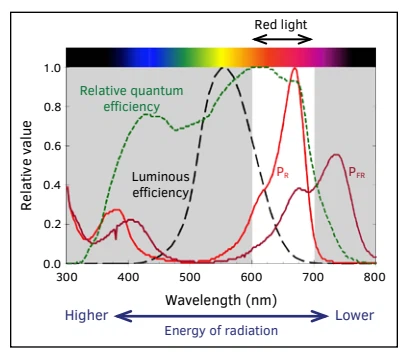
| Photosynthesis | Chlorophyll absorbs red light (600–700 nm) more efficiently than other wavelengths; the McCree curve shows red photons have the highest relative quantum efficiency. | Red light is the most electrically efficient way to drive biomass production. |
| Photomorphogenesis | Red light triggers shade-avoidance responses (stem elongation, leaf expansion) unless counterbalanced by blue light. | Red-only light produces tall, weak plants. The solution is a balanced red-to-blue ratio. |
| Photoperiodism | Phytochrome pigment detects red light to regulate flowering; just 1 µmol/m²/s of red light at night can inhibit flowering in short-day plants. | This is why greenhouse blackout curtains and night-interruption lighting are effective. |
Red light can be strategically applied thanks to these techniques. Let's begin with the red to far-red ratio, which is the most underutilised control lever.
2. Red to Far-Red (R:FR) Ratio: The Crucial Control Lever
Red light doesn't work on its own. The ratio of red (600–700 nm) to far-red (700–750 nm) light, or R:FR, has a significant impact on plant form.
Direct sunlight is indicated by high R:FR ratios (more red, less far-red). In response, plants grow compactly and develop shorter internodes. Shade from nearby plants is indicated by low R:FR ratios (less red compared to far-red). In response, plants stretch higher in an attempt to compete for light.
The following table lists the various R:FR ratios' effects on plant morphology as well as the situations in which they are applicable.
| R:FR Ratio | Morphological Effect | Application Scenario |
|---|---|---|
| High (>3:1) | Suppresses stretch; compact, dense structure | Indoor grows with height restrictions; greenhouse blackout rooms |
| Medium (2:1–3:1) | Balanced growth with moderate internode spacing | General vegetative growth for most crops |
| Low (<1.5:1) | Promotes stem elongation and leaf expansion | Producing long cuttings; adding height to overly compact plants |
One significant difference from MSU's research is that indoor sole-source lighting has a much greater effect on plant form than greenhouse supplemental lighting. Adding LED light with a precise R:FR is less important in greenhouses than it is in an indoor facility without windows because plants there already receive the whole spectrum of the sun.
Pro Tip: Increase overall light intensity proportionately if you supplement with far-red to encourage leaf expansion. This captures the advantage of greater leaf area while counteracting the stretching impact.
3. Red-to-Blue Ratios by Crop: An Information-Based Guide
Not every crop responds well to a single red-to-blue ratio. The following table summarises business practice and existing research into evidence-based foundations.
Crucial: These ratios are not universal recommendations; rather, they represent verified starting points. Optimal ratios are influenced by facility limitations, cultivar selection, and environmental factors. Prior to complete deployment, do small-scale experiments for validation.
| Crop | Recommended Red:Blue Ratio | Source | Key Notes |
|---|---|---|---|
| Cucumber (Seedlings) | 9:1 | Wang et al. 2024 (PMC) | Highest biomass at 100 µmol/m²/s; blue light added primarily for photomorphogenic control |
| Tomato | 7:3 to 8:2 | Literature Review | Maintain slightly higher blue during flowering to promote compact fruit sets |
| Lettuce | 8:2 to 9:1 | Literature Review | Higher red ratios favor leaf biomass; add minimal blue to prevent tip burn |
| Cannabis (Flowering) | 8:2 to 9:1 | Commercial Practice | Pair with UV supplementation during late flower for trichome development |
The data on cucumbers is especially useful. After testing seven red-to-blue ratios, Wang et al. (2024) discovered that 9:1 yielded the maximum biomass. But biomass was greatly decreased by pure red light, indicating that even 10% blue light is crucial. The study also showed that whereas red light maintains the steady-state photosynthetic rate that propels yield accumulation, blue light speeds up a plant's photosynthetic reaction to abrupt changes in light (photoinduction rate).
Grower's Takeaway: When creating a spectrum, begin with the red-to-blue ratio found in the above chart and make adjustments in response to plant responses. Increase blue light by 5% if plants are stretching excessively. If growth is too compact, reduce blue or add a small amount of far-red.
4. Handling Red Light Throughout Growth Stages
Yield and quality are left on the table by a set spectrum from seed to harvest. This is how the red light strategy ought to change as the crop cycle progresses.
4.1 Germination of Seeds
While not all seeds need light to germinate, red light acts as an environmental trigger for photoblastic seeds, such as lettuce and certain herbs. During imbibition, a brief exposure to red light (660 nm) breaks dormancy and starts germination. Before seedlings are transferred to the main grow room, this is usually done in germination chambers in commercial operations.
Practical advice: Applying a red-light treatment during the first 24 hours of the germination cycle will enhance uniformity if you have trouble with uneven germination in light-sensitive crops.
4.2 Stage of Vegetation
Building a solid foundation for future yield is the goal of the vegetative stage. Excessive stretching is the main danger here.
Strategy: Keep the red-to-blue ratio at about 8:2. This maximises photosynthetic efficiency with red light while supplying enough blue light (10–20%) to prevent strain. Increase the quantity of blue light before modifying the overall intensity if your plants have thin stems or extended internodes. More often than not, stretching is a spectrum issue rather than a brightness issue.
Using flowering-stage lights (high red, increased far-red) during vegetative development is a common mistake. Tall, feeble plants with weak structural integrity are the result of this.
4.3 Stage of Flowering and Fruiting
Plants require more red light after they reach the reproductive stage. Red light should be maximised at this time for two reasons: photoperiodic signalling and photosynthetic efficiency.
Method: Change the red-to-blue ratio to about 9:1. To prevent stretch during the crucial early-flowering window, make sure your R:FR ratio remains over 2:1. Any disruption of darkness with red light, even at extremely low intensity, can cause blooming to be delayed or disrupted in photoperiod-sensitive short-day plants. During the dark time, use absolute blackout.
4.4 Finishing and Ripening
Some producers use a finishing spectrum in the last one to three weeks prior to harvest.
Advanced Strategy: To replicate late-season circumstances, slightly lower the overall light intensity (to about 700–800 µmol/m²/s from a peak of 900–1050). Keep your red ratio high. In order to achieve a tighter ultimate bud shape, some growers minimise far-red during this period; nevertheless, there is currently little research on this strategy. This is not a need, but rather an optimisation step. Prioritise mastering the earlier phases.
5. Red Light in Action: Selecting and Applying LED Grow Lights
It's one thing to comprehend red light theory. Another is choosing the appropriate hardware to carry out your plan. These are the main things to think about.
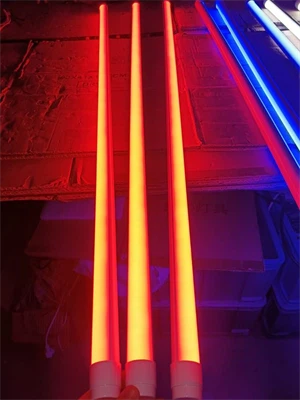
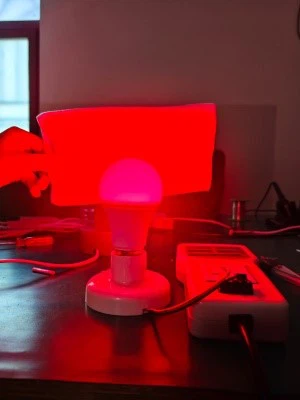
Red LEDs at 630 nm vs 660 nm
In horticulture, the two most used red LED wavelengths have distinct functions. Their features are described in the comparison that follows.
| Wavelength | Characteristics |
|---|---|
| 630 nm (Orange-Red) | Less expensive; historically used in early LED fixtures; slightly lower photosynthetic efficiency |
| 660 nm (Deep Red) | Closer to chlorophyll absorption peak; highest quantum efficiency; preferred for modern horticulture LEDs |
Nowadays, the majority of high-end horticultural LED lamps employ 660 nm chips as their main red source, occasionally adding a tiny amount of 630 nm to expand the red spectrum.
Red LEDs' Efficiency Advantage
When it comes to converting watts into photosynthetic photons, red LEDs are the most electrically efficient. This explains why commercial fixtures often transmit 75–85% of their spectrum in the red region, according to MSU's findings. Instead of focusing only on lumens or watts when comparing fixtures, consider the photosynthetic photon efficacy (PPE) rating, which is expressed in µmol/J. More photosynthetic light is produced per unit of power when the PPE is higher.
Channel Control and Dimming
You need spectrum adjustability in order to apply the stage-based solutions described in Section 4. Seek out fixtures that have dual-channel (or multi-channel) control so that the red and blue/white channels can be dimmed separately.
Explore our range of full-spectrum LED fixtures with independently adjustable red-to-blue ratios →https://www.benweilight.com/professional-lighting/grow-light-for-plants.html
6. State-of-the-Art Studies: Dynamic Photosynthesis and More
Dynamic photosynthesis is a notion introduced in a 2024 study on cucumber seedlings (Wang et al., published in Plants) that will probably influence the future generation of spectrum techniques.
According to the study, blue light prepares a plant's photosynthetic machinery to respond more quickly to abrupt changes in light, like passing clouds or wind-blown leaves. In contrast, the steady-state photosynthetic rate that builds up biomass over hours and days is maintained by red light. To put it another way, plants are receptive to blue light and productive to red light.
Additionally, the researchers examined the performance of seedlings pre-treated under various red-to-blue ratios under "fluctuating light" circumstances, which replicate real-world variability by changing light intensity every 15 minutes. The seedlings that were cultivated with pure blue light and a 9:1 red-to-blue ratio fared the best under these variable circumstances.
Adaptive lighting systems that modify spectrum in real time based on environmental variables are suggested by this line of research. For the time being, the practical implication is obvious: the optimal balance between steady-state productivity and dynamic adaptability is provided by a balanced spectrum based on red light, with just enough blue to preserve responsiveness.
In conclusion
Although it is not a stand-alone input, red light is the most effective activator of photosynthesis. The red-to-blue ratio, which shapes plant architecture, the red-to-far-red ratio, which controls stretching, and the stage-specific adjustments that match spectrum to plant development are the three factors that distinguish a grower who owns LED fixtures from one who actively manages them.
The crop-specific ratios listed in Section 3 should be used first. Observe the reactions of the plants. Make adjustments. The farmers who get the most out of their lighting investment are those who treat spectrum as an active management variable instead of a fixed setting.
FAQ
Q: 1. How do plants respond to red light?
A: Three main purposes of red light (600–700 nm) are to drive photosynthesis at the highest quantum efficiency of any visible wavelength, control flowering time through phytochrome-mediated photoperiod detection, and regulate plant shape (morphology) through red-to-blue and red-to-far-red ratios.
Q: 2. What ratio of red to blue light is ideal for plant growth?
A: There isn't just one ideal ratio. The crop and growth stage determine this. For the majority of fruiting and leafy crops, commercial facilities usually begin with 8:2 to 9:1 (red:blue) during the flowering and vegetative stages, respectively. For crop-specific references, see Section 3.
Q: 3. Can plants thrive under just red light?
A: They are able to endure, but not flourish. Because the plant "thinks" it is being shadowed, pure red light causes shade-avoidance responses, such as extended stems, thin leaves, and weak structure. Compact, robust development is restored with just 10–20% blue light.
Q: 4. How do 630 nm and 660 nm red LEDs differ from one another?
A: The absorption peak of chlorophyll is more closely matched at 660 nm (deep red), which provides greater photosynthetic efficiency. Although less costly, 630 nm (orange-red) is marginally less efficient per watt. The majority of contemporary horticultural LEDs give priority to 660 nm chips.
Q: 5. Describe the R:FR ratio and explain its significance.
A: The ratio of red light (600–700 nm) to far-red light (700–750 nm) is known as R:FR. Plants with a high R:FR (>3:1) remain compact. Leaf expansion and stem elongation are encouraged by a low R:FR (<1.5:1). It is one of the main methods for regulating plant form in the absence of chemical growth regulators.
Q: 6. How is flowering affected by red light?
A: The phytochrome pigment system, which controls flowering time in photoperiod-sensitive plants, detects red light. When evenings are lengthy and there is no exposure to red light during the dark period, short-day plants bloom. Long-day plants bloom during short nights or when the dark period is broken by red light.
Q: 7. What proportion of red light is ideal for tomatoes? Lettuce? Cannabis?
A: A common red-to-blue ratio for tomatoes is 7:3 to 8:2, with a little bit more blue during flowering. Higher red favours leaf biomass, and lettuce does best from 8:2 to 9:1. Cannabis in bloom is often grown at 8:2 to 9:1, and UV is frequently given in late flower to promote the production of trichomes. The complete reference table can be found in Section 3.