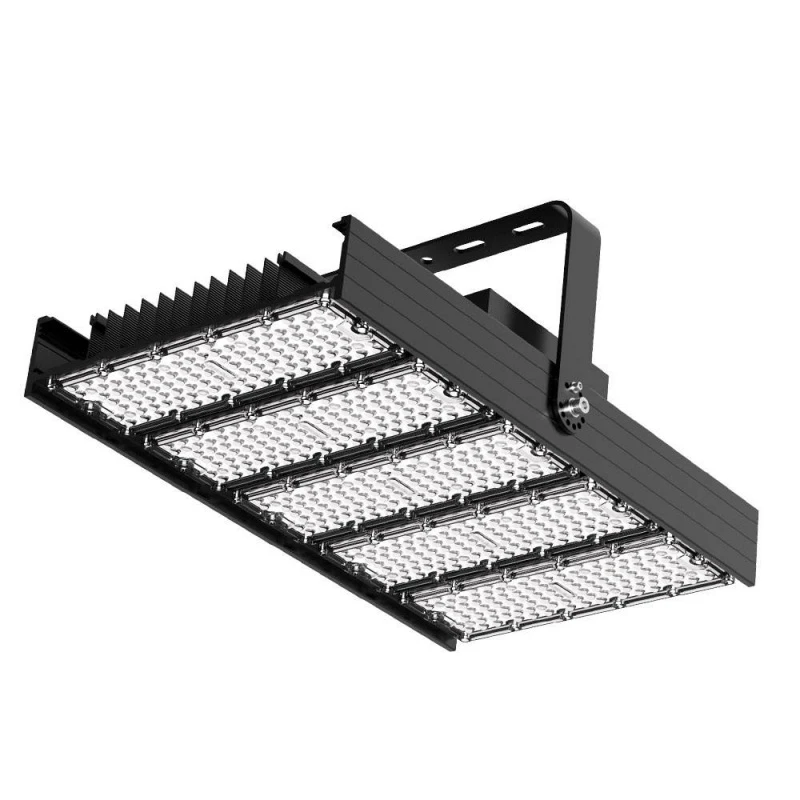
Many sports facility owners and project managers have encountered a frustrating issue: the lights are installed and meet the specified brightness parameters, yet at night, the center of the field is blindingly bright while the corners and areas near the goal lines remain shrouded in darkness. Players struggle to track the landing spot of high-arcing balls, and camera footage suffers from inconsistent, flickering exposure.
The problem usually isn't a lack of brightness, but rather how the lights are positioned, configured, and adjusted. Drawing on practical project experience, this article explores the keys to achieving uniform lighting on a football pitch-helping you avoid "dark zones" during the selection and design phases.
Understanding How Uniformity Is Measured
Uniformity is not a matter of subjective visual judgment; it is defined by specific, measurable metrics. The two most common ratios are:
Emin/Eavg: The ratio of minimum illuminance to average illuminance.
Emin/Emax: The ratio of minimum illuminance to maximum illuminance.
Requirements vary by competition level. Amateur training facilities have more relaxed standards, whereas venues intended for television broadcasting face much stricter criteria-often including requirements for vertical illuminance and uniformity from the perspective of the cameras. Before beginning the design, clarify the intended use of the facility with the owner; otherwise, any subsequent technical parameters are essentially meaningless.
Lighting Pole Configuration Determines Basic Light Distribution
There are three common layout configurations:
Four-Corner Layout: Poles are placed at each of the four corners of the pitch. This is cost-effective and requires minimal space, but it often results in dim areas along the sides of the center line, making it difficult to achieve high uniformity. It is best suited for training-level facilities.
Side-Mounted Layout: Poles are positioned along the sidelines. Light enters from the sides, providing better coverage in the center of the pitch and superior uniformity. This is the standard approach for competitive match venues.
Hybrid Layout: A combination of side-mounted and corner-mounted poles. While this is the most expensive option, it is capable of meeting even the most rigorous broadcasting requirements.
"Dark zones" are often created at this stage of the process. If one attempts to force high uniformity in a four-corner layout by simply increasing the power of the light fixtures, the result is typically excessive energy consumption and problematic glare.
Align Pole Height with Projection Angle
If a light pole is too short, the low angle of incidence causes rapid illumination decay toward the far side of the field, while the area near the pole becomes excessively bright. Conversely, if a pole is too tall, light is more likely to spill beyond the intended area, resulting in wasted energy.
A practical rule of thumb is to ensure that the angle between the pole and the line connecting the pole base to the furthest point of illumination is not too large. The exact value should be calculated based on the dimensions of the field and the light distribution characteristics of the fixtures. For large venues like soccer fields, it is advisable to use software such as DIALux or Relux for simulations rather than relying solely on rough estimates based on experience.
Select Fixtures with Appropriate Beam Angles
Within a single venue, different positions require fixtures with different beam angles:
Narrow beams (e.g., 10°–20°): Used for long-distance projection to illuminate the far side and distant areas of the field.
Medium beams (e.g., 30°–40°): Used for the mid-field and intermediate distances.
Wide beams: Used to fill in nearby areas, preventing dark zones from forming at the base of the light poles.
Using the same beam angle across the entire field is a common cause of "overexposure nearby and insufficient illumination in the distance." High-quality LED sports lighting offers a variety of distribution options, allowing for tailored selection based on the specific location of each fixture.
Control Glare: Don't Let "Uniformity" Turn into "Blinding Light"
Achieving uniform illumination is pointless if players are blinded by the lights when looking up to receive the ball. Key considerations include:
Whether the fixtures are equipped with anti-glare shields or louvers.
Ensuring the installation tilt angle is not excessively high.
Verifying that the Glare Rating (GR) falls within the required standard range.
Goalkeepers and players on the flanks are typically the most sensitive to glare; therefore, visual comfort in the goal areas should be a priority during the design process.
Post-Installation Aiming and Adjustment Are Essential
This step is frequently overlooked: even the most well-crafted simulation is rendered useless if the lights are not aimed according to the design specifications.
Once installed, each fixture must be individually adjusted for its projection direction. Furthermore, actual illuminance levels should be measured at specific grid points across the field and compared against the design values, with adjustments made as necessary. It is recommended to label each light fixture with a unique number and its designated aiming point before installation begins; this will prevent confusion during the commissioning and adjustment phase.
Maintenance and Lumen Depreciation Management
Over time, the luminous flux of light fixtures will decline. Since the rate of decay can vary depending on the fixture's location, the overall uniformity of the lighting may gradually deteriorate. Here are a few recommendations:
Select fixtures with low lumen depreciation rates and superior thermal management (heat dissipation) designs.
Incorporate an appropriate maintenance factor into the initial design.
Clean the surfaces of the light fixtures regularly; accumulated dust can significantly reduce light output.
Periodically re-measure the illuminance levels across the field.
Summary
Achieving uniform lighting on a football pitch boils down to the following core approach:
Define the facility's classification and the required uniformity standards.
Prioritize a side-mounted or hybrid lighting layout to minimize dark zones.
Calculate pole heights and aiming angles using professional simulation software.
Select fixtures with appropriate beam angles based on their specific positions.
Manage glare to ensure visual comfort for the players.
Verify aiming points through on-site measurements after installation and implement a long-term maintenance plan.
In short, lighting uniformity is the result of a combination of "design, hardware (fixtures), and commissioning." Neglecting any of these aspects will inevitably lead to the emergence of dark zones.
Want to eliminate dark zones on your pitch?
We specialize in LED sports facility lighting. We offer complimentary DIALux lighting simulations tailored to your pitch dimensions, existing pole infrastructure, and the required competition standard. We will provide recommendations on fixture models, quantities, and layout, complete with an illuminance distribution map.
Please send us your pitch dimensions, details regarding existing light poles, and your specific requirements; our engineers will respond within 24 hours. Contact us today to receive a customized lighting solution and a formal quote.