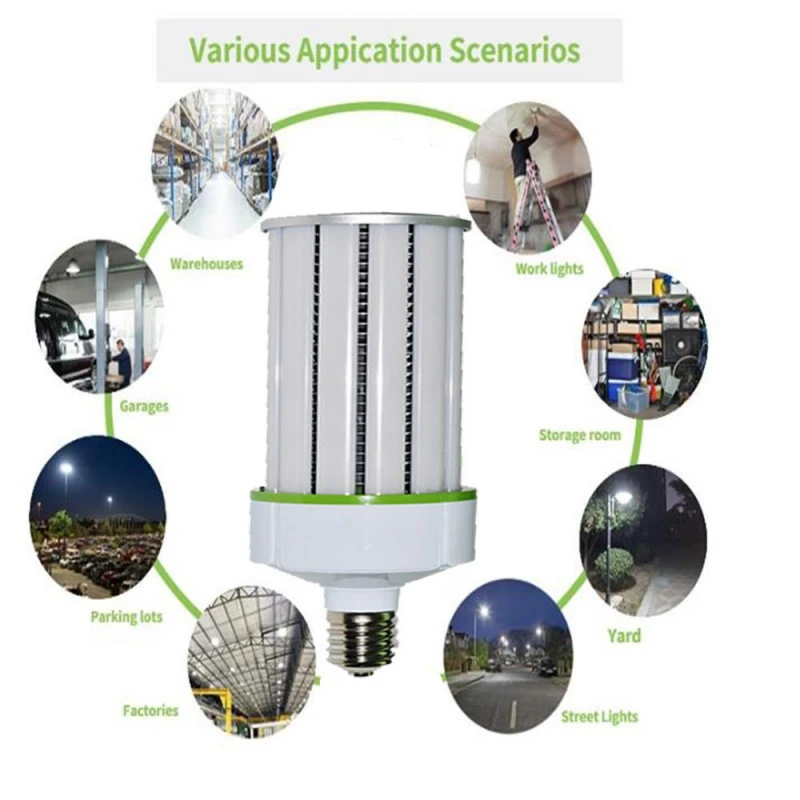
In the lighting procurement business, I am frequently asked the same question by clients: "How long do your corn lights actually last?" The packaging claims 50,000 hours, yet some clients report the lights turning dark or dim after just over a year of use. What accounts for this discrepancy? Today, I'm going to break down the issue of corn light lifespan-no fluff, just practical, technical insights.
Rated Lifespan ≠ Actual Lifespan: Understanding "L70"
The "50,000 hours" or "100,000 hours" figure on the packaging doesn't actually refer to how long the bulb stays lit; rather, it represents a standard industry metric for light output degradation known as L70.
L70 is defined as the time it takes for an LED chip's luminous flux to drop to 70% of its initial value under specific testing conditions. In other words, theoretically, after 50,000 hours of use, the light retains about 70% of its original brightness-it doesn't simply burn out completely. This figure is derived from industry standards LM-80 and TM-21; it is calculated using mathematical models based on accelerated aging data collected by chip manufacturers under specific temperature and current conditions.
This is where the issue arises: the figure is a projection based on "ideal laboratory conditions" and does not necessarily reflect how the fixture will perform in a real-world setting. Factors such as on-site heat dissipation, voltage fluctuations, and switching frequency can significantly compromise the actual lifespan if they fall short of requirements. Consequently, when clients feel a product "isn't as durable as advertised," the problem often lies not with the light itself, but with a misunderstanding of what that number actually means.
Four Key Variables Determining Corn Light Lifespan
Two corn lights with the same nominal 50,000-hour rating can differ in actual lifespan by a factor of two or three. The reasons lie in the following four areas:
Quality of the LED Chip Itself
The chip is the heart of the corn light. Chips from top-tier manufacturers offer excellent consistency and stable degradation curves. To cut costs, low-priced alternatives often use chips from second- or third-tier suppliers-or even old stock-which degrade much faster; some may show visible yellowing or dimming after just six months.
Lifespan of the Driver
There is a consensus in the industry: when a corn light fails, the component that usually gives out first isn't the LED chip, but the driver. Electrolytic capacitors are the most vulnerable components in the driver; they are sensitive to high temperatures and high ripple currents. Once a capacitor bulges and fails, the entire lamp stops working-even if the LED chips themselves remain intact. Therefore, the quality of the driver often plays a more critical role in the lamp's overall lifespan than the chips do.
Thermal Design
Corn lamps have a unique structure with LED chips arranged in a ring around the central column, making heat dissipation inherently more challenging than in flat-panel fixtures. Factors such as the thickness of the aluminum substrate, the design of the heat sink fins, and whether the housing is made of thermally conductive aluminum alloy directly affect the LED chip's junction temperature. It is a widely accepted rule of thumb in the industry that for every 10°C rise in junction temperature, the LED's lifespan is roughly cut in half.
Operating Environment
Environments characterized by high dust levels, high humidity, or enclosed fixtures lacking convective cooling accelerate degradation. This explains why the lifespan of the exact same corn lamp can vary drastically depending on whether it is installed in an open factory space or inside an enclosed fixture.
Common Causes of Premature Corn Lamp Failure
Based on customer feedback, premature failure generally stems from the following scenarios:
Poor heat dissipation in enclosed fixtures: Many customers install corn lamps directly into enclosed housings originally designed for high-pressure sodium lamps without considering that LEDs are sensitive to heat (though not cold). Heat accumulates inside the housing, causing the chip junction temperature to skyrocket and drastically shortening the lamp's lifespan.
Unstable voltage or poor power grid quality: In some industrial parks or older factory buildings, significant voltage fluctuations force the driver to operate outside its rated voltage range for extended periods, accelerating capacitor aging.
Frequent switching: Although LEDs themselves are not harmed by frequent switching (an advantage over traditional light sources), low-quality drivers can generate surge currents during frequent power cycling, accelerating the wear and tear of internal components.
Protection rating mismatch: Using an IP20-rated lamp in an outdoor or humid environment allows water and dust ingress, leading to circuit board corrosion. Such failures are not truly related to the lamp's inherent "lifespan" but rather stem from incorrect product selection.
How to determine when a corn light needs replacing
You don't have to wait until the light stops working completely; look out for these signs:
Noticeable dimming-subjectively appearing more than 30% dimmer than a new light;
Color shift toward yellow or blue-a clear difference when compared side-by-side with a new light from the same batch;
Flickering or unstable brightness-likely indicating that the driver capacitor is aging;
Blackening on the light body-especially near the driver compartment-indicating severe internal overheating.
If any of these signs appear, the light has likely reached the end of its service life; continued use will result in reduced luminous efficacy and energy efficiency, so replacement is recommended.
Tips for selecting and using corn lights to ensure greater durability
As a supplier, we generally offer customers a few practical recommendations:
Prioritize products using chips from major brands and drivers from reputable manufacturers; while the initial purchase price may be higher, the Total Cost of Ownership (TCO) is actually lower;
Select the appropriate IP protection rating based on the installation environment; do not choose a low-protection rating just to save money when installing in outdoor, humid, or dusty areas;
Ensure adequate heat dissipation space when retrofitting old fixtures-especially when replacing high-pressure sodium or metal-halide lamps in enclosed housings; it is best to add ventilation holes or switch to an open-style fixture;
Use a voltage stabilizer; if the local power grid is unstable, installing voltage regulation equipment can significantly extend the driver's lifespan;
Request LM-80/TM-21 test reports from the supplier rather than relying solely on the promotional figures on the packaging; these reports provide actual test conditions and lumen depreciation curves, offering much greater value for assessment.
Summary
The lifespan of a corn light is not merely a numbers game. Nominal figures like "50,000 hours" are simply projections based on chip depreciation under ideal test conditions. The actual lifespan of the complete unit is determined by the interplay of several factors: driver quality, thermal design, chip consistency, and the operating environment. When selecting a light, asking questions like "What driver solution is used?", "How thick is the heat sink?", and "Is there a third-party test report?" is far more reliable than simply looking at an impressive lifespan figure. If you are selecting corn lights for a project, or have concerns regarding issues such as lumen depreciation, blackening, or flickering in your current lighting, please share your application details with us-including the installation environment, fixture type, and voltage conditions. Based on these specifics, we can determine the appropriate chip, driver solution, and protection rating, and provide the corresponding test reports. We welcome your inquiries at any time.