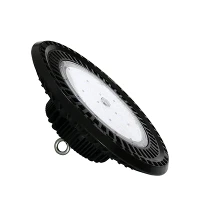
Planning guidance on lighting mounting height and beam angle.
Choosing the Beam Angle for a UFO LED High Bay
Short answer: choose the beam angle mainly by mounting height, then check it against fixture spacing and target lux.
1. Start with mounting height
| Mounting height | Typical beam angle |
|---|---|
| 4-6 m (13-20 ft) | 120° |
| 6-9 m (20-30 ft) | 90° |
| 9-12 m (30-40 ft) | 60° |
| 12 m+ (40 ft+) | 60° or narrower (30°-45°), often with a reflector |
The higher the fixture, the narrower the beam you need to keep light on the work plane instead of the walls and upper structure.
below is 8meter heigh with 120 degree beam angle lux diagram , the lux is not enough for 8meter height installation with 90degree beam angle

below is 8meter heigh with 90 degree beam angle lux diagram , the lux is enough for 8meter height installation with 90degree beam angle

2. Check spacing
For even lighting, the beams should overlap at the work plane. Approximate coverage diameter:
D ≈ 2 × (H − work plane height) × tan(θ/2)
For example, at 8 m height with a 0.8 m work plane and a 90° beam, D ≈ 2 × 7.2 × tan(45°) ≈ 14.4 m. A good fixture spacing is about 0.8-1.2 times the mounting height (narrower beams need tighter spacing). Spacing wider than the coverage gives dark patches between fixtures.
3. Match the application
Wide (120°): low ceilings, supermarkets, light-assembly areas, workshops where uniform, shadow-free light matters
Medium (90°): general warehouses and factories with medium-height ceilings
Narrow (60° or less): tall buildings, high-bay racking, loading docks
Narrow aisles with tall racks: a narrow or asymmetric/batwing distribution reaches the vertical rack face better than a wide beam, which mostly hits the rack tops
4. Trade-offs
Narrow beam: higher center lux and better reach, but a spotty look, more glare, and a need for tighter spacing.
Wide beam: more uniform and less glare, but lower lux on the floor and more light lost to walls.
5. Practical steps
Note the mounting height, room size and work plane height.
Set the target illuminance (typically 150-300 lux for warehouses, 300-500 lux for assembly).
Pick a beam angle from the table, then simulate in DIALux or Relux with the manufacturer's IES file. This is the only reliable way to confirm uniformity (aim for U0 ≥ 0.4-0.6) and glare.
Consider reflective walls and ceiling colors, since light surfaces let you use a wider beam.
6. Spec-sheet notes
Beam angle is normally defined at 50% of peak intensity. The field angle (10%) is wider, so the actual lit area is larger than the beam angle suggests.
UFO high bays commonly come in 60°, 90° and 120°. Some offer swappable lenses or reflectors, which gives flexibility if the layout changes.
If you tell me your mounting height, room dimensions, and target lux, our company can estimate a beam angle and the number of LED fixtures needed. you can see more information on http://www.benweilight.com
90degree beam angle UFO LED highbay light as below :

120degree beam angle UFO LED highbay light as below: