The Problem No One Measures Until It Is Too Late
Walk into any retail store, hotel corridor or high-end residential project after the second lighting refurbishment cycle, and the symptom is obvious: some fixtures glow bright white, others have faded to a dull yellow, and the overall lumen uniformity has collapsed. The maintenance crew blames the LED chips. The contractor blames the driver. Almost nobody points at the component that actually decides the fixture's future: the heatsink buried inside the ceiling cavity.
Light degradation is not a chip-quality lottery. It is a predictable, physics-driven consequence of how hot the LED junction runs over thousands of operating hours. The good news is that it is controllable. The better news is that once you understand the thermal chain, the difference between a budget downlight and a premium one becomes immediately legible on a spec sheet.
Why Recessed Fixtures Are The Worst Case
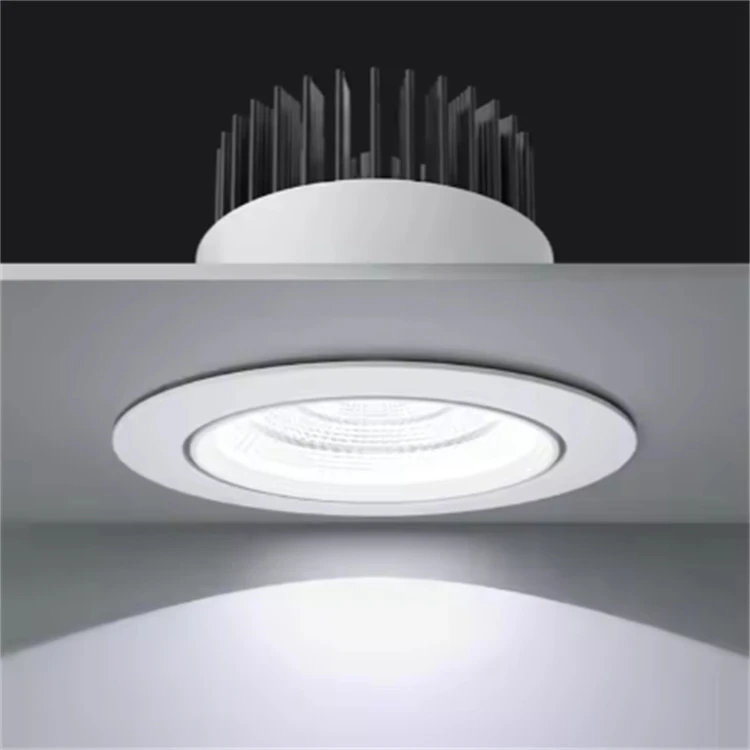
Recessed downlights are the hardest possible cooling environment in mainstream lighting. The LED sits inside an enclosed, insulated ceiling void - a sealed black box with almost no natural convection. Heat that an exposed pendant or track light would shed to open air has nowhere to go except through the fixture's own body. That is why cheap recessed lights decay fastest: they are placed in the worst thermal location and fitted with the smallest, most porous heatsink.
What This Article Delivers
By the end of this guide you will understand the causal chain between junction temperature and lumen loss, the metallurgical difference between cast, extruded and cold-forged aluminum, the system-level choices (driver, binning, enclosure, protection ratings) that compound heatsink performance, and a concrete checklist for qualifying any COB recessed downlight before purchase.
Understanding LED Light Degradation
What Lumen Maintenance And L70 Really Mean
Every LED loses brightness over time. The industry measures this as lumen maintenance: the percentage of initial lumens the fixture still produces after a defined operating period. The universal benchmark is L70 - the operating time after which luminous output has fallen to 70% of its rated value. A fixture rated L70 at 50,000 hours still delivers 70% of its original light after running roughly 5.7 years around the clock; a budget fixture rated L70 at 15,000 hours is effectively half-dead before the first maintenance cycle even begins.
Crucially, L70 is not a marketing number chosen at random. It is derived from accelerated thermal testing, and its accuracy depends entirely on whether real-world operating temperatures match the test assumptions. Put the same LED in a hot ceiling cavity and its true L70 can collapse to a fraction of the rated figure.
The Dominant Driver: Junction Temperature (Tj)
The LED junction is the microscopic point inside the chip where light is generated. Every 10 °C rise in junction temperature roughly doubles the rate at which the phosphor and semiconductor materials age - an Arrhenius-style acceleration that is the most cited relationship in LED reliability. Run a chip at 105 °C instead of 85 °C, and its useful life can be cut by half or more, even if the component itself is identical in every other respect.
Heat does three things at once:
Phosphor thermal quenching. The yellow phosphor layer that converts blue die light into warm white degrades and shifts color as it overheats, causing the familiar yellowing and chromaticity drift.
Solder and bond-wire fatigue. Cyclic expansion and contraction at high temperature cracks die attach layers and weakens electrical bonds, leading to premature failure rather than gentle dimming.
Optics and reflector aging. Plastic reflectors and lens yellow under sustained infrared and heat, further reducing usable lumens.
The Recessed-Light Thermal Trap
In an open luminaire, waste heat (typically 65–80% of input power) escapes upward into the room. In a recessed fixture, the ceiling void acts as an insulator: heat radiates back onto the fixture body, and without a properly designed heatsink the body itself becomes an oven. The result is a self-reinforcing loop - hotter fixture, hotter junction, faster degradation, which generates yet more heat per useful lumen.
LM-80 And TM-21: Honest Longevity Claims
Two industry standards underpin any credible lifetime number. LM-80 is the IESNA test method that measures lumen depreciation of the LED package itself at controlled case temperatures (typically 55 °C, 85 °C and up to 1000 hours minimum, usually run for 6,000–10,000 hours). TM-21 is the calculation method that extrapolates those measured results forward to an L70 figure. The trap for buyers: LM-80 is measured on the bare LED package on a test board, not inside a recessed ceiling. A package rated L70 at 85 °C can deliver far less at a real-world case temperature of 105 °C. A reputable fixture manufacturer therefore re-runs or re-derives the system L70 at its actual measured case temperature - and a cold-forged sink is exactly what keeps that case temperature low enough for the extrapolation to hold.
The Mechanics Of Heat Extraction
The Thermal Chain: Junction To Ambient
Cooling an LED is a relay race with fixed thermal resistance at every leg. Heat must travel through a series of interfaces before it reaches room air:
LED Junction → Solder / Die Attach → MCPCB (Metal Core Printed Circuit Board) → Thermal Interface Pad → Heatsink Base → Heatsink Fins → Convection To Air.
Every contact point adds thermal resistance measured in °C/W. A weak link anywhere in the chain - a porous sink, a dry interface pad, fins too short to dissipate heat - caps the entire system's cooling performance, no matter how good the LED chip or driver is. The heatsink base and fins are the longest, largest leg of that chain, which is why they deserve the most engineering attention.
Why Aluminum Remains The First Choice
Copper conducts heat better but is heavy, expensive and difficult to fin. Aluminum - specifically high-purity wrought grades - offers thermal conductivity in the 200–230 W/m·K range at a fraction of copper's weight and cost, and it can be formed into the high-surface-area geometries convection needs. The practical question is never "aluminum or not"; it is "which aluminum, made by which process, with what fin geometry?"
Cast, Extruded And Cold-Forged: Three Processes, Three Outcomes
Most buyers compare wattage and lumens on a spec sheet. The hidden difference between fixtures lives in how the heatsink was manufactured. Die casting, extrusion and cold forging sound interchangeable; thermally, they are not.
|
Attribute |
Die-Cast Aluminum |
Extruded Aluminum |
Cold-Forged Aluminum |
|---|---|---|---|
|
Material density |
Contains micro-porosity from solidification shrinkage; pores scatter heat flow |
Dense wrought structure, but cross-section limited by die width |
Fully dense, pore-free grain flow aligned with heat paths |
|
Effective thermal conductivity |
Lower, roughly 90–130 W/m·K, limited by alloy and porosity |
Good, ~180–200 W/m·K for 6000-series |
Excellent, up to ~226 W/m·K with 1070 high-purity aluminum |
|
Fin geometry |
Thick, blunt fins; limited fin height and spacing due to die draft angles |
Uniform fins but straight-cut; aspect ratio limited |
Tall, thin, densely packed fins with tapered tips that maximize surface area |
|
Base flatness / contact |
Can warp; post-machining needed for flat mating to PCB |
Flat but may need interface layer |
Press-forged flat base with no porosity, minimizing thermal interface resistance |
|
Best role |
Housings, bezels, structural parts (ADC12 alloy) |
Linear lights, simple rectangular sinks |
High-power point-source sinks (COB downlights) where every degree counts |
Cold-Forged Aluminum Heatsink Explained
The Cold-Forging Process
Cold forging forms aluminum at room temperature (or slightly warm) by pressing a solid slug with hardened steel dies under very high pressure. Unlike die casting, which melts metal and lets it cool in a mold, cold forging never liquefies the material. The grain structure is physically compressed and deformed into the desired fin shape rather than poured around it. The result is a heatsink with zero internal voids and a continuous grain flow that follows the heat path from base to fin tip.
Why The 1070 Aluminum Grade Matters
Thermal conductivity in aluminum is directly tied to purity. Alloying elements added for strength - silicon, copper, magnesium - scatter electron movement and drag thermal conductivity down. 1070 aluminum is a high-purity wrought grade (≈99.7% Al), chosen precisely because it preserves the metal's native thermal conductivity of roughly 226 W/m·K. Cold forging also gives it enough mechanical strength without dilution alloying. In practical terms, a 1070 cold-forged sink moves heat out of a COB chip measurably faster than a cast ADC12 sink of identical footprint.
Dense Fin Geometry And Surface Area
Cooling happens at the surface, not the mass. Because cold forging can push metal into tall, thin, tightly spaced fins without the draft angles and thickness constraints of casting, a cold-forged sink packs dramatically more fin surface area into the same recessed-cutout footprint. More surface area means more convective exchange with whatever limited air sits in the ceiling cavity - exactly the margin a trapped, enclosed fixture needs.
A Pore-Free Thermal Interface
Porosity in a cast heatsink base acts like millions of tiny air pockets at the PCB interface. Air is a terrible conductor, so every pore raises thermal resistance between the LED board and the sink body. The press-forged base of a cold-forged sink is dense and flat, reducing that interface resistance and ensuring the thermal pad performs as designed rather than compensating for a poor surface.
What This Means In Degrees, Not Adjectives
The commercial outcome is concrete: by keeping junction temperature lower across the fixture's life, a cold-forged 1070 sink slows phosphor aging, stabilizes chromaticity and holds lumen output near its initial value for the full rated duration. That is the mechanical reason a well-built COB downlight can honestly claim L70 at 50,000 hours rather than repeating a lab rating that real ceiling conditions will never reproduce.
System-Level Strategies That Protect Lumen Output
A heatsink is necessary but not sufficient. Light degradation is controlled by the whole system working together. Five supporting choices decide whether the cold-forged sink's advantage survives in the field.
Right-Sizing, Low-Stress LED Loading
Running a COB chip at the lower end of its rated current range - "current derating" - directly lowers junction temperature and slows degradation. Premium fixtures deliberately load the LED conservatively, pairing a high-quality COB with an oversized sink so the chip never has to strain to hit target lumens. Under-driven LEDs run cooler, color stays stable, and L70 arrives later.
The Driver Is Part Of The Cooling Story
A flickering or inefficient driver does more than annoy occupants; it wastes energy as additional heat inside an already hot cavity. An isolated constant-current driver with power factor above 0.95 and flicker-free output keeps the electrical stress on the LED low, protects against current surges, and minimizes self-heating. PF > 0.95 also reduces distribution losses, meaning less waste heat generated upstream. The driver and heatsink are partners: a great sink cannot rescue a stress-heavy driver, and vice versa.
Enclosure Design: ADC12 Die-Cast Bezel And Airflow
The housing is not just cosmetic. A rigid ADC12 die-cast aluminum inner and outer bezel acts as a secondary heat-spreading path and a mechanical shield that protects the cold-forged core. In white, black or silver finishes, it also maintains structural rigidity and scratch resistance over years of installation and maintenance. Where ceiling-code allows, controlled venting around the bezel helps convection move trapped heat away from the sink.
IP65 And Fire-Rated: Protection Without Thermal Compromise
Buyers often assume ingress protection kills cooling. It does not have to. An IP65 rated fixture is fully dust-tight and protected against water jets from any direction, which suits bathrooms, kitchens, covered outdoor ceilings and humid retail zones. Combined with a fire-rated construction for recessed ceiling installations, the fixture meets building safety codes - but only if the sealing design still lets the cold-forged sink breathe and dissipate. When the thermal path is engineered first and the gasketing second, protection ratings add safety without sacrificing the L70 target.
Anti-Glare Optics As A Degradation Buffer
A precision reflector does more than control glare and beam angle (24° / 38° / 60° options for accent or ambient light). A well-designed optical system extracts and directs photons efficiently, which means the LED does not need to be overdriven to achieve target brightness - another form of thermal derating. Anti-glare cut-off also keeps the source hidden visually, preserving comfort while the behind-the-ceiling thermal system does its work.
How To Evaluate A Downlight Before You Buy
The Spec-Sheet Red Flags
Budget fixtures compete on raw lumens and price. Use these signals to separate a thermally serious product from a paper-only one:
No explicit L70 / lumen-maintenance claim. A fixture that only states "lifespan 50,000h" without L70 wording is borrowing an LED chip rating, not a system rating.
Vague heatsink description. "Aluminum housing" tells you nothing. Look for cold-forged / 1070 aluminum specifically, and fin geometry detail.
No thermal or Tj data, no LM-80 / TM-21 reference. Legitimate long-life claims trace back to these test standards.
Cheap non-isolated driver, PF < 0.9, visible flicker. A tell-tale sign the LED will run hotter and age faster.
High CRI claimed but no binning consistency. Inconsistent bins across a project mean uneven aging and poor color uniformity over time.
Questions To Put To Your Supplier
What aluminum grade is the heatsink, and is it die-cast, extruded or cold-forged?
What is the rated L70 at the actual fixture-case temperature, not the lab Tj?
Is the driver isolated, flicker-free, and what is its power factor?
Is the fixture IP65 and fire-rated, and how is sealing designed without blocking heat dissipation?
What beam angles and fixed / tilt-adjustable versions are available for the same thermal platform?
The Premium-Platform Checklist
|
System Element |
What To Specify |
Degradation Benefit |
|---|---|---|
|
Heatsink |
1070 cold-forged aluminum, dense fin array, pore-free base |
Maximum heat extraction, lower Tj, slower lumen decay |
|
LED source |
High-CRI COB, conservatively current-loaded |
Stable color, reduced phosphor aging |
|
Driver |
Isolated constant-current, flicker-free, PF > 0.95 |
Electrical stress relief, less self-heating |
|
Housing |
ADC12 die-cast bezel, rigid, scratch-resistant finishes |
Secondary heat spreading and structural protection |
|
Protection |
IP65 dust-tight / water-jet sealed, fire-rated recessed build |
Code compliance without thermal compromise |
|
Lifetime |
L70 ≥ 50,000 hours under rated conditions |
Minimal maintenance and relamping cost over the project life |
The Result: A System Built To Hold Light For 50,000 Hours
The COB Recessed Downlight Platform
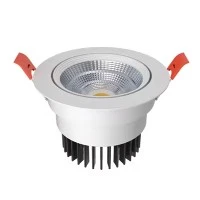
Put those pieces together and you arrive at a premium COB recessed downlight designed around thermal integrity rather than cost-down. Its core is a 1070 cold-forged aluminum heatsink with a dense fin array that pulls heat away from a high-CRI COB chip. An isolated, flicker-free constant-current driver rated above 0.95 power factor feeds the chip cleanly. An ADC12 die-cast bezel in white, black or silver provides rigidity and a finished ceiling look, while an IP65, fire-rated enclosure protects the whole assembly in damp and code-sensitive ceiling zones. Anti-glare reflectors offer 24°, 38° and 60° beam angles, in both fixed and tilt-adjustable versions, and a male–female quick connector speeds installation on large projects.
The Commercial Payoff
Light degradation is a financial issue, not just a lighting one. A fixture that holds 90% of its lumens at 30,000 hours means a retail store never looks washed out, a hotel never has to dim its brand experience, and a specifier never faces a maintenance call-back. Fewer early failures, fewer relamping crews, fewer ladder hours and lower energy bills thanks to high PF - the higher unit cost of a cold-forged, IP65, fire-rated platform is recovered across years of avoided maintenance. That is the real buying argument: you are not paying for a brighter first night; you are paying for the same bright night, year after year.
Where It Performs Best
This thermal architecture is purpose-built for the environments where trapped heat and long operating hours collide: high-end retail and shop accent lighting, hotel lobbies and corridors, restaurant and hospitality ceilings, museums and gallery accent spots, and premium residential recessed installations - especially in bathrooms, kitchens and covered outdoor ceilings where IP65 and fire-rated compliance are required.
Conclusion
Light degradation in recessed ceiling lights is not inevitable, and it is not random. It is the measurable result of running an LED junction too hot for too long - and the single most effective lever a buyer controls is the quality of the heatsink. A cold-forged 1070 aluminum sink, paired with a high-CRI COB, an isolated high-PF flicker-free driver, a rigid ADC12 housing and a properly engineered IP65 / fire-rated seal, is what converts a lab L70 number into a real-world 50,000-hour lighting asset.
Next time you evaluate a recessed downlight, stop comparing only watts and initial lumens. Ask about the aluminum grade, the forging process, the driver isolation, the protection ratings and the honest L70 claim. That is where long-lasting light - and long-term project value - is actually engineered in.
How To Cooperate With Us?
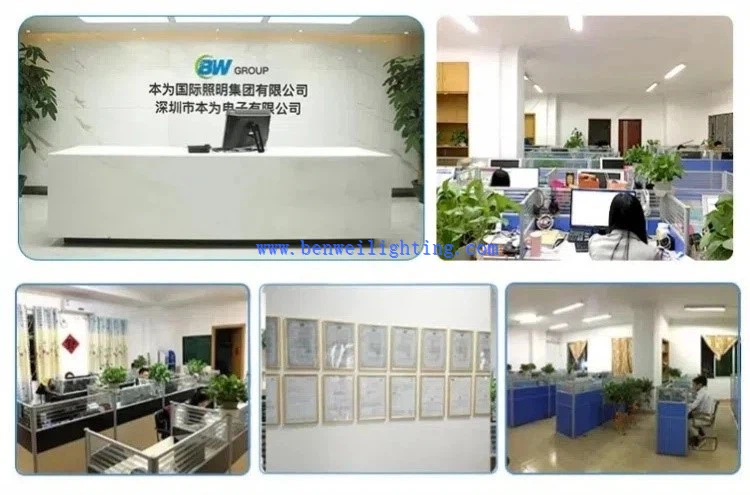
We are happy to have total control over the manufacturing process and the calibre of our products since we have our own facilities. Since we are producers rather than just brokers, we are dedicated to providing our customers with the best pricing. Since we are certain that the price and quality of our products are clear, we invite customers to see our samples first. Our commitment to quality and customer satisfaction drives us to continuously provide top-notch goods.
Our address
3rd Floor, 5th Building, Hebei Industrial Park, Hualian Community, Longhua District, Shenzhen, China