Why Now Is the Moment to Upgrade Street & Garden Lighting
Most street and garden lighting installed in the last two decades was built around high-pressure sodium (HPS) and mercury-vapor lamps. Those lamps are not failing dramatically - they are failing slowly, expensively, and at exactly the moment when energy tariffs, mercury regulations and maintenance labor costs are all moving against them. The window to upgrade efficiently is the next 24–36 months, while the existing poles, arms and wiring still have useful life in them.
The aging installed base
Across the European Union, North America and a growing list of emerging markets, HPS and mercury-vapor sources are being phased out under ecodesign, circular-economy and mercury treaties. Replacement parts are becoming harder to source, and contractors increasingly charge a premium for disposing of failed lamps as hazardous waste. A property manager or municipality that waits for every lamp to burn out before acting will end up buying whatever remains on the wholesale shelf - usually at a higher unit price, with no bargaining leverage.
A 150 W HPS street lamp that runs 12 hours per night consumes roughly 540 kWh per year. At industrial or municipal electricity tariffs, that is a recurring line item that grows every time the utility raises prices. Every year you delay the upgrade is another year of paying twice for the same light: once for the wasted energy, and again for the maintenance visits to replace failing bulbs. The math on a premium corn light retrofit typically pays back the capital cost within three to four years - and every year after that is pure savings.
Why a "bulb-level" upgrade beats a full luminaire replacement
The most expensive part of any street-lighting installation is not the bulb. It is the pole, the concrete foundation, the underground cable and the traffic control required to reach it. A full luminaire replacement program would force you to re-spend that capital on infrastructure that is physically fine. A premium corn light lets you keep the pole, keep the reflector and keep the wiring - and only swap the internal light source. That is the difference between a €40 retrofit per pole and a €400–€600 pole-level replacement.
Flat LED panels and single-sided round bulbs look modern on a datasheet, but inside an old post-top lantern or cobra-head reflector they light only half the area. The corn light, with its multi-sided LED array, emits 360° - exactly the way the sodium lamp it replaces did. It fills the existing reflector symmetrically, restores the original beam pattern, and produces no dark side behind the socket. For a retrofit project, this is not a cosmetic detail; it is the engineering reason the upgrade works without photometric redesign.

What "Premium" Actually Means Inside the Bulb
Every manufacturer claims a premium product. The claim is meaningful only when it can be read off the bill of materials. Here is what we build into every corn light we ship, and why each item matters to a street or garden upgrade.
Optical design that respects the existing fixture
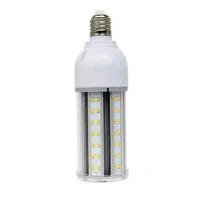
The LED chips are soldered onto three to six curved or flat PCB faces wrapped around the aluminum core. This multi-face layout is what produces genuine omnidirectional output: light goes forward, sideways, backward and upward toward the reflector, with no dark zone behind the E27 or E40 base. When you screw our corn light into an existing cobra-head street fixture or a decorative post-top garden lantern, the lamp behaves the way the fixture was designed to expect - and the road, pathway or flower bed gets even, continuous illumination.
Cheap corn bulbs mix chips from different bins, which is why some poles on the same street end up noticeably cooler or warmer than others. We bin every LED die by forward voltage, wavelength and high-temperature lumen maintenance, so that across an entire upgrade project - whether 20 poles or 2,000 poles - every lamp emits the same correlated color temperature. This is what makes a lighting upgrade look intentional rather than patched together, especially in high-end garden and hospitality installations.
Thermal and driver engineering that protects the upgrade
A premium corn light is built around a die-cast and machined aluminum radiator with deep, closely pitched fins running the full length of the body. The fins provide the convective surface that rejects the 60–70% of input power that an LED turns into heat - there is no fan, and the sealed luminaire provides no forced ventilation. The radiator is sized with real-world margin for a sealed post-top fixture on a 40 °C summer night, not for a clean bench test in the factory.
Inside each LED package, the die is connected by tiny bond wires. We use pure gold wire rather than copper-clad or aluminum alternatives, because gold wire tolerates daily outdoor thermal cycling far better. Over years of heat-up and cool-down, the gold-wire joint resists fatigue and delamination - which directly suppresses light decay and extends the L70 service life beyond 30,000 hours.
The driver sits in the socket base, the hottest part of the lamp. We use an isolated switching topology with high-temperature-rated electrolytic capacitors and integrated over-current, short-circuit and surge protection. This is the subsystem that most often fails in cheap corn bulbs - a non-isolated driver with consumer-grade capacitors cooks itself inside the sealed base in 12–18 months. Our driver is the reason our warranty can be offered at all.
The outdoor envelope
The polycarbonate shade is not decorative. It seals the internal chamber against dust, flying insects and rain splash. Insects are a chronic problem in garden and low-position fixtures: moths and beetles enter unsealed bulbs, die inside, accumulate on the PCB, and both absorb light and insulate the chips. Our shade uses UV-inhibited, anti-yellowing PC so that after three summers in direct sun it still transmits the same amount of light - unlike cheap PC that turns brown and loses 20–30% of its transmittance.
Street and garden networks are noisy: long cable runs cause voltage sag at the end of the line, and lightning seasons cause transient surges. Our driver accepts a wide input voltage range and absorbs surge spikes, so the first pole on the circuit and the last pole on the circuit emit the same brightness - and a summer thunderstorm does not produce a cluster of failed bulbs requiring a maintenance visit.
Street Lighting Upgrade: A Practical Playbook
A street upgrade program does not need to be a grand project. Done right, it is a bulb-by-bulb swap with measurable economics.
Audit and cross-reference before you buy
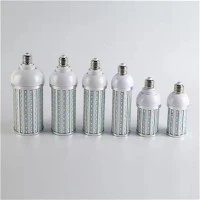
The single most common mistake in a street retrofit is oversizing or undersizing the corn bulb. Oversizing wastes energy and often violates the lighting design; undersizing leaves the road dim. The rule of thumb we recommend is a 1:2 to 1:3 wattage ratio - a 50 W corn light replaces a 100–150 W HPS, an 80 W corn light replaces a 150–250 W HPS. For precise projects, pull the photometric file of the existing luminaire and run the replacement through a lighting calculation; for most municipal retrofits, the cross-reference chart we provide is sufficient.
|
Legacy HPS / MH bulb |
Our recommended corn light |
Typical application |
|---|---|---|
|
70 W HPS |
25–30 W corn |
Residential streets, pathways, small plazas |
|
100 W HPS |
40–50 W corn |
Local roads, parking areas, garden poles |
|
150 W HPS / MH |
60–80 W corn |
Arterial streets, industrial yards, large car parks |
|
250 W HPS / MH |
100–120 W corn |
Main roads, freight depots, mining camps |
For urban and residential streets we usually recommend 4000 K neutral white - enough clarity for safety without the harsh glare of cool daylight. For historic districts, resort areas and hospitality zones, 3000 K warm white preserves the character of the streetscape. The 5000 K daylight class is reserved for industrial yards and security lighting where maximum detail recognition matters more than atmosphere.
Project economics
Consider a street lamp currently running a 150 W HPS bulb at 4,200 operating hours per year, at an electricity cost of €0.12 per kWh. The HPS bulb consumes 630 kWh per year and costs roughly €75 per year in energy. An 80 W corn light consumes 336 kWh per year and costs roughly €40 per year - a saving of €35 per lamp per year. Add the maintenance saving: HPS bulbs are replaced every 2–3 years at a typical service cost of €60–€100 per visit when lift-truck time and traffic control are included. A premium corn light runs 30,000+ hours, eliminating that visit for roughly seven years. Combined, the annual saving per pole easily exceeds €70–€100, which means a typical retrofit pays for itself in three to four years - and then continues saving for the remaining life of the pole.
Garden and Landscape Upgrade: A Practical Playbook
Garden, plaza, pathway and resort lighting imposes a different design brief: the light must look right as well as perform well.
Matching decorative fixtures
Decorative garden fixtures are designed around a glowing cylindrical source visible through clear or frosted glass. A flat LED panel inside such a lantern produces a bright front face and a dark back - visible through the glass and visually awkward. A corn light, by contrast, glows symmetrically from every side, preserving the original intended look of the lantern while delivering LED efficiency. This is why landscape architects consistently specify corn bulbs for heritage-style post-tops, cast-aluminum wall packs and bollard heads.
A garden upgrade across 50 poles or a hotel resort across 200 bollards must look like one coherent design. Our tight binning (3–5 step SDCM) ensures every lamp on the property matches, so the guest walking the pathway never sees a cool patch next to a warm patch. For hospitality and landscape projects, this consistency is what separates a professional installation from a DIY patch job.
Warm white, neutral white - and why it matters
We typically recommend 3000 K warm white for gardens, courtyards, restaurant terraces and resort pathways: it complements foliage, stonework and water features, and avoids the clinical feel of cooler light in a leisure setting. For public plazas, parking areas and building entrances where pedestrian safety matters, 4000 K neutral white gives a better view of faces, signs and surface texture. The same corn light model is available in both color temperatures, so a project can mix them by location while keeping one spare-parts inventory.
Garden fixtures are often close to eye level, so harsh glare is a guest-experience issue. Our PC shade is available with a clear or frosted finish depending on the fixture; the frosted finish softens the visible source and reduces direct glare while maintaining most of the light output. For low bollards and terrace lamps we almost always recommend the frosted option.
Before-and-After: What the Upgrade Actually Delivers
The table below summarizes the typical change a property or municipality sees when it swaps a legacy HPS or CFL garden bulb for our premium corn light.
|
Dimension |
Before (legacy HPS / CFL) |
After (premium corn light) |
|---|---|---|
|
Power consumption |
100–250 W |
40–100 W, ~50% lower |
|
Warm-up time |
Several minutes to full brightness |
Instant full brightness |
|
Color appearance |
Amber sodium hue, uneven aging |
Consistent 3000 K or 4000 K, binned |
|
Light distribution |
360°, but dims as bulb ages |
True 360°, maintained over 30,000 h |
|
Lamp life |
~8,000–24,000 h |
30,000+ h L70 |
|
Insects and dust |
Enter unsealed bulbs, accumulate inside |
Sealed shade, clean internal chamber |
|
Maintenance visits |
Every 2–3 years, lift-truck labor |
Every 7+ years |
|
Environmental |
Mercury-containing, hazardous waste |
No mercury, RoHS-compliant |
The Upgrade Process: Six Steps to a Finished Project
A professional corn-light upgrade is not complicated, but it is best done in the right order.
Audit the site. Inventory every pole: current bulb wattage, socket type (E27 or E40), fixture model, mounting height and current condition. This is also the moment to flag cracked fixtures or damaged cable that should be repaired while the crew is on site.
Cross-reference the replacement. Use the mapping chart in Section 3.1.1 to select the correct corn wattage for each fixture. For large projects, request photometric calculation support.
Order samples and trial-install five to ten poles. Run them for two weeks, compare brightness, color and glare against the existing HPS poles, and confirm the look before committing to the full quantity.
Plan the install windows. Street and garden work is fastest done in night shifts when traffic and foot traffic are low. Schedule the crew, lift truck and traffic control in one pass rather than revisiting each pole twice.
Dispose of legacy bulbs properly. HPS and mercury-vapor lamps are hazardous waste; arrange licensed collection and keep the disposal certificates for compliance records.
Log the install. Record pole ID, corn bulb model, color temperature and install date in a simple spreadsheet. That log is what makes future warranty claims, partial replacements and maintenance planning trivial for the next ten years.
Common Pitfalls to Avoid
After hundreds of retrofit projects, the same mistakes come up again and again. They are easy to avoid if you know them in advance.
Buying the cheapest corn bulb on the list. A €5 corn bulb and a €15 corn bulb look identical in a photo. The difference shows up in month nine, when the cheap unit's driver capacitor dries out and half the street dims. The unit price saving is erased by one maintenance visit.
Ignoring the driver in the base. The driver is the most common failure point. Always confirm isolated topology, high-temperature capacitors and surge protection in writing.
Oversizing for "extra brightness." An over-powered corn bulb wastes energy, violates the lighting design, and often creates glare complaints from residents. Match the wattage to the cross-reference chart.
Mixing color temperatures on the same street. It looks like a patchwork. Specify one CCT per project and stick to it.
Skipping the trial install. Two weeks of trial on ten poles saves months of warranty disputes. We supply free samples for exactly this reason.
Conclusion: A Low-Risk Upgrade With a Measured Return
Upgrading street and garden lighting is one of the few capital projects where the engineering case is unambiguous. You keep the poles and wiring you have already paid for. You cut energy by roughly half. You eliminate mercury waste. You extend the maintenance cycle from two years to seven. You restore the lighting distribution the fixture was designed around. And you do all of this with a bulb that screws directly into the existing socket, in a single night's work per pole.
The difference between a good upgrade and a bad one is the quality of the corn light you choose. A premium unit - screened gold-wire chips, thickened aluminum radiator, isolated protected driver, sealed anti-yellowing PC shade, wide-voltage surge-tolerant driver - delivers the payback in three to four years and keeps delivering for the decade after. A generic unit looks identical on day one, but its real cost shows up in the second maintenance cycle, when the cheap drivers start failing in clusters.
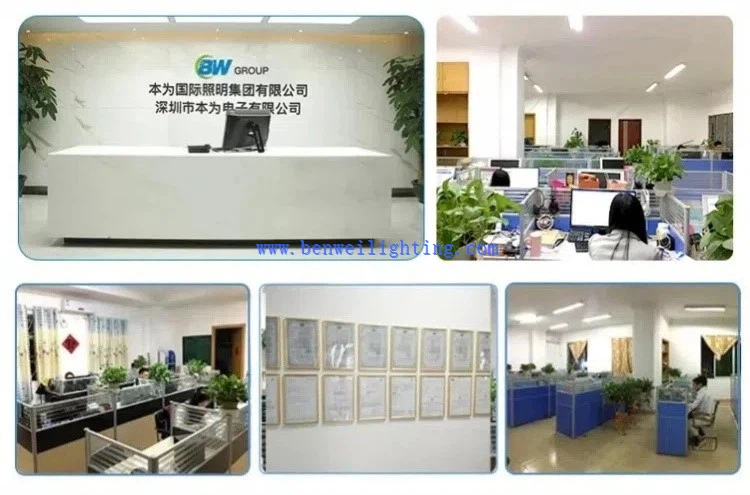
How To Cooperate With Us?
We are happy to have total control over the manufacturing process and the calibre of our products since we have our own facilities. Since we are producers rather than just brokers, we are dedicated to providing our customers with the best pricing. Since we are certain that the price and quality of our products are clear, we invite customers to see our samples first. Our commitment to quality and customer satisfaction drives us to continuously provide top-notch goods.
Our address
3rd Floor, 5th Building, Hebei Industrial Park, Hualian Community, Longhua District, Shenzhen, China