

Incandescent, CFL, and LED – A Century‑Long Duel of Three Generations of Light Sources and LED's Path to Victory
Since Edison lit the first commercial incandescent lamp in 1878, human history of electric lighting spans barely a century and a half, yet we have witnessed three disruptive technological turnovers. This century‑spanning "Romance of the Three Kingdoms" of light sources is not merely a physical contest between tungsten filaments, phosphor powders, and semiconductors – it also reflects humanity's evolving understanding of light, energy, and the environment. Looking back from the luminous summit paved by LEDs, the successes and failures of each generation tell a vivid epic of technological progress.
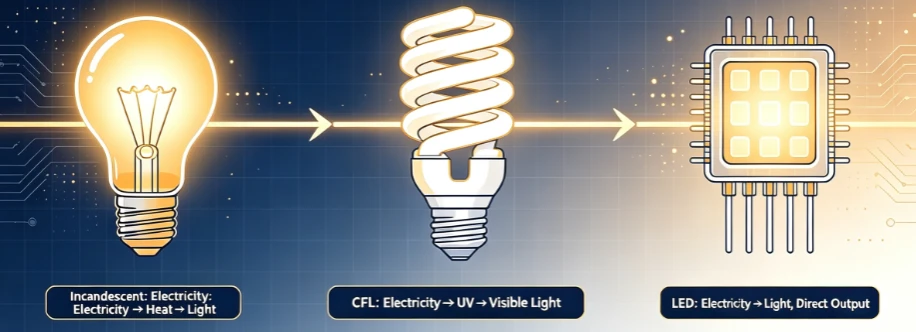
I. Philosophies of Light: From Thermal Glow to Excitation, and Then to Quantum Leaps in Semiconductors
The incandescent lamp produces light through thermal radiation in its purest form. Current passing through a tungsten filament generates intense heat, heating the filament above 2,000 °C until the white‑hot metal emits visible light. Like a red‑hot piece of iron – light comes from heat, and heat is the price of light. Its energy conversion path is "electricity → heat → light," with a large proportion of energy escaping as heat, dooming it to inherent inefficiency.
The CFL (compact fluorescent lamp) takes a different route, relying on gas excitation. Electrons collide with mercury atoms, generating ultraviolet radiation, which in turn strikes the phosphor coating on the tube wall to produce visible light. The path is "electricity → ultraviolet → visible light." Although it avoids the intense heat of incandescence, mercury serves as an intermediary. This process is more efficient than incandescence, but still involves two conversion steps, with losses at both the UV generation and absorption stages.
The LED lamp completely abandons the classical physics framework and steps into the realm of quantum mechanics. It utilises the recombination of electrons and holes in a semiconductor PN junction, releasing energy directly as photons – electricity in, light out, in one step. No heat, no ultraviolet, no intermediate states. This "electroluminescence" makes LEDs the only light source among the three that lacks a "waste‑heat" genetic defect. If incandescent light is "firelight" and CFL light is "fluorescence," then LED light is "cold light" – rational, controllable, and pure.
II. Efficacy and Lifespan: A Marathon of Thrift and Endurance
On the efficacy track, numbers reveal brutal disparities. Incandescent lamps achieve only about 15 lumens per watt; CFLs rise to 50‑70 lm/W; while mass‑produced LEDs easily reach 100‑200 lm/W, with laboratory prototypes exceeding 300. For the same luminous output, an LED consumes roughly 1/20 the electricity of an incandescent and about 1/3 to 1/4 of a CFL. Assuming 4 hours of daily use at residential electricity rates, the annual electricity cost is roughly ¥67 for incandescent, ¥13.5 for CFL, and ¥6.8 for LED. Over twenty years, the electricity saved by an LED could buy dozens of replacement lamps.
Lifespan differences are even more striking. Incandescent lamps are rated in thousands of hours; CFLs in 5,000‑10,000 hours; while LEDs have a theoretical lifetime of up to 100,000 hours, with practical products commonly rated at 50,000 hours (about 34 years at 4 h/day). More importantly, incandescent lamps fail by filament burnout, CFLs by phosphor degradation or ballast failure, whereas LEDs die slowly through "luminous decay" – brightness gradually dropping to 70% – giving users ample warning. LEDs are immune to frequent switching, which actually shortens CFL life. In smart scenarios requiring motion sensing, strobing, or dimming, LED's longevity and robustness are unrivalled.
III. Environment and Cost: The Entanglement of Green Ideals and Real‑World Economics
Environmentally, incandescent lamps contain no mercury, but their extreme energy consumption implies high carbon emissions. CFLs were once hailed as green pioneers for their energy savings, yet they contain mercury – one CFL can contaminate up to 180 tonnes of water. China promoted hundreds of millions of CFLs with subsidies, but the recycling infrastructure lagged behind, creating a latent ecological bomb. LEDs contain no mercury and are recyclable, but their environmental concerns shift to manufacturing (rare materials like gallium arsenide and indium) and blue‑light photobiological safety. Considering the full life‑cycle, studies show that CFLs have 1.3 times the ecotoxicity and 2.5 times the human toxicity of LEDs. LED is unequivocally the "cleanest" option.
Economic costs require a balanced view. The initial purchase price of LEDs remains higher than that of incandescents and CFLs, and most are integrated designs (chip + driver + heatsink in one unit) – if the driver fails, the whole lamp is discarded, whereas an incandescent bulb can be replaced individually. However, when energy consumption and lifespan are factored into the total cost of ownership, LEDs far outperform the others. Over 50,000 hours of use, an incandescent would need 50 replacements, a CFL 5‑10, while an LED would need almost none; adding electricity savings, the total cost of an LED is a fraction of the others. The economic winner depends on whether one values "immediate outlay" or "long‑term expenditure."
IV. Spotlight on LED: Light and Shadow Beneath the Throne
Since LEDs are widely acknowledged as the victor, it is worth examining their strengths and limitations in detail. Their principle advantages bring unparalleled energy efficiency and longevity, yet they are not flawless.
Three notable shadows beneath the glare:
- Blue‑light dilemma: Mainstream white LEDs use a "blue chip + yellow phosphor" combination, producing a prominent blue spike in the spectrum. Excessive high‑energy blue light can cause visual fatigue and disrupt circadian rhythms. To improve the colour rendering index (Ra) above 95, manufacturers turn to violet‑chip or multi‑phosphor solutions, which sacrifice 20‑30% of luminous efficacy – meaning "true colours" come at the cost of "higher energy consumption."
- Thermal Achilles' heel: Although LEDs are cold‑light sources, the PN junction still generates heat. Poor heat dissipation raises junction temperature, accelerating luminous decay exponentially. Hence LEDs must be paired with heatsinks (aluminium or fans), adding bulk and cost. Many cheap LED lamps fail precisely because of skimped heat sinks – the chip survives, but the phosphor degrades under high temperature, dimming the lamp prematurely.
- Driver bottleneck: LEDs are low‑voltage DC devices requiring constant‑current drivers. The electrolytic capacitors in these drivers typically last only 10,000‑20,000 hours, becoming the weakest link in the entire luminaire. The LED chip may still be good, but the driver dies first; and with integrated designs, users often have to replace the whole fixture, incurring high maintenance costs.
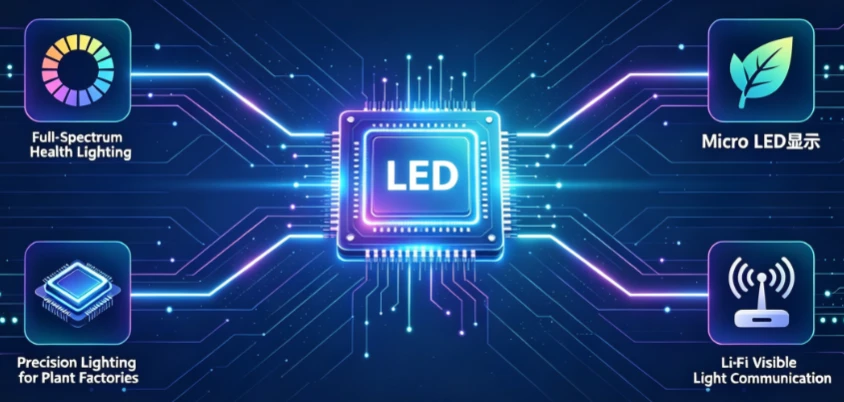
Yet LED's true power lies in its "evolvability." It is not locked into one technology but continuously iterates as a semiconductor platform:
- Full‑spectrum healthy lighting: By combining multiple chips or novel phosphors, it can supplement cyan and deep‑red bands, reduce the blue peak, mimic sunlight, and enable human‑centric lighting.
- Micro‑LED and Mini‑LED: Micrometre‑scale LEDs used for displays are revolutionising TVs, AR, and VR.
- Li‑Fi visible light communication: LEDs flicker at ultra‑high speeds (imperceptible to the eye) to transmit data, offering bandwidth far exceeding Wi‑Fi – in the future, "the lamp is the router."
- Precision lighting for plant factories: Tailored red‑blue light recipes optimise photosynthesis, boosting both yield and quality.
Conclusion: Victory is Not the End, but the Beginning of a Light Ecosystem
The duel among the three generations has long been decided – LEDs have triumphed with overwhelming efficacy, longevity, and environmental superiority. But this victory does not signal the end of lighting exploration; rather, it opens a new definition of "light." Light is no longer just an illumination tool, but a carrier of information, a health regulator, and a life‑support system. Incandescent lamps warmed the early nights of humanity; CFLs awakened environmental consciousness; and LEDs hand us a key – a key that can open any door: waking light in the morning, focusing light in the afternoon, soothing light at night, and even red‑blue light for plant growth or pulsed light for data transmission.
The next time you change a bulb, you are not just choosing a lamp – you are choosing a way of relating to light. And LEDs are placing the remote control for that relationship into everyone's hands. The light of the future will be written in semiconductors.


