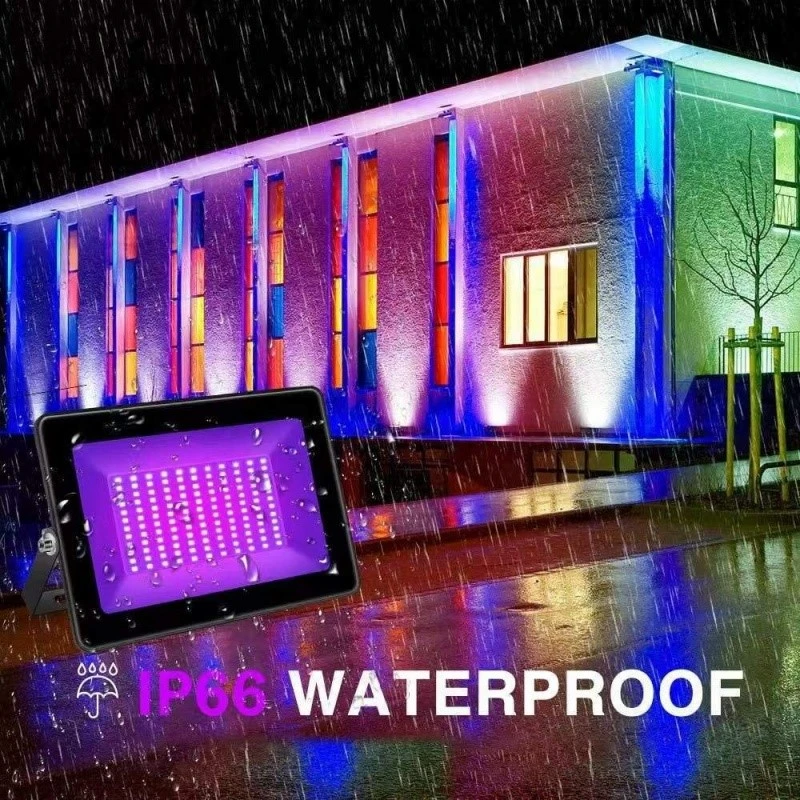
Many customers ask the same question when choosing floodlights: what's the difference between UV floodlights and ordinary floodlights? They look similar, yet their prices can differ by several times. In fact, these two types of lights differ fundamentally in their light-emitting principles, core materials, and application scenarios. Choosing the wrong one can not only fail to achieve the desired effect but also potentially create safety hazards. Today, we'll explain the differences between the two from a product perspective to help you make the right choice before purchasing.
Light-Emitting Principle and Wavelength Differences
Ordinary floodlights (also known as LED floodlights) emit visible light with a wavelength of approximately 400-700 nanometers. Their function is to illuminate a space, allowing the human eye to see objects clearly. UV floodlights, on the other hand, emit ultraviolet light, typically with a wavelength of around 365 or 395 nanometers. The illumination effect is almost invisible to the naked eye. Their function is not to "illuminate," but rather to stimulate fluorescence or trigger specific chemical reactions. This is the most fundamental difference between the two; all subsequent differences revolve around this wavelength difference.
Differences in LED Chip and Lens Materials
Ordinary floodlights use standard LED chips coated with phosphor, which, when combined with PC polycarbonate or tempered glass lenses, emit light normally. UV floodlights are more complex. They require specialized gallium nitride (GaN/AlGaN)-based UV chips, and the lens material must also be changed-ordinary PC lenses absorb ultraviolet light, significantly reducing light transmittance. Therefore, UV lamps typically use quartz glass or special UV-transmitting resins for their lenses. This is why many customers find that UV lamps are considerably more expensive for the same wattage; the material costs are a significant factor.
Application Scenarios Comparison
The applications of ordinary floodlights are familiar, such as outdoor plaza lighting, building facade floodlighting, stadium lighting, parking lot security lighting, etc. The core requirement is to illuminate a large area evenly.
The uses of UV floodlights are entirely different, with common scenarios including:
Industrial curing, such as the rapid curing of UV adhesives, inks, and coatings;
Fluorescence detection and banknote verification, such as jewelry appraisal, artifact identification, and currency anti-counterfeiting;
Disinfection and sterilization, used for surface disinfection in specific locations;
Entertainment lighting, such as luminous parties and fluorescent paint decorative effects;
Special industrial uses such as ore detection and agricultural pest control.
It can be seen that ordinary floodlights serve "illumination" needs, while UV floodlights serve "functional" needs, and the two are almost not interchangeable.
Different Safety Protection Requirements
This is a point that many customers easily overlook. The visible light from ordinary floodlights is relatively safe for the human eye, and no additional protection is needed at normal operating distances. However, UV light, especially short-wave UV, can cause damage to the skin or eyes with prolonged direct exposure, such as skin burns and retinal damage. Therefore, in scenarios using UV floodlights, operators usually need to wear UV-protective glasses and protective clothing, and the luminaires themselves must be designed to prevent leakage and avoid direct UV radiation to unauthorized personnel. This point must be clearly communicated with the manufacturer in advance when making industrial purchases or project integrations to avoid potential safety hazards later.
Heat Dissipation Performance and Lifespan
UV LED chips generally have lower photoelectric conversion efficiency than ordinary white LEDs. This means that for the same input power, UV lamps generate more heat, requiring more sophisticated heat dissipation designs. Larger heat sinks or active cooling structures are typically needed to ensure stable chip temperatures. Furthermore, because ultraviolet light itself has an aging effect on materials, internal components such as sealants and lenses are more susceptible to damage. Therefore, in actual use, UV floodlights generally have a shorter lifespan than ordinary floodlights. The specific lifespan depends on the chip brand and the overall lamp's heat dissipation and protection design.
Price and Cost Differences
In summary-dedicated chips, quartz lenses, enhanced heat dissipation, and safety protection structures-the overall manufacturing cost of UV floodlights is significantly higher than that of ordinary floodlights, and their market price is usually considerably higher. Therefore, when purchasing, it is not recommended to simply compare prices based on wattage or appearance, as they are not the same type of product, and price comparisons are meaningless. The key is to consider your actual application needs.
Summary
In short, ordinary floodlights are responsible for "illumination," solving the problem of visibility; UV floodlights are responsible for "functional applications," addressing professional needs such as curing, testing, disinfection, and special effects displays. There are significant differences between the two in terms of emission wavelength, chip material, lens selection, safety requirements, heat dissipation, lifespan, and cost. They are not simply "upgraded" and "ordinary" versions, but rather two completely different types of products with entirely different applications. Before purchasing, the most important thing is to first clarify your specific use case, and then match the appropriate type of lighting fixture to that scenario. This will prevent you from spending more money without achieving the desired effect.
If you are selecting suitable floodlights for your project, whether for general lighting engineering or professional needs such as UV curing and testing, please tell us your specific application scenario and parameter requirements. We can recommend suitable product solutions based on your actual situation and provide detailed quotations. Feel free to send us an inquiry at any time.