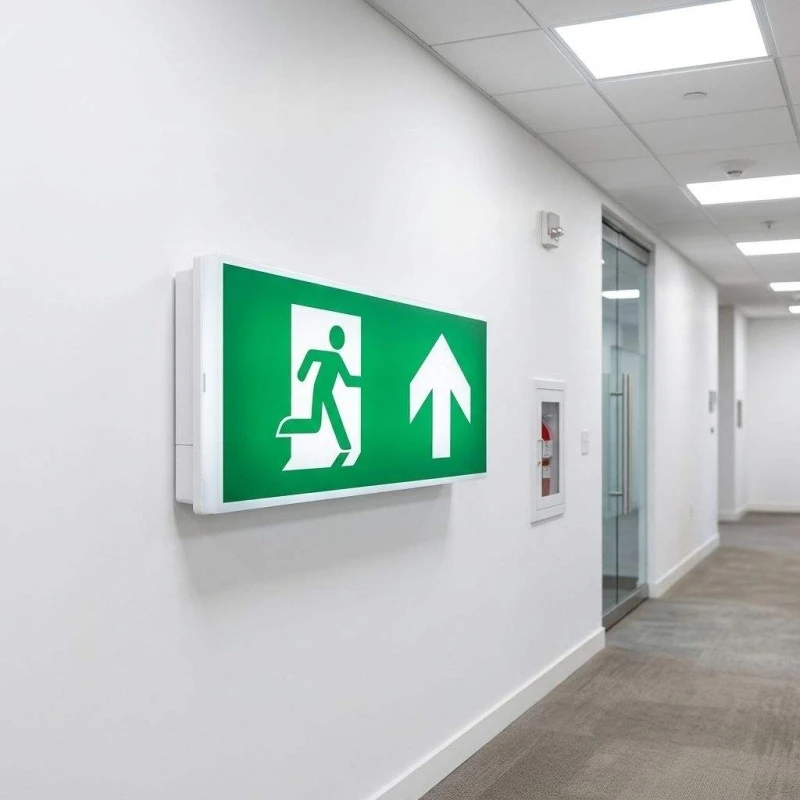

"Your enclosures are made of ABS-do they meet fire safety requirements?" The answer isn't a simple "yes" or "no"; it depends on the specific type of ABS used and the standards required by your project. This article breaks down the issue to help you with material selection and client communication.
Standard ABS vs. Flame-Retardant ABS
Standard ABS is inherently combustible; it continues to burn even after the ignition source is removed and tends to melt and drip. It typically carries a UL 94 rating of only "HB," which is unsuitable for use in emergency lighting for public buildings.
"Flame-retardant ABS" refers to resin modified with flame-retardant additives (commonly brominated flame retardants combined with antimony-based synergists). This modification allows the material to achieve ratings such as V-0, V-2, or even 5VA. Therefore, before asking whether an ABS material is "flame-retardant enough," you must first confirm that you are actually using a flame-retardant grade rather than standard, unmodified ABS.
Understanding Flame-Retardant Ratings: UL 94 and the Glow-Wire Test
When selecting materials, you will frequently encounter two types of data that are often confused. Here is a breakdown of each:
UL 94 Vertical Burning Test: Ratings range from V-2 and V-1 to V-0, with 5VA being the most stringent. A V-0 rating indicates that the specimen stops burning quickly after the ignition source is removed and does not produce flaming drips that could ignite cotton wool placed underneath. Emergency lighting enclosures typically require a rating of V-0 or higher.
Glow-Wire Test (GWT): This test simulates the overheating of components during an electrical fault. The standard EN 60598-1 mandates higher glow-wire temperature resistance-often 850°C-for plastic parts located near live electrical components.
These two tests evaluate different criteria. UL 94 assesses how a material behaves when exposed to an open flame, while the glow-wire test determines whether a component will ignite when subjected to an overheated part. A material might achieve a V-0 rating under UL 94 but fail the glow-wire test (or vice versa); therefore, it is best to obtain test reports for both. Additionally, it is important to note that UL 94 ratings are tied to specimen thickness. A specific grade of material might achieve a V-0 rating at a thickness of 3.0 mm, but could drop to a lower rating if the thickness is reduced to 1.5 mm. A common pitfall is that the actual wall thickness of an enclosure may end up being thinner than the thickness specified in the test report.
Drawbacks of Flame-Retardant ABS
While flame-retardant ABS can meet the requirements of many projects, it is not a universal solution. Keep the following limitations in mind:
Limited Heat Resistance: ABS has a relatively low heat deflection temperature. If a lamp housing contains components like batteries or LED drivers, the heat generated during operation-compounded by high ambient temperatures in summer-can cause the enclosure to deform.
Moderate Aging Resistance: When exposed to light over long periods, ABS tends to yellow and become brittle; this tendency is often more pronounced in flame-retardant modified versions. If a lamp is to be installed near a window or in an area subject to intense light, this factor must be considered.
Smoke Generation During Combustion: Flame-retardant systems containing halogens produce high smoke density when burned. Certain applications (such as those in subways or tunnels) require low-smoke, halogen-free materials; in such cases, standard flame-retardant ABS may not meet the requirements.
Risks Associated with Recycled Material: To reduce costs, some manufacturers may incorporate recycled (reprocessed) material. This can lead to inconsistent flame-retardant performance, with significant variations between different batches.
When is ABS sufficient, and when should you consider alternative materials?
Based on the points above, you can evaluate your needs as follows:
Scenarios where flame-retardant ABS is typically sufficient:
Standard indoor environments, such as office buildings, schools, and general retail spaces.
Projects where the specifications only require a UL 94 V-0 rating or an equivalent glow-wire test rating.
Fixtures with low power consumption and minimal internal heat generation.
Scenarios where other materials should be considered:
Projects with strict requirements for "low-smoke, zero-halogen" (LSZH) materials, such as those in subways, tunnels, or hospitals.
Outdoor or semi-outdoor environments with high UV exposure-consider flame-retardant PC or PC/ABS alloys.
Environments with high ambient temperatures or products that generate significant internal heat-consider metal enclosures or engineering plastics with superior heat resistance.
How to verify enclosure materials during procurement
Do not rely solely on a supplier's claim that a material is "flame-retardant." Instead, request the following:
The UL "Yellow Card" for the raw material, which confirms the specific grade, rating, and applicable thickness.
Third-party test reports for the complete fixture (do not rely exclusively on reports for the raw material alone).
Documentation regarding batch consistency control-for example, details on incoming material inspection and whether recycled materials are used.
If necessary, conduct your own spot checks by performing a combustion or glow-wire test on samples; this is a low-cost measure that can prevent issues during final project acceptance.
Summary
Using flame-retardant ABS for emergency exit light enclosures is a viable solution for most standard public buildings, provided that the material is a genuine flame-retardant grade and is supported by UL 94 V-0 and glow-wire test data for the specific thickness used. Standard (non-flame-retardant) ABS must not be used. For specialized environments-such as those requiring low-smoke, zero-halogen materials, or those involving high temperatures or intense UV exposure-you should evaluate alternatives like PC, PC/ABS, or metal enclosures. Always review project specifications before selecting materials, and verify test reports and batch consistency after procurement to avoid potential pitfalls.
Interested in learning about the materials and certifications for our emergency exit light enclosures?
We offer a variety of enclosure options for our emergency exit lights-including flame-retardant ABS, flame-retardant PC, and aluminum alloy-and can provide both UL Yellow Cards for the raw materials and third-party test reports for the complete fixtures. If you have specific project requirements, installation environment details, or target markets, please leave a message or send an inquiry; our engineers will help identify the most suitable model and provide a quote.